"There may be differences in timing,
but the overall approach is similar"
"Sanctions relief could be discussed if necessary for denuclearization"
On August 22, National Security Advisor Wi Sunglak stated that there is a consensus between South Korea and the United States regarding North Korea's "three-stage denuclearization theory," which President Lee Jaemyung mentioned for the first time in an interview with Japan's Yomiuri Shimbun. In the interview, which was released the previous day, President Lee outlined his vision for addressing the North Korean nuclear issue, saying, "The first stage is a freeze on nuclear weapons and missiles, the second stage is a reduction, and the third stage is denuclearization."
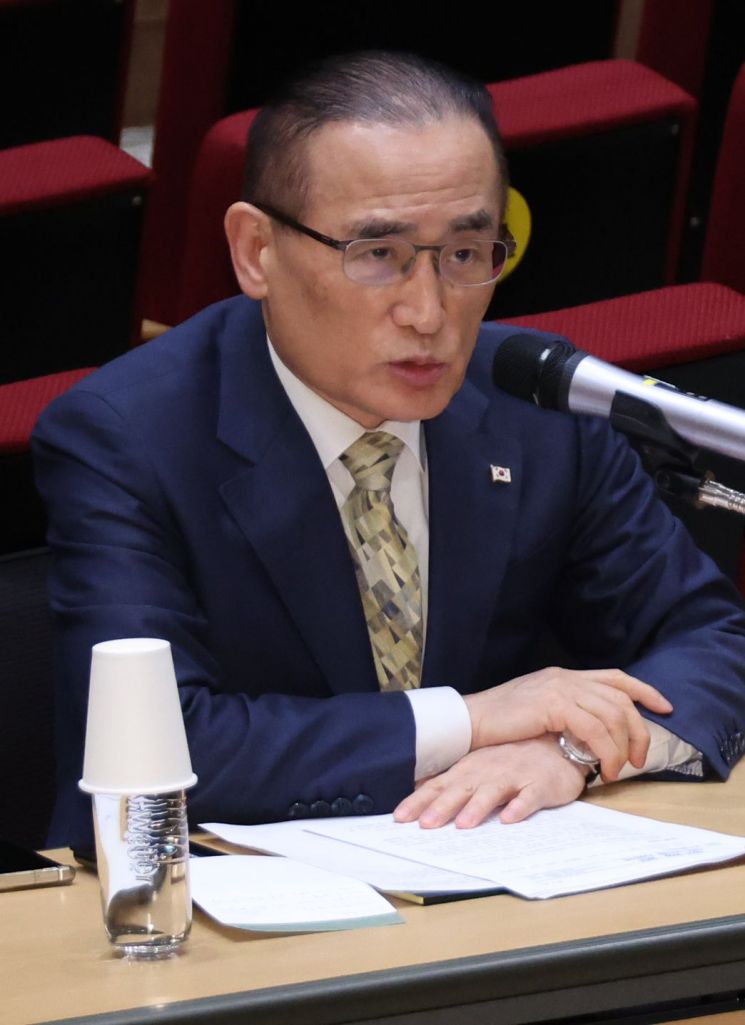
At a press briefing held at the presidential office in Yongsan, Advisor Wi said, "There is generally a consensus between South Korea and the United States on the basic approach," adding, "While there may be differences in the timing and sequencing of what is exchanged with North Korea, the overall approach is largely similar." He further explained the three-stage denuclearization theory, stating, "It should be seen as a concept where North Korea is first halted on the path to denuclearization, then turned around to return, and ultimately brought back to the starting point."
He also mentioned that discussions on easing sanctions against North Korea could take place during this process. Advisor Wi said, "In the process of bringing North Korea back to the starting point, there must be give-and-take, and discussions on easing sanctions could be part of this."
Regarding the recent controversy over the dismantling of North Korea's loudspeakers aimed at the South, he said, "It has been confirmed as a fact that North Korea did dismantle the loudspeakers at one point," but added, "It is difficult to specify the exact timing."
On North Korea's decision to halt its broadcasts targeting the South, he stated, "Depending on one's perspective, it could be seen as a response to our suspension of broadcasts toward the North, but I am somewhat hesitant to use the term 'response.'"
He further explained, "When we used loudspeakers, North Korea would broadcast noise to prevent the content from being heard. I think North Korea also stopped broadcasting because it was no longer necessary, so whether this can be seen as a response is open to discussion."
© The Asia Business Daily(www.asiae.co.kr). All rights reserved.
![Clutching a Stolen Dior Bag, Saying "I Hate Being Poor but Real"... The Grotesque Con of a "Human Knockoff" [Slate]](https://cwcontent.asiae.co.kr/asiaresize/183/2026021902243444107_1771435474.jpg)















