Full-Scale Launch of the 600 Billion Won "AX Demonstration Valley" Project
1,000 AI Convergence Companies to Cluster Over Five Years Starting Next Year
Expected Economic Impact: 1.5 Trillion Won and 6,000 New Jobs
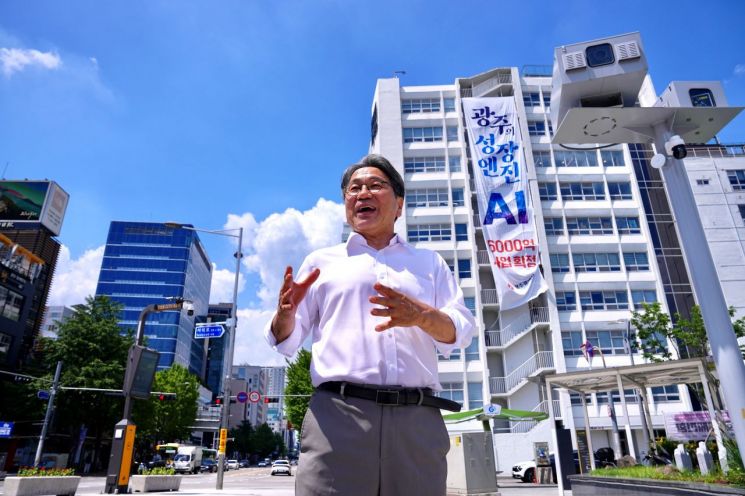 On the 22nd, when the preliminary feasibility exemption for the second phase of the artificial intelligence (AI) project was finally confirmed, Gwangju Mayor Kang Gijeong explained the vision of the AI project at the May 18 Democratic Square. On the same day, a banner celebrating the AI preliminary feasibility exemption was displayed at Jeonil Building 245. Provided by Gwangju City
The second phase of Gwangju's artificial intelligence (AI) initiative, known as the "AX Demonstration Valley Project," has been officially confirmed as a project exempt from the preliminary feasibility study (pre-feasibility study), following approval by the National R&D Project Evaluation Committee of the Ministry of Science and ICT after a resolution by the Cabinet.
On the 22nd, Gwangju City announced that the National R&D Project Evaluation Committee of the Ministry of Science and ICT had approved and finalized the exemption from the pre-feasibility study for the second phase of Gwangju's AI initiative, the "AX (AI Transformation) Demonstration Valley Project."
The second phase of the AI project was previously approved at the 37th Cabinet meeting presided over by President Lee Jaemyung on August 18. With this decision, the second phase will undergo a project plan adequacy review by the Korea Institute of S&T Evaluation and Planning (KISTEP) and will be fully implemented over five years starting in 2026, with a total budget of 600 billion won.
Over the past five years, the city has established first-phase infrastructure, such as the National AI Data Center and a large-scale driving simulator, with an investment of 430 billion won. Building on this foundation, the second phase will focus on three main areas: AI transformation (AX) of regional strategic industries such as mobility and energy, citizen-centric urban and lifestyle innovation, and the establishment of core AX infrastructure. The goal is to integrate artificial intelligence into citizens' daily lives and address urban challenges.
The city will invest intensively in developing leading AI transformation technologies for regional strategic industries like mobility and energy, and in establishing the "AI InnoSpace," a control tower overseeing the entire commercialization process of artificial intelligence. This is aimed at accelerating the implementation of the "Five Axes, Three Special Zones" policy for balanced regional development, as well as the national policy tasks of the Lee Jaemyung administration, such as the creation of a national AI mobility pilot city and the RE100 industrial complex project.
In particular, as an AI-centered city, Gwangju will promote the development of a "Gwangju-style AI for All" so that every citizen can experience and share the benefits of AI technology, and will also implement citizen-centric urban and lifestyle projects that transform everyday life.
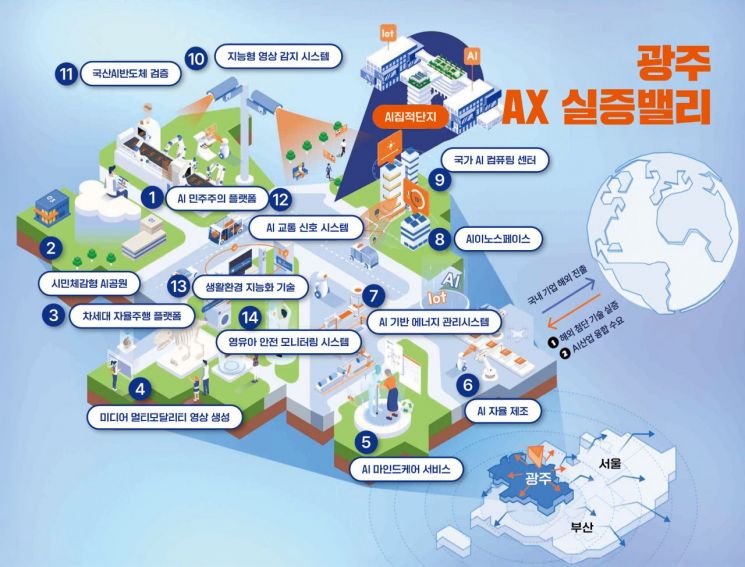
Gwangju City plans to design the second phase project around large-scale initiatives to generate substantial results and support broad participation from local companies. Building on the achievements of the first phase and the construction of the AI Knowledge Industry Center in the Advanced District 3, the city aims to attract 1,000 AI convergence companies through the second phase. In addition, 3,375 public facilities will be opened as "AX Demonstration Labs," and companies will be provided with access to 3,879 types of research equipment from 48 innovation institutions to foster outcome-oriented demonstrations.
Significant economic effects are also expected. The second phase is projected to generate 983.1 billion won in production inducement, 494.2 billion won in value-added inducement, and create 6,281 jobs, indicating a major impact on the regional economy.
Since applying for the pre-feasibility exemption in September last year, the city has made dozens of visits to the Presidential Office, the Ministry of Science and ICT, and the Ministry of Economy and Finance to explain the necessity of the project and hold consultations. Local National Assembly members, including Ahn Dogeol and Cho Incheol, have also made active efforts.
Going forward, the city plans to seek designation as a "National AI Cluster" and an "AI Regulatory Free Zone" to create an environment where research and demonstration can be freely conducted, and will also work to attract the "National AI Computing Center."
Mayor Kang Gijeong stated, "If the first phase was a period for building infrastructure and nurturing talent, the second phase is the time to realize 'Gwangju as an AI Demonstration City' that citizens can truly experience," adding, "We will do our utmost to make Gwangju the leading artificial intelligence city and to attract the National AI Computing Center."
© The Asia Business Daily(www.asiae.co.kr). All rights reserved.


















