SK Becomes Second-Largest Shareholder in TerraPower
HD Hyundai Expands Supply of Reactor Vessels
U.S. Regulatory Streamlining and Tax Incentives Provide Tailwinds
Long-Term Partnership in the Vaccine Sector Reaffirmed
Bill Gates, founder of the U.S. next-generation nuclear power developer TerraPower and Chairman of the Gates Foundation, met consecutively with the heads of SK and HD Hyundai. This coincides with the acceleration of small modular reactor (SMR) commercialization in the United States. As more projects have entered the demonstration phase, there is growing interpretation that Korean companies are gaining access to participate in real business opportunities.
According to business circles on August 22, SK became the second-largest shareholder in TerraPower by investing $250 million in 2022. This is significant not just as a financial investment but as a strategic foothold that enables direct participation in the construction of demonstration reactors and the initial business phase. TerraPower’s sodium reactor, currently undergoing construction permit review in Kemmerer, Wyoming, is targeting completion by 2030, and a training center at the site recently began construction. There is growing speculation that SK’s role could expand in the supply of equipment, commissioning, and operation and maintenance (O&M) processes required for the initial plant construction.
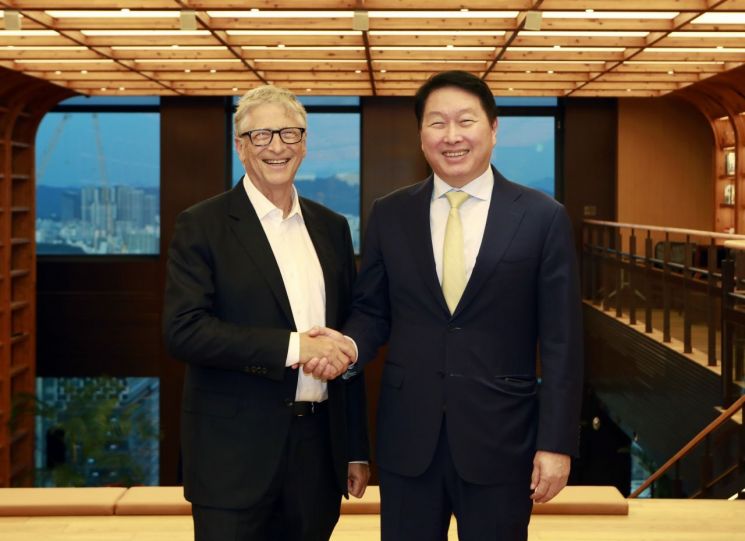 Chairman Chey Tae-won of SK (right in the photo) and Bill Gates, Chairman of the Gates Foundation, shake hands on the 21st at the SK Seorin Building in Jongno-gu, Seoul. Photo by SK
Another project SK is focusing on is the ‘industrial complex-type SMR’ being promoted at Dow’s plant in Texas. Dow and X-energy have applied for a permit to build a small reactor that will supply electricity and steam. If approved, it is expected to become the first commercial model in a U.S. industrial complex. SK possesses a chemical and energy value chain. If combined with this model, SK’s participation could go beyond simple equity investment to include operations and the creation of added value.
HD Hyundai is emphasizing equipment supply. Under its agreement with TerraPower, the company is scheduled to supply reactor vessels. In March, it also signed a memorandum of understanding (MOU) to expand the supply chain for global commercialization. Once the manufacturing and transportation of Kemmerer Unit 1 begins in earnest, initial orders will be generated, and as commercial reactors are rolled out, companies with stable supply chains are expected to have greater opportunities to win contracts. The technology accumulated in the shipbuilding and plant sectors could also lead to the development of ‘SMR-powered ships’ in the long term.
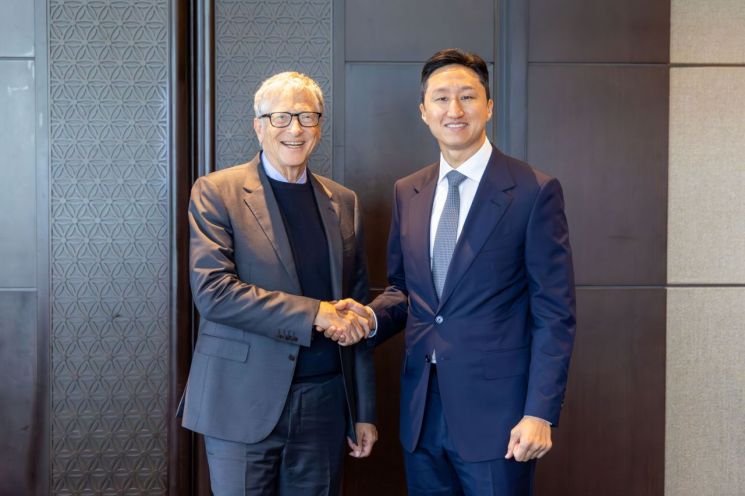 Jung Ki-sun, Vice Chairman of HD Hyundai, met with Bill Gates, Chairman of TerraPower, on the 22nd to discuss cooperation plans for the SMR business. Photo by HD Hyundai
The U.S. government’s policy environment is also favorable. To strengthen renewable energy connectivity, it is offering tax incentives such as the ‘domestic bonus.’ Regulatory reforms are underway to shorten the approval period for new nuclear plants to 18 months. The Department of Energy has supported the restart of the Palisades nuclear plant with more than $1.5 billion through the Loan Programs Office (LPO). The technology-neutral tax credit, which took effect this year, is expected to benefit projects with a high proportion of domestic manufacturing.
However, there are clear challenges to overcome. TerraPower’s sodium reactor uses high-assay low-enriched uranium as fuel, but domestic production capacity in the U.S. is still limited. If fuel procurement is delayed, the commercialization schedule could also be affected. Other hurdles for Korean companies include the Foreign Ownership, Control, or Domination (FOCD) rule, which restricts foreign ownership in nuclear operations, and localization requirements for tax benefits.
Previously, Chairman Gates met consecutively over two days with SK Group Chairman Chey Tae-won and HD Hyundai Senior Vice Chairman Jung Ki-sun to discuss cooperation plans in the SMR and vaccine sectors. At a dinner meeting the previous day, Chairman Chey said, “I believe Korea and SK can play a crucial role in the commercialization of TerraPower’s SMR,” adding, “Let’s work together to enhance market acceptance based on safety, efficiency, and eco-friendliness.” Senior Vice Chairman Jung stated, “Next-generation SMR technology is a key solution for realizing a sustainable future energy system,” and added, “Cooperation between our companies will serve as a catalyst for building a global nuclear supply chain and accelerating the energy paradigm shift.”
© The Asia Business Daily(www.asiae.co.kr). All rights reserved.


















