Ahn Kyucheol's "Twelve Questions" Exhibition Opens at Busan International Gallery
Reflecting on Over 30 Years of Artistic Journey Since 1991
"Art Itself Can Be a Question"
Challenging Fixed Ideas and Conventions Through Inquiry
Artist Ahn Kyucheol, well known as a writer-artist, made this statement at a press conference for the exhibition "Twelve Questions" held at Busan International Gallery on the 22nd. This exhibition was organized as a time for him to reflect on his artistic journey after stepping down from his long career as a professor at Korea National University of Arts. Centered around his new works created last year, the exhibition poses "12 questions" to the audience.
The role of art is diverse. Art expresses a variety of themes, consoles wounded hearts, and sometimes explores a range of sensations. However, this exhibition is based on the premise that "art itself is a question." Ahn explained, "I think an artist is someone who asks questions. The role is to pose questions and let the audience answer them. It is important to stimulate and encourage people to become thinking subjects. The problems of reality do not stem from a lack of wisdom, but from not asking the right questions."
Ahn juxtaposes disparate and opposing elements in his works, guiding viewers to seek questions within their inherent absurdities. "Questions arise when what should exist is absent, and when what should be absent is present."
The work 'Muwijayeon' features the phrase "nature as it is," but is artificially gilded with gold leaf. Ahn said, "By expressing the signifier as betraying the signified, I wanted viewers to develop their own sense of doubt."
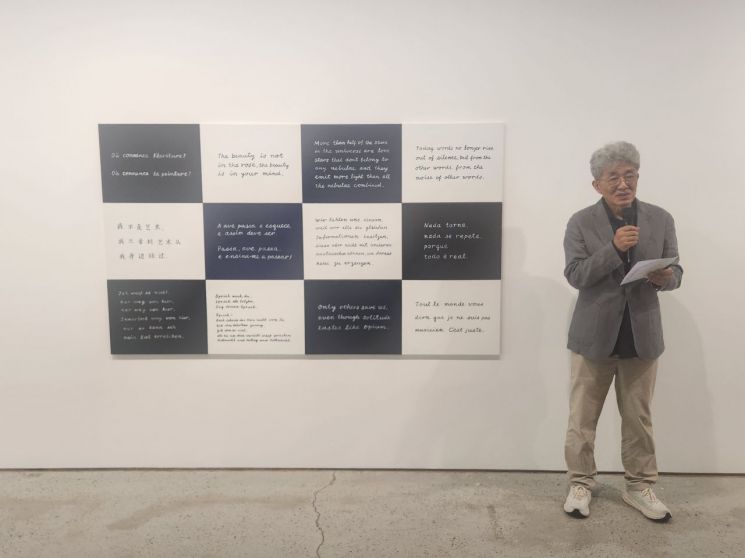 On the morning of the 22nd, artist Ahn Kyucheol is explaining in front of his work "Twelve Proverbs in Foreign Languages" (2024) at a press conference held at Busan International Gallery. Photo by Seo Mideum
The work "Twelve Proverbs in Foreign Languages" presents proverbs from artists such as Roland Barthes, Fernando Pessoa, and Franz Kafka, each written in a different foreign language. Roland Barthes once asked, "Where does writing begin? Where does painting begin?"-a question that aligns with the intention of the work. When writing conveys meaning, it functions as text, but if the meaning is unknown, it is no different from a painting. Ahn stated, "I wanted to emphasize that both writing and painting ultimately exist within the viewer's mind."
"The Road to Art" conveys the idea that a work is not art in itself, but rather serves as a signpost guiding viewers toward art. The various traffic signs in the piece are depicted as if shrouded in fog, suggesting that viewers should imagine the art that lies beyond the work itself.
"Two Stones" questions the fiercely competitive nature of society. The black stone placed on the floor symbolizes nature outside the museum, while the white stone inside a glass case represents an artwork exhibited in the museum. This poses the question: "What truly defines art?" Ahn explained, "What becomes art and what does not? It is a challenge to the criteria set by established systems."
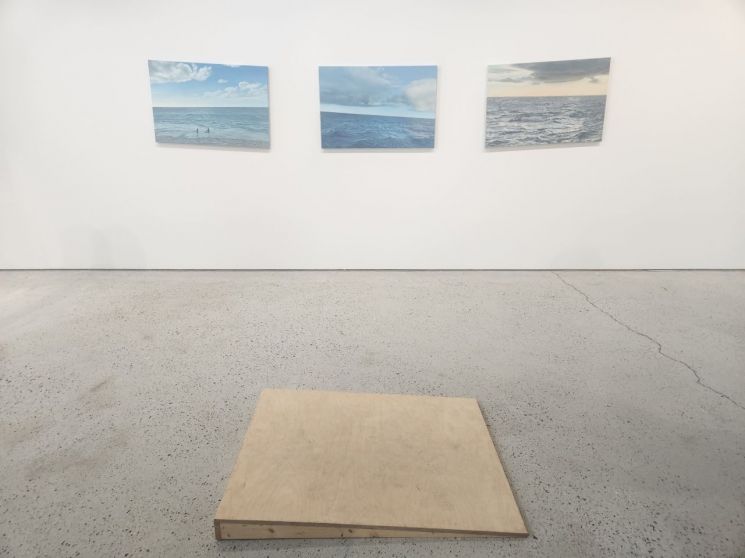 Ahn Kyucheol's work Three Horizontal Lines (2024), the paintings on both sides were hung crookedly to match the tilted horizontal lines, and an inclined panel with the same slope as the horizontal lines was installed in front of the central work to align the eye level. Photo by Seo Mideum
The work "Three Horizontal Lines" challenges conventional notions of painting. Paradoxically, the horizontal lines in the paintings are not actually level. While the paintings appear misaligned from a typical perspective, the artist intentionally hung them crookedly to achieve true horizontality. Additionally, an inclined platform is installed in front of the paintings, aligning the viewer's gaze with the tilted horizontal lines. This arrangement leads viewers to the realization that "beauty is not in the rose itself, but within one's own heart."
Ahn said, "I wanted to convey that even without special imagination or inspiration, simply mixing paint and filling in designated spaces can become art. It is difficult to be recognized without claiming to be different from others, but perhaps that itself is a stereotype. Rather than offering works that move or teach, I want to pose questions."
▶Who is Ahn Kyucheol?
Born in Seoul in 1955, Ahn Kyucheol graduated from the Department of Sculpture at Seoul National University. From 1980 to 1987, he worked as a reporter for the quarterly magazine 'Art.' In 1987, he left for Paris, France, and the following year moved to Germany to enroll at the State Academy of Fine Arts Stuttgart. After completing both undergraduate and research programs there, he returned to Korea in 1995 and served as a professor at the School of Visual Arts at Korea National University of Arts from 1997 to 2020. He has held exhibitions at institutions such as the Asia Culture Center, the National Museum of Modern and Contemporary Art, and the Nam June Paik Art Center. He is also recognized as a "writer-artist" who creates art through writing, with publications such as "The Other Side of Things" (2021), "Ahn Kyucheol's Questions" (2024), and "The One Who Speaks of Shadows" (2025). The exhibition runs through October 19.
© The Asia Business Daily(www.asiae.co.kr). All rights reserved.


















