Consensus Between Medical Community and Government on Need to Improve Resident Training Environment
Excessive Work Hours: Over 80 Hours Per Week and 36 Consecutive Hours Commonplace
As the return rate of residents to major training hospitals in the second half of the year is expected to reach around 70-80%, there are increasing calls that "improving the training environment" must be the next urgent priority.
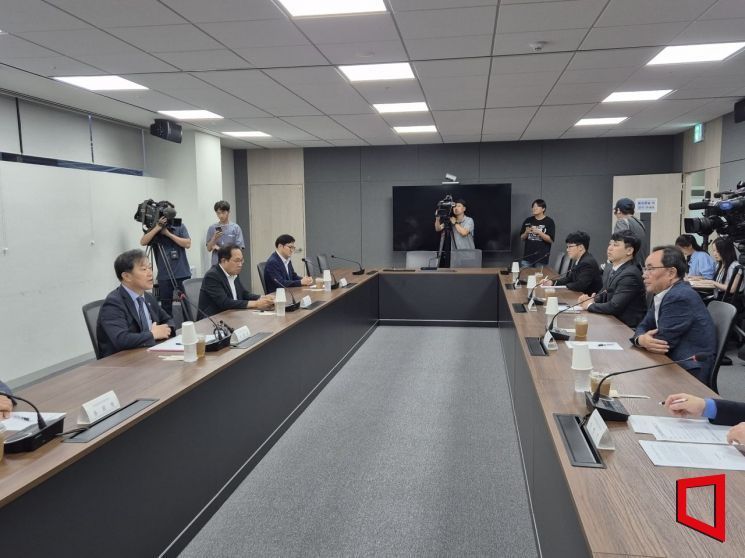 On the 21st, the 4th Training Council Meeting was held at T Tower in Jung-gu, Seoul. Attending the meeting were Lee Hyun, 2nd Vice Minister of the Ministry of Health and Welfare (first from the left), Han Sungjon, Acting Chairman of the Korean Intern and Resident Association (second from the right), and other officials from the Ministry of Health and Welfare and the medical community. Photo by Choi Taewon
According to the medical community on August 23, it has been found that about 70-80% of the available positions at the "Big 5" major university hospitals in Seoul, including Seoul National University Hospital, received applications for resident recruitment in the second half of the year. However, unlike popular specialties such as dermatology, ophthalmology, and plastic surgery, essential medical fields such as pediatrics, emergency medicine, and obstetrics and gynecology reportedly saw lower application rates.
Amid these developments, there are growing arguments that it is now time to improve the resident training environment. At the 4th Training Council Meeting held at T Tower in Jung-gu, Seoul on August 21, Lee Hyun, 2nd Vice Minister of the Ministry of Health and Welfare, stated, "After the return of residents, we need to focus discussions on ways to improve the training environment and enhance the quality of training in order to address concerns in the medical field," adding, "We will expand national support based on ongoing initiatives such as reducing training work hours and the multi-institutional collaborative training pilot project."
It is known that the Ministry of Health and Welfare discussed the revision of the Resident Special Act (the Act on the Improvement of the Training Environment and Status of Residents) as a major agenda item on this day.
The stance of the medical community is no different. The Emergency Response Committee of the Korean Intern and Resident Association (KIRA) also conveyed its position to the government regarding measures to improve the training environment, such as shortening the internship training period. KIRA's Emergency Response Committee had previously discussed these issues at a temporary general assembly of delegates held on August 18 in preparation for delivering its position.
Earlier, at a seminar hosted by the Korean Hospital Medicine Association on August 20, there were also calls for a complete overhaul of resident training and education. Kim Daejung, Director of Training at the Korean Society of Internal Medicine, said, "Those who, like first- and second-year residents, need basic education should be able to receive systematic training in specialized departments capable of providing it," emphasizing, "It is time for each hospital and each department to redesign the structure of clinical practice and subdivided resident training."
Improving the resident training environment is one of the long-standing goals of the medical community. Article 7, Paragraph 1 of the "Act on the Improvement of the Training Environment and Status of Residents" stipulates that hospital directors must not require residents to train for more than an average of 80 hours per week over four weeks. Paragraph 2 prohibits residents from working more than 36 consecutive hours except in emergency situations. However, despite undergoing excessive work of up to 80 hours per week and 36 consecutive hours, residents are often not even afforded the minimum legal protections such as break times under the Labor Standards Act.
According to a 2022 survey conducted by KIRA, the average weekly working hours for residents was 77.7 hours. The proportion of residents working more than the four-week average of 80 hours per week reached 52%. In addition, 66.8% of respondents said they worked more than 24 consecutive hours at least once a week. It was also reported that when on-call shifts are included, it is not uncommon for weekly working hours to exceed 100 hours.
© The Asia Business Daily(www.asiae.co.kr). All rights reserved.
![Clutching a Stolen Dior Bag, Saying "I Hate Being Poor but Real"... The Grotesque Con of a "Human Knockoff" [Slate]](https://cwcontent.asiae.co.kr/asiaresize/183/2026021902243444107_1771435474.jpg)















