Key Water Source Supplying 180,000 Residents
Discussion Underway to Secure Alternative Water Resources, Including Storage Dams
The Ministry of Environment has launched an emergency response after the water storage rate at Obong Reservoir, the main water source for Gangneung City, fell below 20%, prompting the drought stage to be raised to "severe."
On August 22, the Ministry announced that Minister Kim Sunghwan would visit Obong Reservoir in Gangneung City in the afternoon to inspect the drought response measures and discuss future plans with related agencies, including the Ministry of the Interior and Safety. Obong Reservoir supplies 86.6% of Gangneung City's domestic and industrial water and serves as a critical water source for approximately 180,000 residents.
After entering the "attention" stage of drought on July 4, Gangneung City has taken preemptive actions such as utilizing discharged groundwater and restricting agricultural water supply. However, with cumulative precipitation over the past six months (February 21 to August 20) reaching only 386.9 mm-just 49.8% of the average for this period-the reservoir's water storage rate has rapidly declined, dropping to 20.1% as of August 21, which led to the escalation to the "severe" stage.
As part of its mid- to long-term measures to minimize drought damage, the Ministry of Environment is either implementing or planning projects such as constructing groundwater storage dams, reusing treated wastewater, and reducing leakage rates in aging water supply systems.
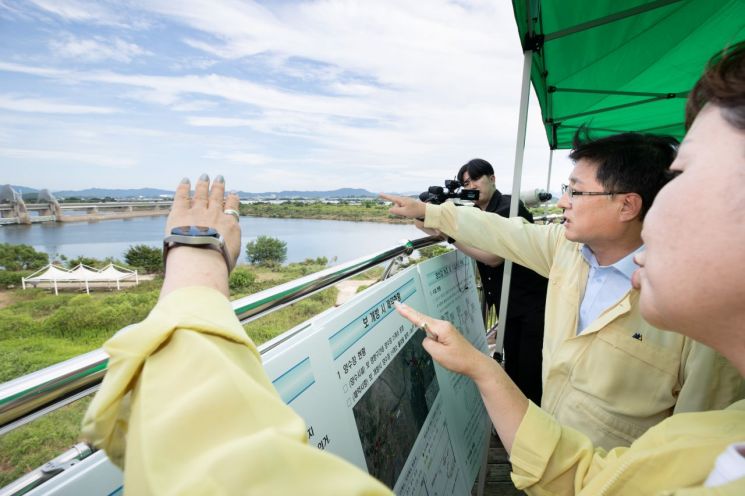 Minister Kim Sunghwan Inspects Seungchonbo Site
(Seoul=Yonhap News) On July 30, Minister Kim Sunghwan of the Ministry of Environment is inspecting the operation status of the Seungchonbo weir in Namgu, Gwangju. 2025.7.30 [Provided by Ministry of Environment. Resale and DB prohibited]
Photo by Yonhap News (End)
After inspecting Obong Reservoir, Minister Kim is also scheduled to visit Doam Dam in Daegwallyeong-myeon, Pyeongchang County, Gangwon Province. Doam Dam, which holds about 30 million tons of water, has been considered an alternative to address Gangneung City's drought, but its use has been delayed due to water quality issues and conflicting interests among regions.
According to the Ministry of Environment, pollution management of livestock manure in the upstream area of Doam Dam has been strengthened since the Livestock Manure Act was enacted in 2006, and continuous pollution source reduction projects have been implemented since the area was designated as a non-point pollution management zone in 2007. As a result, water quality has significantly improved compared to the past, and there is renewed demand for the use of Doam Dam.
Meanwhile, Gangneung Mayor Kim Hongkyu and Oh Byungkwon, Director of the Natural Disaster Division at the Ministry of the Interior and Safety, also participated in the on-site inspection to check the reservoir's status and water supply situation. They plan to discuss proactive response measures through close inter-agency cooperation and securing additional water resources.
Minister Kim stated, "Gangneung City is experiencing great difficulties this year, including the implementation of water restrictions for domestic and industrial use due to the worst drought. Going forward, we will comprehensively review ways to secure alternative water resources, such as groundwater storage dams, and efficiently utilize existing resources, including linking Doam Dam, whose water quality has improved."
© The Asia Business Daily(www.asiae.co.kr). All rights reserved.

















