Jungkwan Kim Heads to Washington Following Hyun Cho and Han-Koo Yeo
Pre-Summit Coordination Intensifies
Shipbuilding, Semiconductors, Batteries, and Nuclear Power
Set to Dominate the Summit Agenda
With just three days remaining before the Korea-U.S. summit, South Korea's key diplomatic and trade officials are gathering in Washington, D.C. Following Han-Koo Yeo, head of trade negotiations at the Ministry of Trade, Industry and Energy, who arrived in the U.S. on the 20th, Foreign Minister Cho Hyun made a surprise trip to the U.S. on the 21st, and on the morning of the 22nd, Minister Jungkwan Kim of the Ministry of Trade, Industry and Energy also departed for the U.S. As a result, the industrial, trade, and diplomatic teams are fully mobilized, making an all-out effort to coordinate ahead of the summit.
Jungkwan Kim Heads to Washington with 'Industrial Alliance' Initiative
According to the Ministry of Trade, Industry and Energy on the 22nd, Minister Kim is scheduled to meet with key U.S. government officials in Washington, D.C., including Secretary of Commerce Howard Lutnick and Secretary of Energy Chris Wright. The main focus of this visit is to fine-tune details of industrial cooperation, one of the major agenda items of the Korea-U.S. summit. In particular, discussions are expected to center on joint supply chain design and investment cooperation in strategic industries where South Korea excels, such as shipbuilding, semiconductors, secondary batteries, and nuclear power.
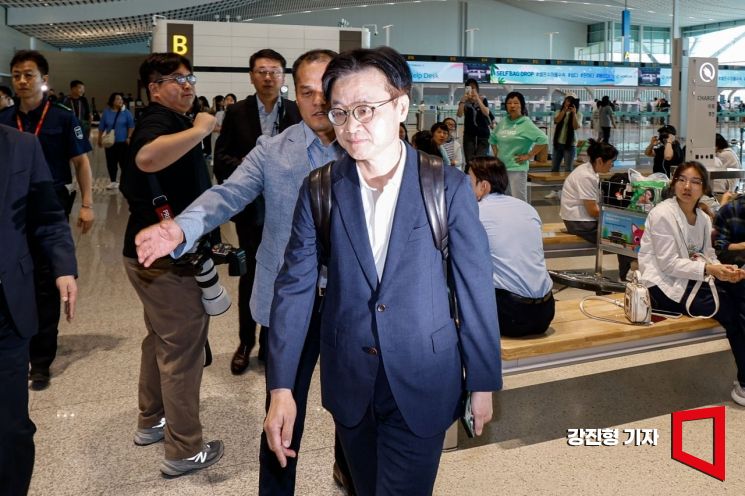 Minister Jungkwan Kim of the Ministry of Trade, Industry and Energy is departing from Incheon International Airport Terminal 2 on the 23rd to attend the high-level U.S. tariff talks. 2025.7.23. Photo by Jinhyung Kang
Minister Kim also played a leading role in the Korea-U.S. tariff negotiations concluded last month. Returning to Washington just three weeks after coming back to Korea, he is regarded as the 'key man' who will translate the industrial alliance agreement reached at the summit into concrete action plans. The ministry plans to bring key officials, including the Deputy Minister for Trade, the Director-General for Nuclear Industry Policy, and the Director-General for Resource Industry Policy, to focus on in-depth discussions of industry-specific issues.
Previously, Chief Negotiator Yeo arrived in the U.S. on the 20th and met with Jamieson Greer, the U.S. Trade Representative, on the 21st. In a recent meeting with reporters, Yeo stated, "An agreement has been reached at the framework level. The specific details are still being coordinated through ongoing negotiations." This suggests that follow-up negotiations are underway to address detailed implementation measures, non-tariff barriers, currency issues, and regulatory matters after the broad framework was established in last month's tariff talks.
Cho Hyun Heads Directly to Washington, Skipping Japan... Diplomatic Focus Shifts
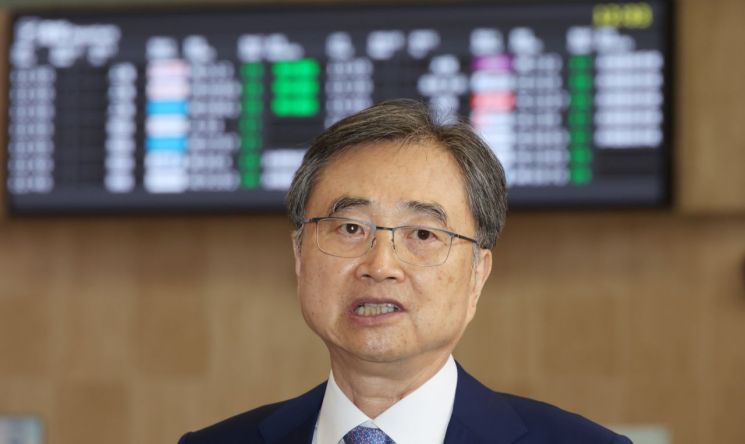
Foreign Minister Cho Hyun departed for the U.S. on the 21st, four days before the Korea-U.S. summit. Although he was scheduled to accompany President Lee Jaemyung and attend the Korea-Japan summit on the 23rd, his decision to skip Japan and head directly to the U.S. has drawn attention. It is understood that this move aims to finalize close pre-summit consultations on-site for the Korea-U.S. summit. Upon arrival in the U.S., Minister Cho is expected to meet with Secretary of State Marco Rubio in Washington, D.C.
President Lee will depart on the 23rd for both the Korea-Japan and Korea-U.S. summits. On the afternoon of the 23rd, he will hold a summit with Japanese Prime Minister Shigeru Ishiba, and on the 25th, he will meet U.S. President Donald Trump for the first time. The Korea-Japan summit is expected to focus on economic and security cooperation, while the Korea-U.S. summit is likely to address trade and security issues. After meeting with business and academic leaders, President Lee will visit the Philadelphia Philly Shipyard on the 26th, which Hanwha Group acquired for $100 million (about 140 billion won) in December last year.
The Korea-Japan summit will focus on supply chain and economic security cooperation, as well as trilateral Korea-U.S.-Japan collaboration. Attention is on how concretely practical agenda items-such as semiconductor and battery core materials, standards and certification, and streamlined export procedures-will be reflected in the official documents.
From Shipbuilding to Nuclear Power... Industrial Alliance Scenario
The Korea-U.S. summit is likely to cover mutual tariff application and details of U.S.-bound investment funds, review of non-tariff barriers, currency, and regulatory issues, as well as discussions on 'alliance modernization,' including increased defense spending and U.S. Forces Korea operations. Major business leaders, including those from the four largest conglomerates, are expected to join the U.S. trip as part of an economic delegation.
The core focus is industrial cooperation. In the nuclear power industry, talks on establishing a joint venture (JV) between Korea Hydro & Nuclear Power and U.S.-based Westinghouse are expected to gain momentum. If a cooperation framework is established at this summit, both countries could expand their reach beyond nuclear plant construction in the U.S. to joint entry into Middle Eastern and Eastern European markets. In particular, with Korea's shipbuilding industry recently demonstrating its technological prowess in advanced vessels such as LNG carriers and military ships, a 'shipbuilding-nuclear power package cooperation' initiative may also be discussed.

In the semiconductor sector, the focus is expected to be on Korean companies' investments in the U.S. With Samsung Electronics and SK Hynix already pursuing large-scale investments to strengthen the U.S. semiconductor supply chain, the summit is likely to focus on the scope of Inflation Reduction Act (IRA) subsidies, semiconductor security regulations, and tax incentives. This could go beyond simple investment to include securing stable production bases in the U.S. and exchanging advanced process technologies.
Cooperation in the secondary battery (battery) industry is also expected to be a hot topic. As Korea's three major battery companies-LG Energy Solution, Samsung SDI, and SK On-are rapidly establishing joint factories in the U.S., the summit is expected to address stabilization of critical mineral supply chains and the establishment of joint procurement systems. The possibility of expanding participation in the U.S. Mineral Security Partnership (MSP), as well as cooperation in battery recycling and reuse technologies, may also be discussed.
© The Asia Business Daily(www.asiae.co.kr). All rights reserved.



















