"Incorrect Statements by Trump Should Be Addressed After the Summit,"
U.S. Experts Advise Ahead of the South Korea-U.S. Summit on the 25th
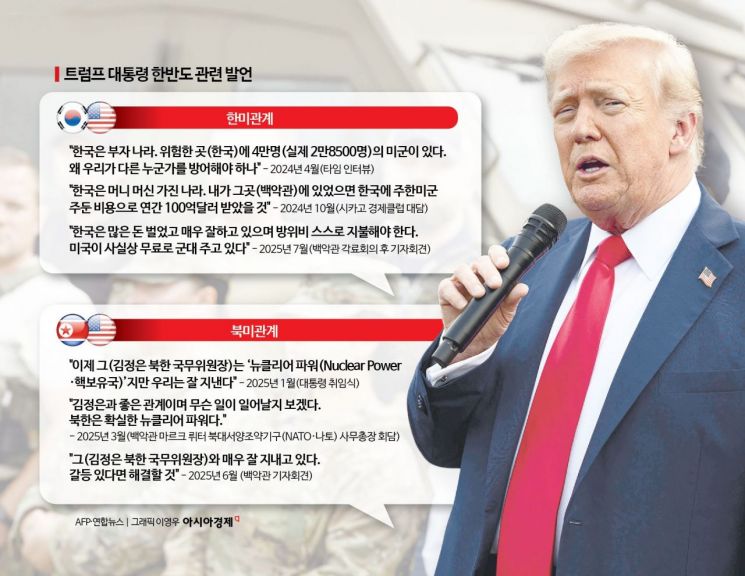
U.S. experts have advised that during the upcoming South Korea-U.S. summit on the 25th (local time), President Lee Jae Myung should refrain from immediately correcting President Donald Trump if he mentions incorrect figures or makes factually inaccurate claims, particularly regarding defense cost-sharing. This advice is due to the real-time, "reality TV show"-like nature of the summit. Since President Trump has previously referred to South Korea as a "money machine," it is expected that the issue of defense cost-sharing will be difficult to avoid.
"Incorrect figures should be corrected by both sides after the summit"
Scott Snyder, President of the Korea Economic Institute of America (KEI), stated at a KEI-hosted seminar on the 21st that it would be preferable for "people from both sides" to correct any inaccuracies after the summit, rather than President Lee responding on the spot, if President Trump repeatedly brings up "incorrect defense cost figures" in front of the press during the summit. During last year's presidential campaign, President Trump incorrectly stated that the number of U.S. troops stationed in Korea was 40,000, instead of the actual figure of about 28,500, while discussing negotiations with South Korea to increase its share of defense costs.
Snyder said, "It is difficult to expect real-time corrections even if President Trump makes inaccurate statements," adding, "But it cannot simply be ignored either." He continued, "President Zelensky (of Ukraine) experienced a very uncomfortable moment in the Oval Office a few months ago, but he returned this week and had a fairly positive meeting," emphasizing, "What matters is not just what happens in that moment, but how you respond in the next meeting."
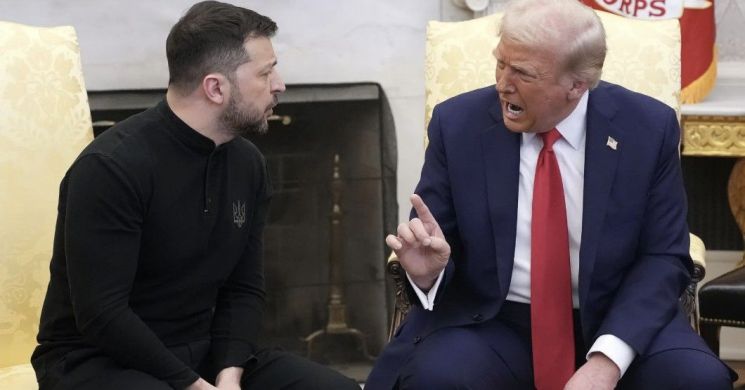 In February, U.S. President Donald Trump (right) and Ukrainian President Volodymyr Zelensky had a heated argument at the White House. The incident where President Zelensky walked out midway amid insults from aides was recorded as a "diplomatic fiasco."
Snyder pointed out that, unlike European leaders such as President Zelensky, President Lee must communicate through an interpreter, making the situation different. This, he noted, makes it both an "advantage and a disadvantage" that President Lee cannot respond immediately to President Trump's remarks. In fact, some analyses suggest that the absence of an interpreter was a factor in the diplomatic fiasco last February, when President Zelensky was driven out of the White House amid insults. As Trump's aides criticized Zelensky for "not expressing gratitude," Zelensky immediately retorted, "I did, several times," escalating the tension. Regarding this, Japan's Nikkei newspaper commented, "If it had been a situation dealing with a hostile counterpart, an interpreter would have been even more necessary."
Erius Dare, Director of Communications at KEI, also advised that preparations should be made for the possibility that Trump might make impromptu or off-the-cuff remarks about trade or North Korea that are completely different from or even contradict the achievements derived from existing bilateral agreements. He recalled that, immediately after his first summit with President Moon Jae In in June 2017, President Trump posted on Twitter about renegotiating the Korea-U.S. Free Trade Agreement (FTA).
Expected agenda items include defense costs, China issues, and more
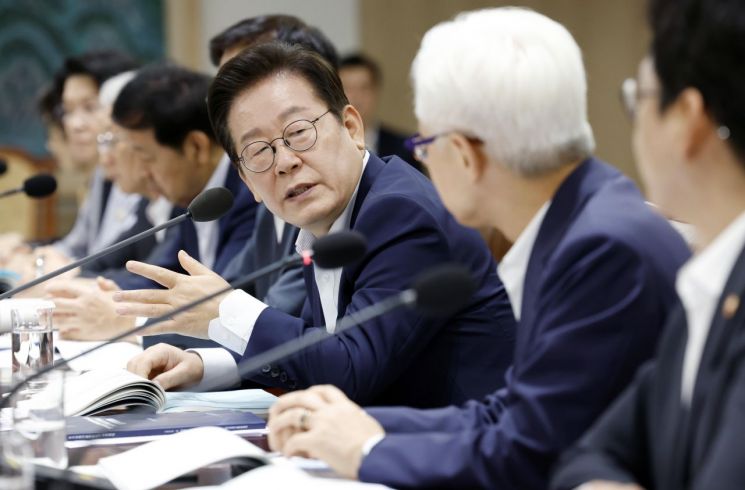 President Lee Jae Myung is speaking at the 1st National Science and Technology Advisory Council plenary meeting held at the Yongsan Presidential Office on the 22nd. Photo by Yonhap News
The upcoming summit is expected to focus primarily on defense spending, cost-sharing issues, the China issue, discussions on the modernization of alliances, and strategic flexibility. Victor Cha, Korea Chair at the Center for Strategic and International Studies (CSIS), also mentioned during a media briefing on the 20th that President Trump is likely to demand solutions for the U.S. trade deficit with South Korea and ask about South Korea's position in the event of a Chinese emergency.
Ellen Kim, Director of Academic Affairs at KEI, predicted, "President Trump tends to actually attempt what he says," and noted that since he has repeatedly raised the issues of defense spending and cost-sharing, he may seek to present these as achievements of the summit. She added, "There is also a strong possibility that he will ask about the China issue."
Regarding the "alliance modernization" discussions, which are also being mentioned as another agenda item, she said, "The overall U.S. (Trump administration's) defense strategy has not yet been announced," and predicted that only a general direction for alliance modernization would be presented, rather than specific details. She suggested that it may take the form of a "joint vision statement," such as, "There is a need to upgrade the strengthened alliance," or, "A strengthened alliance is very useful in addressing increasingly complex security situations."
Dare also commented, "Strategic flexibility is an element being discussed in the negotiation process, and it is still unclear how it will actually combine with (defense costs and other issues)," adding, "It is part of a process led by the Department of Defense through its defense strategy."
© The Asia Business Daily(www.asiae.co.kr). All rights reserved.
![Clutching a Stolen Dior Bag, Saying "I Hate Being Poor but Real"... The Grotesque Con of a "Human Knockoff" [Slate]](https://cwcontent.asiae.co.kr/asiaresize/183/2026021902243444107_1771435474.jpg)


















