Increased by 19.3% from This Year, Reaching a Record-High Scale
Intensive Investment in the Complete Restoration of the Collapsed Research Ecosystem and Realization of Genuine Growth
A Major Shift to an R&D Investment System for "Technology-Driven Growth" and "Growth for All"
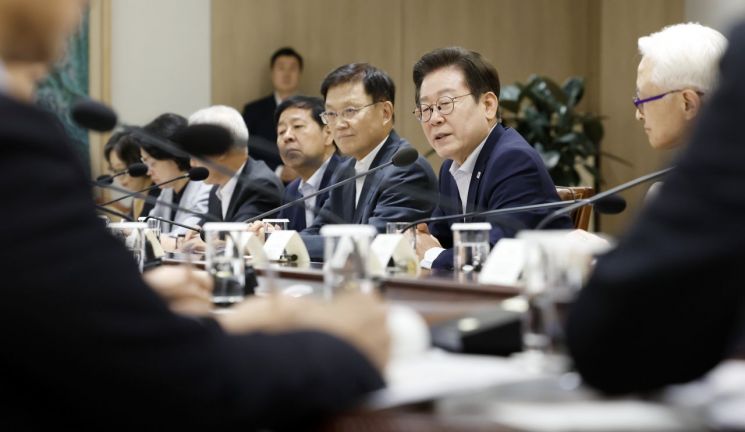
On August 22, President Lee Jaemyung held a meeting of the National Science and Technology Advisory Council at the presidential office in Yongsan, where he announced that next year's research and development (R&D) budget would reach a record-high 35.3 trillion won. This figure represents a 19.3% increase compared to this year. In particular, the "major R&D" budget-allocated and coordinated by the Ministry of Science and ICT, reviewed and approved by the advisory council, and finalized by the Ministry of Economy and Finance-was set at 30.1 trillion won, up 21.4% from this year. The government plans to focus intensive investment on the complete restoration of the collapsed research ecosystem and the realization of genuine growth, with "technology-driven growth" and "growth for all" as its key policy directions.
According to the government's "2026 National R&D Project Budget Allocation and Coordination Plan," the major R&D budget exceeding 30 trillion won is divided into "technology-driven growth" and "growth for all." The core of technology-driven growth is to boost industrial and export competitiveness for a major leap in the economy. Five key sectors have been selected for concentrated investment: artificial intelligence (AI), energy, strategic technologies, defense, and small and medium-sized ventures.
The AI sector will see the steepest increase in budget. The government will invest 2.3 trillion won in AI, a 106.1% increase from this year. The goal is to secure a rapid competitive edge in the global market and strengthen independent capabilities across the AI ecosystem. The budget will be intensively invested in next-generation technologies such as artificial general intelligence (AGI) and lightweight, low-power AI.
Funding will also support the construction of the so-called "AI Expressway" and address the research demand for high-performance graphics processing units (GPUs). In particular, the government aims to efficiently share and manage GPU resources to support the localization of core technologies for an AI-based society. Additionally, the transition to an "AI-based society," enabling all citizens to use AI reliably, will be accelerated. To this end, the government will promote the development of AI models specialized by research field and the integration of AI across all industries, while also introducing AI into public sectors such as administration, healthcare, and national defense.
The largest portion of the budget will go to strategic technologies. With an 8.5 trillion won budget, up 29.9%, the government has set a plan to achieve self-reliance in core technologies within five years. To lead future markets and the industrial ecosystem, the government will support foundational technologies in quantum computing and synthetic biology, and internalize essential core technologies for supply chain and security, such as AI semiconductors. For technologies where Korea already has a high level of expertise, such as autonomous vehicles and humanoid robots, the government will support the development of demonstration technologies to enable commercialization in the short term.
The energy sector will receive 2.6 trillion won, with a focus on eco-friendly renewable energy. Whereas previous budgets targeted technology development or small-scale demonstration projects, the new focus will be on localization and full-scale demonstration. To accelerate the energy transition centered on renewables, the government will develop ultra-high-efficiency solar cells, large-scale wind power systems, next-generation power grids, and long-duration energy storage (ESS) technologies. Investment in small modular reactor (SMR) core technologies will also continue to respond to increased electricity demand resulting from the AI transformation.
The defense sector has been allocated 3.09 trillion won, with plans to upgrade the K-9 self-propelled howitzer and Cheongung missile systems. Investment has also been expanded for electronic warfare and the development of the next-generation KF-21 fighter jet to prepare for space and cyber warfare. The budget for small and medium-sized ventures is set at 3.4 trillion won, supporting follow-up R&D for companies and technologies that have passed private sector investment verification.
Another pillar of this R&D budget is the restoration of the research ecosystem. The basic research budget was set at 3.4 trillion won, a 14.6% increase, with the government planning to expand the number of individual basic research projects to revive the weakened research ecosystem. As a result, the number of research projects, which decreased from 14,499 in 2023 to 11,827 this year, will sharply increase to 15,311 next year. The discontinued basic research program will be reinstated, and new projects will be expanded so that non-tenured faculty can also participate in research.
For talent development, 1.3 trillion won will be invested to attract top-tier science and engineering talent. In particular, to quickly recruit world-class talent, the government will provide a package of globally competitive salaries, stable research funding, and settlement allowances. The budget for government-funded research institutes will be 4 trillion won, guiding them to focus on national mission-oriented research through mid- to long-term and large-scale projects. Projects completed under government contracts will be redistributed as institutional contributions, and a new incentive system for top researchers will be introduced to improve the research environment. In addition, 2.4 trillion won has been allocated for disaster safety, and 1.1 trillion won for regional growth to strengthen autonomous research capabilities.
Minister of Science and ICT Baek Kyunghoon emphasized, "This R&D budget proposal is the largest ever and has been dramatically expanded not only for the recovery but for the complete restoration and genuine growth of the research ecosystem," adding, "We plan to establish a sustainable research ecosystem together with the science and technology community through a stable and predictable R&D investment system."
© The Asia Business Daily(www.asiae.co.kr). All rights reserved.
![Clutching a Stolen Dior Bag, Saying "I Hate Being Poor but Real"... The Grotesque Con of a "Human Knockoff" [Slate]](https://cwcontent.asiae.co.kr/asiaresize/183/2026021902243444107_1771435474.jpg)
















