407 New Steel and Aluminum Derivatives Added
Difficult to Accurately Determine Content Due to Numerous Suppliers
"Government Consulting Support Must Be Expanded"
Kang, who runs an automotive brake parts company in Hwaseong, Gyeonggi Province, was thrown into confusion upon hearing that the range of U.S. steel and aluminum derivative products had been significantly expanded. To assess the extent of the potential damage, he needs to calculate the proportion of steel and aluminum in his products. However, since he sources parts from multiple suppliers, it is virtually impossible to determine the exact content. Kang receives materials and components necessary for producing brake discs and pads from specialized alloy companies and other suppliers. Kang lamented, "I have no idea how severe the damage might be, so I don't know how to respond. The entire industry is in a similar situation, and everyone feels at a loss."
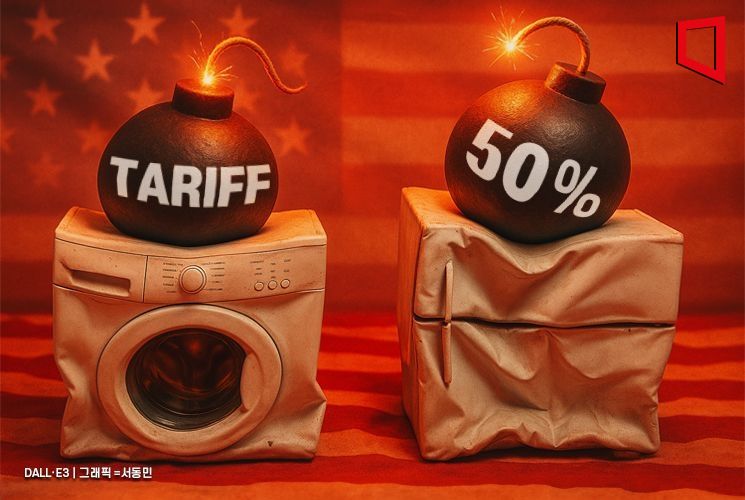
Confusion continues in the industrial sector after the Donald Trump administration decided to add 407 product categories to the list of steel and aluminum derivatives subject to a 50% tariff. Numerous related companies are struggling to determine the steel and aluminum content and the origin of their products. Experts advise that government consulting support for small and medium-sized enterprises should be expanded to help verify product content and provide proof of origin.
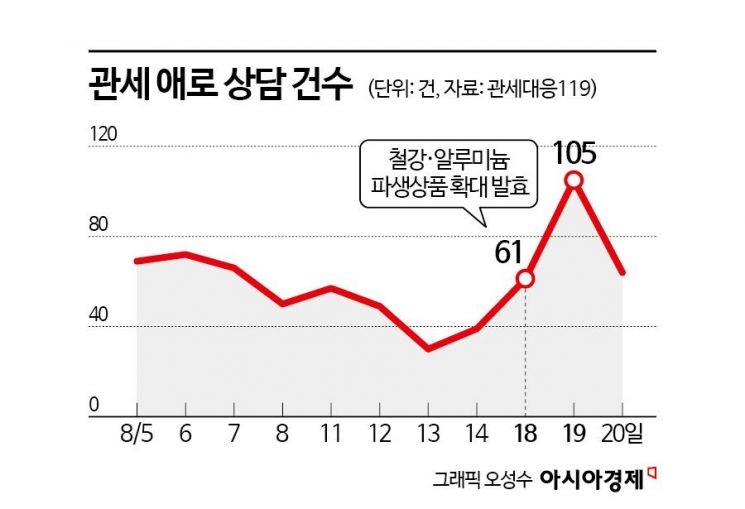
According to the government and the small business community on August 22, the number of inquiries received by "Tariff Response 119," a consultation center for tariff-related damages, soared to 105 on August 19, the day after the U.S. announced the significant expansion of steel and aluminum derivatives. Considering that the average daily number of inquiries this month is 68, this represents an increase of more than 1.5 times. By type, questions about specific tariff regulations-classified as "tariff confirmation"-accounted for the largest share at 91.4%.
The newly added steel and aluminum derivative products include automotive parts, transformers, cosmetics, home appliances, and construction machinery-most of which are produced by small and medium-sized enterprises. In particular, many of the affected items, such as cosmetics and automotive parts, have a high export ratio to the U.S., making it inevitable that SMEs will be hit hard.
The problem is that the vast majority of SMEs affected by this measure either do not know the steel and aluminum content and origin of their products or find it extremely difficult to determine. When parts and packaging materials are supplied through various domestic and international partners, companies must obtain and examine related data from all suppliers involved.
Kim, who runs a small home appliance company in Bucheon, Gyeonggi Province, said, "Many parts for our microwaves-such as the outer panel, fan, motor, and condenser-are sourced from suppliers, so we have no idea about the steel and aluminum content of our products. While it might be possible to check through the specifications, it is complicated and requires a lot of time and money." Han Areum, a senior researcher at the Korea International Trade Association, explained, "Depending on the company, a single product may include dozens or even more than 100 parts-such as bolts, nuts, and screws-that are classified as derivative products. In such cases, it is practically impossible to track the content."
The confusion is further compounded by the fact that so many product categories were added at once, and concrete details have yet to be communicated. Many companies do not know whether their products are among the 407 newly added categories. Kim Pilsoo, a professor in the Department of Automotive Engineering at Daelim University, said, "There are over 30,000 automotive parts alone, so it is difficult to know which ones are included and which are excluded. The government needs to provide clear assistance from the outset if companies are to formulate countermeasures."
Senior researcher Han emphasized, "From the perspective of companies, they often have to trace back to first- and second-tier suppliers, or even further, to identify product composition. Therefore, expert consulting on content determination and proof of origin is essential. It is urgent to establish an administrative system that allows companies to easily identify the content and origin of steel and aluminum derivative products at a glance."
© The Asia Business Daily(www.asiae.co.kr). All rights reserved.
![Clutching a Stolen Dior Bag, Saying "I Hate Being Poor but Real"... The Grotesque Con of a "Human Knockoff" [Slate]](https://cwcontent.asiae.co.kr/asiaresize/183/2026021902243444107_1771435474.jpg)
















