15% Tariff to Be Applied to European Automobiles and Auto Parts
If All Tariffs on US Industrial Goods Are Eliminated
The United States and the European Union (EU) issued a joint statement on the 21st (local time), ensuring that the final tariff rates imposed on EU-produced pharmaceuticals, semiconductors, and timber will not exceed 15%.
On this day, the US and the EU released a joint statement documenting the contents of their trade agreement. This comes 25 days after the leaders reached an agreement on July 27.
The statement reads, "The United States plans to swiftly ensure that the combined (final) tariff rate, including both the Most-Favored-Nation (MFN) tariffs and tariffs imposed under Section 232 of the Trade Expansion Act, on EU-produced pharmaceuticals, semiconductors, and timber does not exceed 15%."
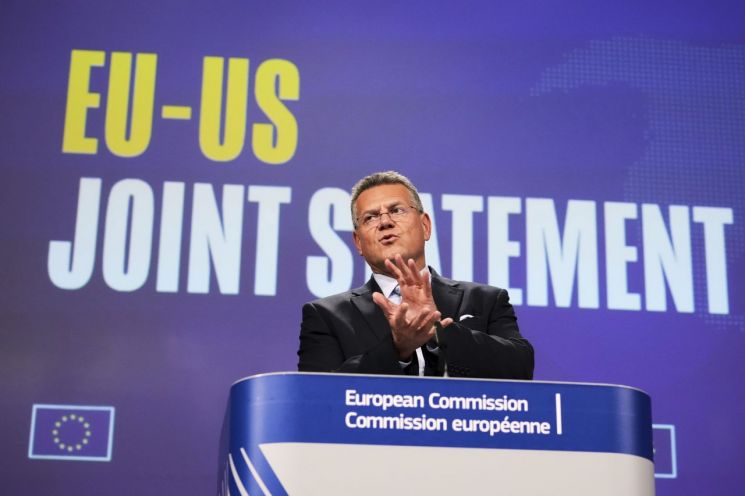
The joint statement also specifies that, once legislation is officially prepared to implement the agreement between the two sides-such as eliminating all tariffs on US industrial goods-a 15% tariff will be applied to European automobiles and auto parts. Currently, a total of 27.5% is imposed, which includes a 2.5% MFN tariff and an additional 25% item-specific tariff.
Additionally, regarding steel, aluminum, and their derivatives, which are currently subject to a 50% tariff by the US, both sides pledged to "review the possibility of cooperation to protect their respective domestic markets from oversupply," and stated, "This includes ensuring mutual supply chain security, with a Tariff Rate Quota (TRQ) solution also being part of the agreement."
The plan to introduce a steel TRQ was announced by the EU after last month's agreement, but this is the first time the US has formalized it. While further discussions are needed regarding the specific TRQ volumes to be applied, from the European perspective, being able to benefit from tariff reductions on TRQ volumes as well is a significant gain.
Previously, the US and the EU agreed last month to lower the mutual tariff rates on EU goods from the originally announced 30% to 15%, and this took effect on the 7th of this month.
However, the release of a joint statement documenting the agreement was delayed at that time, and the US side's slow implementation of the agreement left European exporters with lingering dissatisfaction and uncertainty.
© The Asia Business Daily(www.asiae.co.kr). All rights reserved.
![Clutching a Stolen Dior Bag, Saying "I Hate Being Poor but Real"... The Grotesque Con of a "Human Knockoff" [Slate]](https://cwcontent.asiae.co.kr/asiaresize/183/2026021902243444107_1771435474.jpg)















