Kim Changyeol's "Droplets": Enigmatic Yet Imbued with Violence
Crossing South Alone at 16:
War Scars as the Foundation of Art
"Phenomenon": The Horrors of New York Life,
Organs Seem to Melt
"Droplets": Meaning Beyond Material Form
"Return": Reconciliation with Past Scars
The "Kim Changyeol Retrospective," which highlights the artistic transformation that led Kim Changyeol, known as "Monsieur Gouttes (Mr. Droplets)" among Parisian artists, to his signature "Droplets," is being held at the National Museum of Modern and Contemporary Art, Seoul. This is the first large-scale retrospective since Kim Changyeol's passing (1929-2021), featuring over 120 works, including 31 previously undisclosed pieces, spanning both his representative and early works.
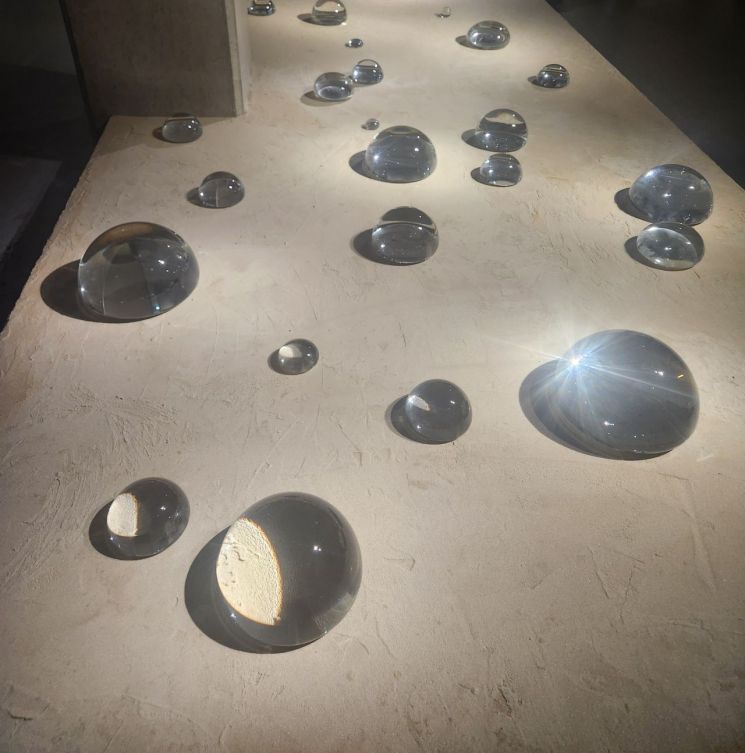 Installation work 'Water Drop' inside the National Museum of Modern and Contemporary Art, Seoul, Jongno-gu, where the Kim Changyeol retrospective is held. Photo by Seo Mideum
Kim Changyeol was a symbolic figure who led the Informel (a branch of abstract painting characterized by emotional intensity and subjectivity) movement in the 1950s, pioneering the integration of Western contemporary art styles with Korean sentiment. From his time in New York in 1965 to his settlement in Paris in 1969, he was devoted to experimentation in pursuit of original art that responded to the times. From the early 1970s, the water droplet, which he explored throughout his life, became synonymous with Kim Changyeol as an artist.
Kim Changyeol's "Droplets": Enigmatic Yet Imbued with Violence
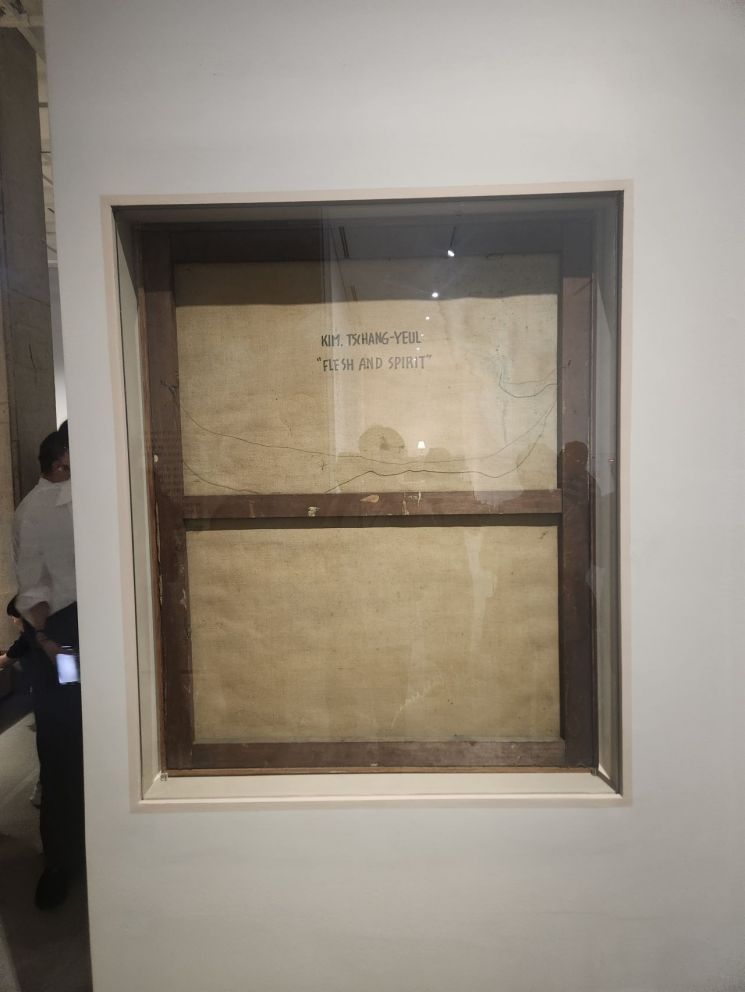 At the entrance of the exhibition hall, the back of the artwork titled "Flesh and Spirit" welcomes visitors. Photo by Seo Mideum
Interestingly, the droplets carry a far more tragic meaning than they appear. At a press conference held on the 21st at the National Museum of Modern and Contemporary Art, Seoul, curator Seol Wonji, who organized the exhibition, explained, "Kim Changyeol witnessed horrifying scenes during the war, such as intestines spilling out when corpses were crushed, which led to his deep interest in the human body." She continued, "Through this exhibition, I wanted to show that while the droplets may appear fantastical and mysterious, they also imply the violence of humanity in the process of purification." During his lifetime, Kim Changyeol described the meaning of the droplets as an "act of mourning" in his early years, and later stated, "In truth, they are nothing. I wish to become nothing as well."
At the entrance to the exhibition hall, visitors are greeted by the back of an artwork. The phrase "Flesh and Spirit" stands out, and curator Seol explained, "The reason for starting the exhibition from the back of the artwork is to shed light on the other side of the droplets," adding, "The inscription holds significant meaning for this exhibition." The exhibition is structured into four sections: "Scars," "Phenomenon," "Droplets," and "Return." In addition, a separate area has been created to showcase previously undisclosed materials and works, offering insight into the artist's life and creative process.
Crossing South Alone at 16: War Scars as the Foundation of Art
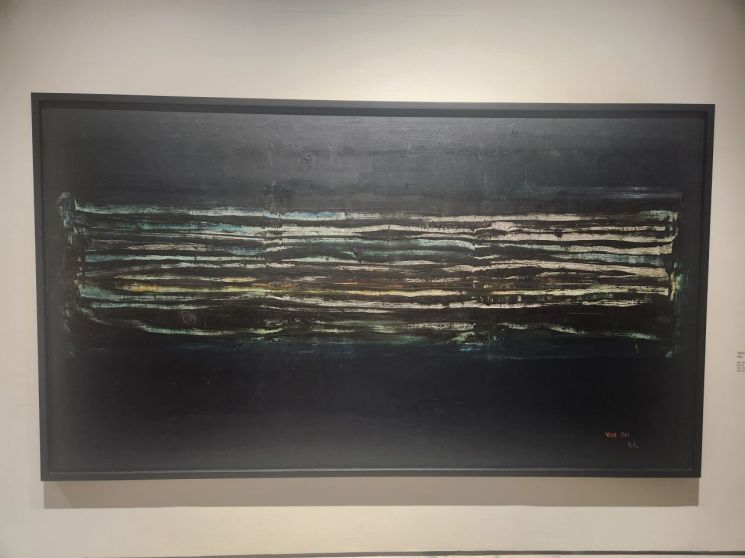
The "Scars" section focuses on Kim Changyeol's early works, examining the historical context and activities that shaped his artistic world. Born in Maengsan, South Pyongan Province, Kim crossed to the South alone at age 16, leaving his hometown behind. In doing so, he experienced the turbulent times of liberation, division, and war, inevitably internalizing the issues of life and death-elements that became a crucial foundation for his entire artistic career.
In the late 1950s, Kim led the Informel movement and participated in international events such as the Paris Biennale (1961) and the Sao Paulo Biennale (1965), introducing Korean contemporary art to the world stage. Most works from this period were titled "Jesah," with paint forming solidified masses that left vivid, corporeal traces on the surface, revealing the sculptural aspect of wounds.
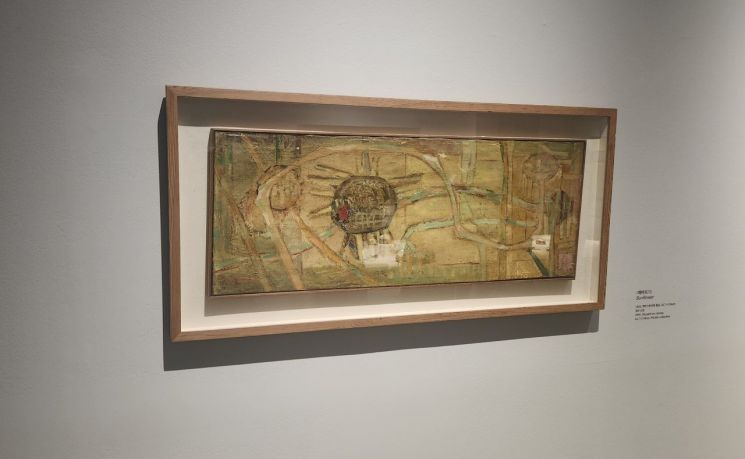 Kim Changyeol 'Sunflower' (1995). A work from just before the En Plein Air period, exhibited for the first time in this exhibition. Photo by Seo Mideum
Among his pre-Informel works, "Sunflower" (1955) and a cover illustration for the bimonthly magazine "Police Creed" from his time as a police officer have been publicly exhibited for the first time.
"Phenomenon": The Horrors of New York Life, Organs Seem to Melt
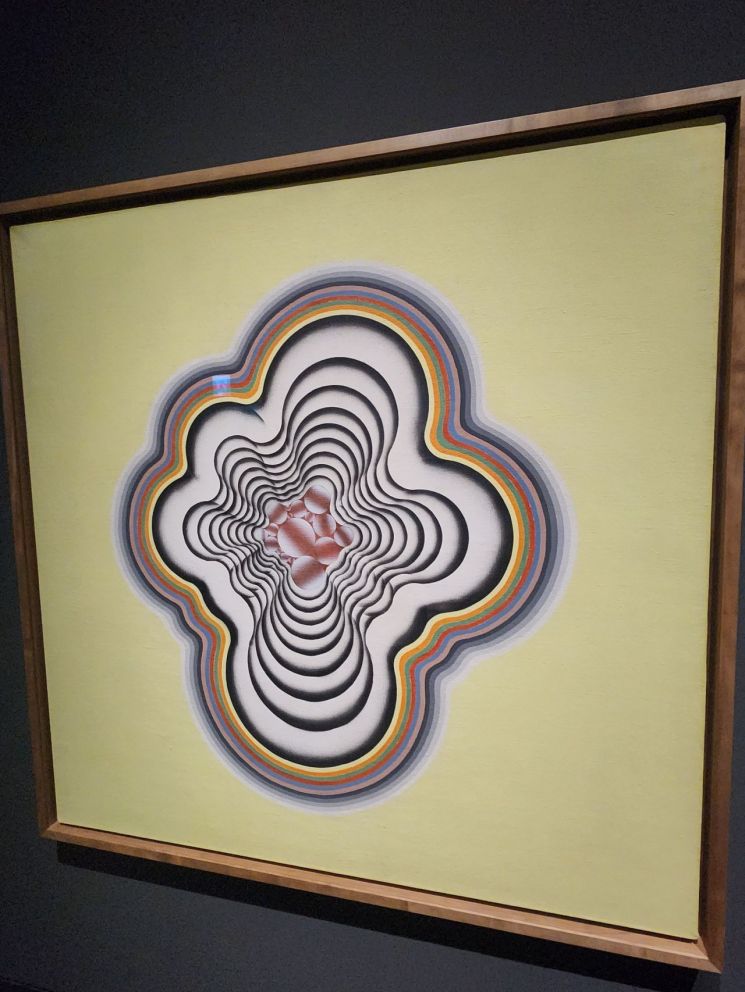 Kim Changyeol 'Composition' (1970), after moving to New York in 1965, broke away from the thick texture of Informel and began to develop geometric forms and optical illusion spatial experiments on a refined surface. Photo by Seo Mideum
The "Phenomenon" section focuses on works from Kim's transitional period in New York and Paris, exploring the formative signs that hint at the origins of his abstract painting and droplets. In 1965, encouraged by Kim Whanki and supported by the Rockefeller Foundation, Kim moved to the United States, but his Informel paintings did not attract much attention. He felt a deep sense of emotional alienation and estrangement in the consumerist capitalist society. As a result, he began to move away from the thick textures of Informel, conducting formal experiments with geometric shapes and illusory spatial perception on refined surfaces. Around the time he moved to Paris in 1969, his work began to feature organic forms reminiscent of melting human organs, a precursor to his later "Droplets" paintings.
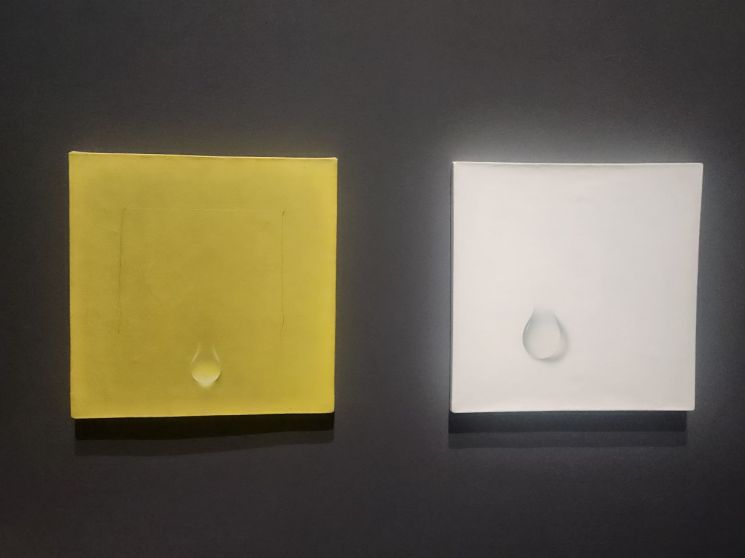 'Waterdrops' (left in the photo), created in 1971, one year earlier than the 1972 work known as the first waterdrop piece. It was unveiled for the first time in this exhibition. Photo by Seomideum
This exhibition unveils for the first time eight previously undisclosed paintings and eleven drawings from his New York period. Additionally, two water droplet paintings from 1971, created before the previously known first droplet work "What Happened at Night" (1972), are being shown for the first time.
"Droplets": Meaning Beyond Material Form
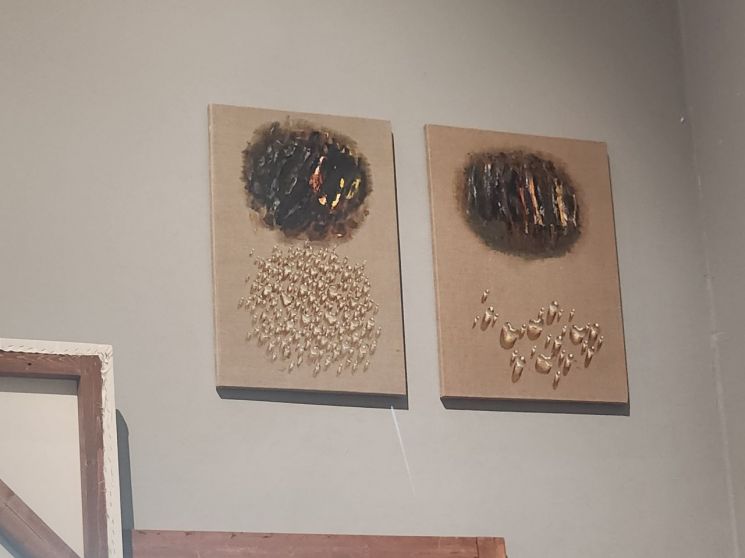 Kim Changyeol's "Droplet" (1986) solidified the artistic language of "Droplet" using stains and collage techniques. Photo by Seo Mideum
The "Droplets" section finally reveals the fully realized form of the water droplet. This was achieved while Kim struggled to make ends meet in a stable-turned-studio on the outskirts of Paris. During this period, he incorporated air spray techniques he learned while working at a necktie factory to support himself, which brought him considerable attention in Paris in 1973. Later, by utilizing stains and collage techniques, he solidified the artistic language of the droplet. At the time, renowned French critic Alain Bosquet praised, "Kim Changyeol's droplets possess a rare hypnotic power that redefines materiality and presents spirituality."
"Return": Reconciliation with Past Scars
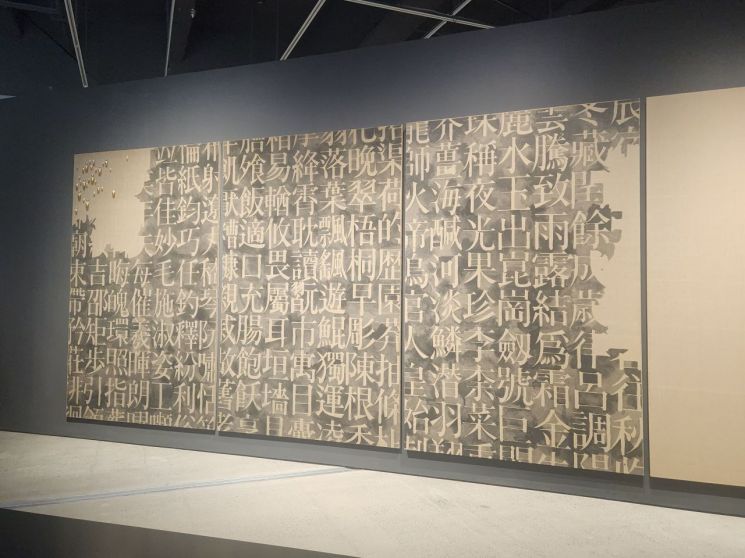 Kim Changyeol's 'Return SNM93001' (1991). Adding water droplets to the Thousand Character Classic learned in childhood is interpreted as the act of stitching the scars of life with brushstrokes. Photo by Seo Mideum
The final "Return" section focuses on a new expressive world achieved by combining the Thousand Character Classic with images. Kim wrote the Thousand Character Classic, which he learned as a child, on calligraphy paper and combined it with droplets to create new imagery. This act was akin to stitching the scars of life with brushstrokes, a form of requiem. The exhibition features the first public showing of the large-scale work "Return SNM93001" (1991), measuring 7.8 meters.
Curator Seol noted, "A distinctive yellow color appears consistently in works from all periods, including those reflecting the horrors of war," adding, "Perhaps yellow was what he clung to in the face of human violence and death. Further research on this is needed."
Kim Sunghee, director of the National Museum of Modern and Contemporary Art, stated, "This exhibition serves to supplement the previously insufficient research on the artist and provides an opportunity to comprehensively examine Kim Changyeol's artistic world through works from previously overlooked periods. It is a chance to rediscover and redefine the artist Kim Changyeol, and I hope it will be a precious time to fully encounter the unique aesthetics and emotions of his life and art." The exhibition runs until December 21.
© The Asia Business Daily(www.asiae.co.kr). All rights reserved.



















