Loss Ratio of Major Non-Life Insurers Hits 92.1%, Up 10.1 Percentage Points Year-on-Year
3,874 Vehicles Flooded in a Single Week Last Month, Losses Reach 38.86 Billion Won
Excessive Medical Treatment for Minor Injury Patients Remains a Chronic I
Last month, the auto insurance loss ratio of major domestic non-life insurance companies surpassed 90% for the first time in the past five years. The decline in insurance profits due to the worsening auto insurance loss ratio is expected to continue to weigh on the performance of major non-life insurers for some time.
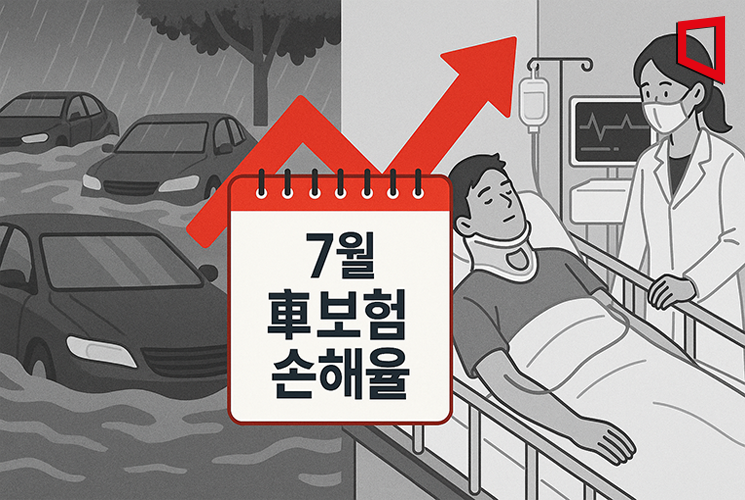
According to the non-life insurance industry on August 21, the auto insurance loss ratio for the four major non-life insurers-Samsung Fire & Marine Insurance, DB Insurance, Hyundai Marine & Fire Insurance, and KB Insurance-stood at 92.1% (simple average of the four companies) last month, up 10.1 percentage points from the same period last year. This is the first time since statistics began in 2021 that the auto insurance loss ratio for these four companies, which together account for over 85% of the auto insurance market, has exceeded 90% as of July.
By company, Samsung Fire & Marine Insurance’s loss ratio rose by 9.9 percentage points year-on-year to 91.2%. During the same period, DB Insurance’s loss ratio increased by 11.7 percentage points to 91.7%. Hyundai Marine & Fire Insurance saw a 10 percentage point increase to 92.4%, while KB Insurance’s ratio climbed by 8.6 percentage points to 92.9%.
The cumulative auto insurance loss ratio for the four major non-life insurers from January to July was 84%. This figure is up 4.1 percentage points compared to the same period last year. The industry considers a loss ratio of 80% to be the break-even point.
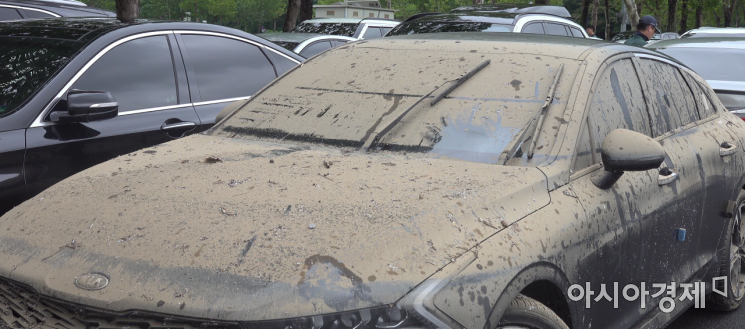
The deterioration in the auto insurance loss ratio among major non-life insurers was due to extensive flood damage caused by heavy rainfall last month. From July 16 to 22, a total of 3,874 vehicles were reported damaged by flooding and other incidents to 12 domestic non-life insurers, with estimated losses totaling 38.862 billion won. An insurance industry official explained, "Heavy rainfall, an increase in vacation travelers, and rising insurance costs such as repair fees have all negatively impacted the auto insurance loss ratio."
Excessive medical treatment for minor injury patients is also a key factor driving up the auto insurance loss ratio. According to statistics from the Korea Insurance Research Institute, the actual medical expenses per minor injury patient (grades 12 to 14) increased 4.5 times from 187,000 won in 2013 to 839,000 won at the end of 2022. During the same period, actual future medical expenses (settlement payments) rose 2.4 times from 388,000 won to 936,000 won. This is due to an increase in cases where minor injury patients are hospitalized at Korean medicine hospitals and receive excessive treatment before claiming insurance payouts.
As a result, the auto insurance profit of major non-life insurers plummeted in the first half of this year. Samsung Fire & Marine Insurance’s auto insurance profit fell 79.4% year-on-year to 30.7 billion won. DB Insurance’s profit dropped 52.1% to 77.7 billion won. Hyundai Marine & Fire Insurance’s profit decreased 58.6% to 16.6 billion won, and KB Insurance’s profit declined 75.6% to 8.6 billion won.
Due to four consecutive years of premium reductions, increases in repair costs, and excessive treatment of minor injury patients, the worsening of the auto insurance loss ratio is expected to continue for the time being. There is also a possibility that auto insurance profits will turn into losses in the second half of the year.
© The Asia Business Daily(www.asiae.co.kr). All rights reserved.


















