"No Reason for Business Community Concerns,
Business Associations Are Overreacting"
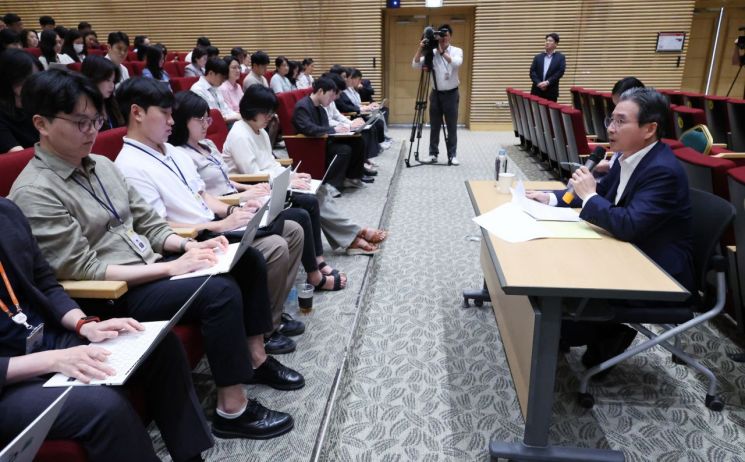 Kim Yongbeom, the Chief Policy Officer, is holding a press briefing at the Yongsan Presidential Office on the 20th. Photo by Yonhap News
Kim Yongbeom, the Chief Policy Officer, assessed on the 20th that concerns from the business community and opposition parties regarding the Yellow Envelope Act (the amendment to Articles 2 and 3 of the Trade Union and Labor Relations Adjustment Act) are exaggerated. He analyzed that the Yellow Envelope Act will not lead to a surge in bargaining demands from subcontractors or cause companies to move overseas. Regarding the business associations' protests, he warned, "It seems a bit excessive."
On this day, during a press briefing at the Yongsan Presidential Office, Kim stated, "Many of the current concerns are quite exaggerated." He added, "If a forum for dialogue and order is established, many of these concerns will likely be resolved," and further explained, "If the Ministry of Employment and Labor provides guidelines or instructions for about six months, that should suffice."
The core of the amendments to Articles 2 and 3 of the Trade Union Act is to expand the definition of 'employer,' thereby strengthening the primary contractor's responsibility for subcontracted workers and limiting the scope of damages claims against unions and workers. Subcontractors can request bargaining with the primary contractor, and unions are allowed to strike even over managerial decisions. The business community has expressed concerns that this will lead to excessive labor disputes and make business decisions more difficult.
"No Reason for Business Community Concerns, Business Associations Are Overreacting"
Kim stated, "Some claim that if the Yellow Envelope Act passes, all companies will leave Korea, as suggested by the American Chamber of Commerce in Korea (AMCHAM), but such things will not happen." He explained, "The wording has been changed from the bill that the Yoon Suk Yeol administration vetoed." He continued, "Unions cannot strike unconditionally; strikes are only permitted in cases of mass layoffs or major mergers and acquisitions."
Kim further argued, "Even when subcontractors request the primary contractor to negotiate, there must be a close, practical relationship, such as with in-house subcontractors," and emphasized, "This is only recognized in areas like safety."
Regarding the backlash from the business sector, he claimed, "If the Yellow Envelope Act passes, an official negotiation table will be established, which will address the concerns raised by the Korea Employers Federation. If, by any chance, the situation they fear does occur-which should not happen-the law can always be amended." He warned, "The fact that a few associations are leading these protests seems a bit excessive."
Kim pointed out, "As the gap between primary and subcontractors becomes entrenched and widens, the companies people belong to have become a social class issue and a social problem." He criticized, "There is a lack of communication channels to address this phenomenon." He continued, "Under the current law, primary contractors are not obligated to respond to requests for dialogue from subcontractor unions. As a result, subcontractor unions are repeatedly resorting to extreme measures, such as illegal strikes, to express their opinions."
© The Asia Business Daily(www.asiae.co.kr). All rights reserved.
![Clutching a Stolen Dior Bag, Saying "I Hate Being Poor but Real"... The Grotesque Con of a "Human Knockoff" [Slate]](https://cwcontent.asiae.co.kr/asiaresize/183/2026021902243444107_1771435474.jpg)















