- Conflicting Interests Among Market Participants... Building Trust Through "Collaborative Governance"
- "Scalping" Frame and "Paradox of Regulation" Identified as Barriers to Growth of Korea's Secondary Ticket Market
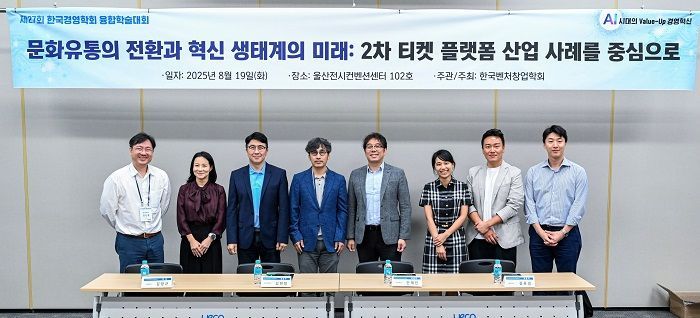
The Korean Venture Startup Association (President: Woojin Lee, Professor at Kookmin University) co-hosted a convergence academic conference with the Korean Academic Society of Business Administration on August 19 at the Ulsan Exhibition and Convention Center (UECO), under the theme "Transformation of Cultural Distribution and the Future of the Innovation Ecosystem: Focusing on the Secondary Ticket Platform Industry."
This academic conference was organized to discuss the conditions for creating an innovation ecosystem and directions for institutional improvement to ensure the sustainable growth of the cultural industry, with a focus on the secondary ticket market. Moderated by Professor Shin-Hyung Kang of Chungnam National University, the conference featured presentations by Professor Juhee Kim of Dongduk Women's University (Department of Culture and Arts Management), Professor Byungchul Choi of Hankuk University of Foreign Studies (Department of Business Administration), and Professor Woojin Lee of Kookmin University (School of Business Administration).
Professor Juhee Kim, as the first presenter, delivered a presentation titled "The Structure and Characteristics of the Cultural Distribution Ecosystem: Focusing on the Secondary Ticket Trading Market." She explained the fundamental reasons why the domestic secondary ticket market has not become as active as overseas markets, as well as potential solutions, using the analytical framework of "Institutional Logics."
Professor Kim pointed out, "As the live entertainment industry becomes more advanced, the market structure surrounding ticket sales and resales is evolving into a sophisticated distribution system and platform ecosystem." She further noted, "The structural limitations of the primary ticket market, where demand exceeds supply, and the problems of the existing scalping market are being shifted onto the secondary market, thereby delaying innovation in the ticket distribution market."
To address these issues, she suggested the need to understand the complex and conflicting interests among market participants, such as "the commercial logic of resellers," "the logic of consumer rights," and "the logic of public interest from the government." She recommended leveraging the technical expertise of platforms to enhance market transparency and introducing "collaborative governance" involving the government, platforms, organizers, consumer groups, and experts to build trust.
As the second presenter, Professor Byungchul Choi gave a presentation on "Global Technology Trends and Implications for the Secondary Ticket Market," analyzing advanced global cases where technology has built market trust, and suggested directions for the technology and institutional models needed in the Korean market.
Professor Choi emphasized, "A trustworthy secondary ticket market begins with clear boundaries and rules established by robust technological measures such as escrow and dynamic QR codes." He added, "Cases from the US, Japan, and other countries show that, despite various regulations, securing trust and activating the market through technology is the key."
Professor Choi explained, "The US leads the market with technology, Germany designs the structure of technology through law, and so on. It is necessary to apply the lessons from each country in a balanced way to foster a healthy and sound secondary ticket market in Korea." Specifically, he suggested applying the following according to market conditions: securing legal legitimacy as in the Japanese model (escrow, KYC), expanding technology-based capabilities as in the US model (bot blocking, AI fraud detection), adopting a complex security architecture as in the German model (AI detection, log analysis, etc.), and maintaining user convenience as in the French model (simplified authentication, fast UI/UX).
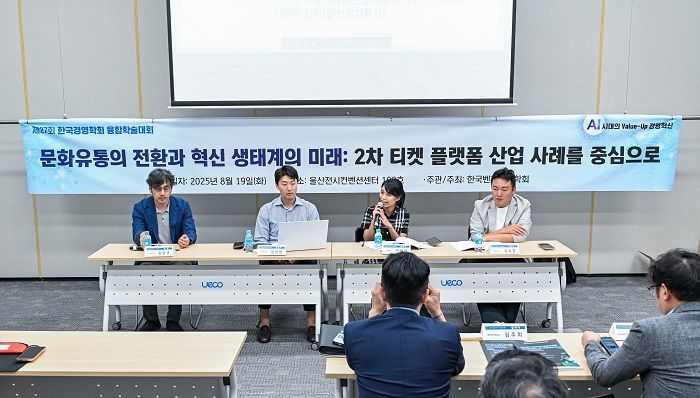
Continuing with a presentation titled "Factors Hindering the Growth of the Secondary Ticket Market," Professor Woojin Lee identified the "paradox of regulation" as the core factor impeding the growth of the domestic secondary ticket market, diagnosing the limitations of the current institutional approach that fails to reflect market realities.
Professor Lee stated, "Although secondary ticket trading platforms provide positive functions by solving the problems of direct transactions between individuals through safety measures such as escrow, they are socially undervalued due to the negative frame of 'scalping.' Furthermore, ambiguous regulations stemming from a lack of understanding of the platform economy have paradoxically led to the spread of illegal transactions." He emphasized, "For the sustainable growth of the secondary ticket market, it is urgent to build a social consensus on the positive effects of secondary ticket platforms, such as creating consumer benefits and fostering a sound market; to establish clear and consistent legal standards that reflect the characteristics of the platform economy; and to reduce the gap between policy and market reality through regular consultative bodies between regulators and businesses."
During the comprehensive discussion that followed the presentations, Professor Youngkyu Kim of Korea University served as moderator, with Professor Hyejin Ahn of Konkuk University, Yookyung Kim, Head of Communications at Nol Universe, and Hyunmyung Kim, Team Leader at Ilshin Venture Investment, participating as panelists.
The discussants deeply agreed that regulations disconnected from reality could actually shrink the secondary ticket market, and they reached a consensus on the need for a new approach that considers the differing consumer demands of the primary and secondary markets. In particular, there was a strong opinion that an ecosystem should be created where various innovative platforms can compete fairly and grow, leading to an in-depth discussion. Through this, it was suggested that while securing consumer trust through the system should be the top priority, the activation of the secondary ticket market through "collaborative governance" involving diverse stakeholders would also increase the growth potential of artists.
Hyunmyung Kim, Team Leader, commented, "The secondary ticket market has the potential to go beyond simple resale and expand the pie of the performance industry, providing new value to all participants." He added, "In particular, by utilizing unsold tickets and creating new demand, additional value can be generated." However, he also noted, "Just as the musical market has grown based on the symbiotic relationship between primary platforms and producers, the secondary ticket market should also consider its impact on the performance production ecosystem before seeking ways to activate it."
Yookyung Kim, Head of Communications, stated, "While tickets are certificates of rights for attending performances and many terms prohibit resale, it is also necessary to protect individual rights when attendance is difficult." She emphasized, "Since premium prices do not return to creators or organizers, which can hinder industry growth, cooperation among stakeholders is essential."
Finally, Professor Hyejin Ahn stressed, "The secondary ticket trading market can provide new opportunities for marginalized creators, and the direction of the cultural distribution ecosystem should focus on the growth of cultural value rather than regulation."
Woojin Lee, President of the Korean Venture Startup Association, remarked, "This academic conference served as an opportunity to diagnose the growing pains of the domestic cultural distribution industry in the face of the global expansion of K-culture, and to present directions for moving toward an innovation ecosystem through the case of secondary ticket platforms." He emphasized, "Now is the time to revitalize the secondary ticket industry and support the sustainable growth of K-culture by gaining market trust through technological innovation and seeking institutional rationality through collaborative governance."
© The Asia Business Daily(www.asiae.co.kr). All rights reserved.
![Clutching a Stolen Dior Bag, Saying "I Hate Being Poor but Real"... The Grotesque Con of a "Human Knockoff" [Slate]](https://cwcontent.asiae.co.kr/asiaresize/183/2026021902243444107_1771435474.jpg)
















