Agreement Reached on Resuming Border Trade and Direct Flights
Lower Barriers for Visa Issuance Between the Two Countries
Reconciliation Appears Aimed at Countering U.S. Tariff War
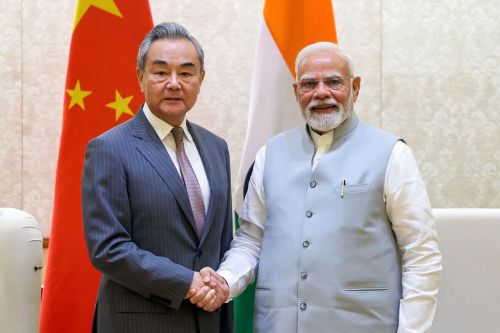 Indian Prime Minister Narendra Modi (right) shakes hands with Wang Yi, Chinese State Councilor and Foreign Minister, during a bilateral meeting held in New Delhi, India, on the 19th (local time). Photo by AFP, Indian Government, Yonhap News Agency
China and India have agreed to improve relations five years after their military conflict in the disputed Himalayan region in 2020. The prevailing analysis is that both countries have joined forces on a diplomatic level to counter U.S. President Donald Trump's tariff policies.
On the 19th (local time), the Indian Ministry of External Affairs announced that China and India have agreed to resume border trade through three designated trading posts, according to reports from foreign media such as AP and Reuters. The two countries also agreed on specific measures to promote trade and investment.
The two nations will also resume direct passenger flights between them, which had been suspended for five years. They will lower the barriers for visa issuance for tourists, businesspeople, journalists, and other visitors from both countries. Additionally, they agreed to mutually support the hosting of the BRICS meetings scheduled in India in 2026 and China in 2027.
The Indian Ministry of External Affairs stated that China has agreed to share hydrological information in emergency situations on humanitarian grounds. As China is upstream and India is downstream, India can suffer flood damage without warning if China builds dams or releases water upstream.
The resumption of border trade between China and India comes five years after trade was suspended following a military clash between the two countries' armed forces near the Himalayas in 2020. Tensions between the two nations temporarily escalated again in May when it was reported that China had supplied fighter jets and other equipment to Pakistan, which is in an armed conflict with India.
The thaw in relations began at the end of last year. In October of last year, Indian Prime Minister Narendra Modi and Chinese President Xi Jinping held their first bilateral meeting in five years during the BRICS summit in Kazan, Russia, laying the groundwork for these changes. At that time, the two countries also agreed to patrol their 3,500 km-long border.
The Financial Times (FT) of the UK assessed that the second Trump administration has influenced relations between the two countries. Praveen Donthi, senior analyst for India at the Crisis Group, said, "This is an important stage of strategic re-engagement," adding, "Trump's tariff war may have provided the clarity India needed." Amit Ranjan, a researcher at the South Asian Studies Institute at the National University of Singapore, also commented, "Both countries are responding to Trump's tariffs," and described it as "a tactical move rather than a major strategic shift."
However, the Economic Times of India pointed out that territorial disputes such as Aksai Chin, located in the Kashmir region under China's effective control, remain issues that require dialogue between the two countries. The newspaper also noted that longstanding mutual distrust, India's high dependence on Chinese manufacturing, and differences in geopolitical stances remain as challenges.
© The Asia Business Daily(www.asiae.co.kr). All rights reserved.

















