Financial Supervisory Service Reveals Major Types of Auto Insurance Fraud
False Claims for Repair Costs and Personal Belongings on the Rise
Duplicate Repair Cost Claims Drive Annual Increase in Fraudulent Payouts
FSS Steps Up Insurance Fraud Prevention and Public Awareness Efforts
Mr. A scratched the rear of his vehicle against a wall while parking at a large supermarket. He then filed a repair claim with Insurance Company B using his own vehicle damage coverage under his auto insurance policy. During this process, Mr. A falsely reported an area that had previously been damaged in a collision with another car-an incident for which he had already received property damage compensation from Insurance Company C but had not repaired-as if it were new damage, and received insurance money. Mr. A was later caught during an insurance fraud investigation by Insurance Company B and was reported to the police.
On August 20, the Financial Supervisory Service disclosed major types of insurance fraud, including false claims for car repair costs and personal belongings. Last year, the amount of fraudulent auto insurance claims, such as duplicate repair cost claims, reached approximately 208.7 billion won. This figure has been increasing annually, from 156 billion won in 2022 to 196.1 billion won in 2023.
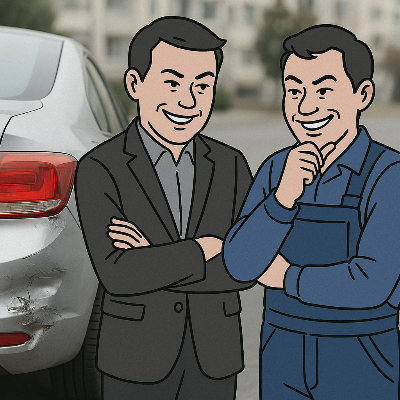
While driving through an intersection, Mr. D was rear-ended by another vehicle and took his car to auto repair shop E for repairs. The owner of E suggested that Mr. D take this opportunity to get a new glass coating and offered to issue a fake warranty certificate to claim the repair cost. Mr. D agreed and submitted the false warranty certificate provided by E to Insurance Company F as part of his insurance claim. During its investigation, the Financial Supervisory Service discovered that the warranty certificate was fake and reported both Mr. D and the owner of E to the police for insurance fraud and forgery of private documents.
Mr. G, a motorcycle delivery worker, was involved in a collision with a vehicle in an alley during a delivery and claimed property damage auto insurance. Mr. G was aware that, according to the policy, personal belongings damaged in a traffic accident were also covered by auto insurance, and he had previously received compensation for such a claim. Despite not having a damaged phone in this incident, he submitted photos of a previously compensated phone taken from a different angle to receive duplicate property damage insurance payments. Insurance Company H detected this during an insurance fraud investigation and reported Mr. G to the police.
Mr. J, a used car dealer, purchased a used car in his own name to repair and resell it at a higher price. He filed a repair claim using the used car performance and condition inspection insurance for defects in the vehicle. In collusion with auto repairman Mr. K, he falsely recorded the pre-existing defects as being in good condition on documents and made it appear as if the defects had occurred after he purchased the car. After receiving the insurance payout, Mr. J repaired the defective used car and resold it at a higher price than the purchase cost. The Financial Supervisory Service discovered these actions and reported both Mr. J and Mr. K to the police.
Auto insurance fraud is punishable under the Special Act on the Prevention of Insurance Fraud by up to 10 years in prison or a fine of up to 50 million won. In cases where forgery of private documents, such as creating false warranty certificates, is recognized, offenders can also be charged under the Criminal Act with forgery of private documents, which carries a penalty of up to 5 years in prison or a fine of up to 10 million won. False inspections and falsification of records by auto inspectors are considered false inspection acts under the Automobile Management Act and are punishable by up to 2 years in prison or a fine of up to 20 million won.
A representative from the Financial Supervisory Service stated, "We will continue to identify cases of consumer damage and precautions for types of insurance fraud that are highly likely to involve policyholders," adding, "We will actively respond to new types of auto insurance fraud through close cooperation with the Korea Automobile Damage Insurance Association and the National Rent-a-Car Mutual Aid Association."
© The Asia Business Daily(www.asiae.co.kr). All rights reserved.

















