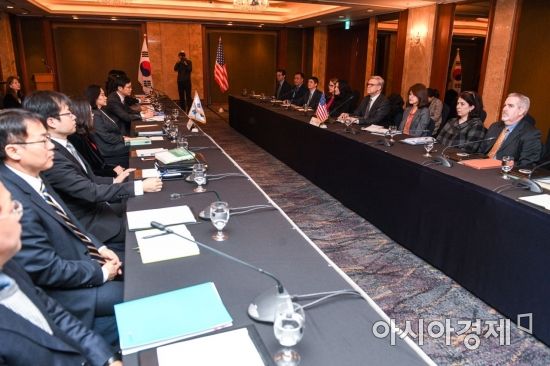
 Yoo Myunghee (fifth from the left), Director General for Trade Policy at the Ministry of Trade, Industry and Energy, and Michael Berman (fourth from the right), Deputy United States Trade Representative, are attending the "2nd Korea-US FTA Amendment Negotiations" held at Lotte Hotel in Jung-gu, Seoul, on the 31st, waiting for the meeting to begin. Photo by Kang Jinhyung aymsdream@
The Korea-US Free Trade Agreement (FTA) remains legally valid, but its practical function has been significantly weakened. This is because the United States introduced a reciprocal tariff system, imposing a flat 15% tariff on Korean exports, effectively eliminating the core benefit of tariff-free treatment. Nevertheless, as the agreement is maintained in form, there are growing concerns about a cost structure with little real benefit, since various expenditures such as agricultural subsidies, administrative operating expenses, and international law firm advisory fees may continue.
According to the government and industry sources on August 20, the prevailing view is that the current Korea-US FTA is not an agreement that can be easily terminated in terms of treaty form. To withdraw from the agreement, either party must give written notice and wait 180 days. The Korea-US FTA carries symbolic significance as an economic pillar of the alliance, going beyond a simple trade agreement. For this reason, experts commonly agree that it is virtually impossible for the Korean government to unilaterally declare termination.
Although the agreement is maintained due to diplomatic burdens, there are concerns that, as its practical benefits have diminished, only unnecessary domestic costs remain. The most prominent example is in the agricultural sector. Since the FTA took effect, the government has provided "damage compensation direct payments" to offset price drops. This system compensates 95% of the price decline below a reference price, supporting up to 35 million won per farm and 50 million won per corporation annually.
In 2015 alone, there were nine items eligible for compensation, including soybeans, potatoes, sweet potatoes, cherries, and grapes. About 76,000 farms received a total of 47.1 billion won in compensation payments, and with business closure support added, total expenditures reached 162.1 billion won. Since then, the number of eligible items and the scale of payments have been greatly reduced. In 2023, only ginger was selected as a supported item, and in 2025, only mung beans are scheduled to receive FTA compensation payments. While the practical benefits have decreased, subsidy expenditures continue.
As long as the agreement remains in force, administrative operating expenses do not decrease. The Korea-US FTA Joint Committee, as well as subcommittees on automobiles, telecommunications, and intellectual property rights, are held annually, requiring ongoing administrative costs for meeting preparation, statistics compilation, and report submission.
International advisory costs are also incurred. To prepare for potential WTO (World Trade Organization) or ISDS (Investor-State Dispute Settlement) cases, consultations with overseas law firms are essential. Advisory fees from major international law firms are said to reach several hundred thousand to several million dollars per case. Although the actual amounts have not been disclosed, it was reported that during the surge in trade disputes in 2019, the government left 3.7 billion won in overseas law firm fees unpaid.
Companies also complain about the cost burden. When tariff-free benefits were available, exporters could tolerate the requirements for certificates of origin and customs verification. Now, however, they must still follow the same administrative procedures while paying a 15% tariff. A representative from a domestic exporting company said, "When the FTA was active, we benefited from tariff-free exports, so preparing origin documents was natural. But now, the benefits are gone and only the procedures remain," adding, "An agreement with no real benefit has become a cost instead."
In a situation where the practical benefits of the FTA have diminished, the ongoing use of tax and corporate resources is highly controversial domestically. Even acknowledging the FTA's diplomatic symbolism, there is a growing argument that the costs of maintaining the agreement should be minimized. However, some believe that the value of the agreement should still be assessed, since costs are involved. While it is true that tariff benefits have decreased, the FTA's effects have not disappeared for all items.
Minister of Trade, Industry and Energy Kim Jungkwan recently responded in a radio interview to claims that "the Korea-US FTA is over," by stating, "I do not believe that the FTA's effects have disappeared due to this tariff measure." He explained, "When exporting to the United States, Japanese instant noodles are subject to the existing 6.4% tariff plus the newly added 15%, totaling 21.4%. However, thanks to the FTA, Korea's rate was originally 0%, so only the new 15% applies, meaning we still enjoy a 6.4% lower tariff than Japan."
He continued, "For products like automobiles, where item-specific tariffs apply, the new tariff has effectively eliminated the FTA's effect. However, for instant noodles, polypropylene, and plastics, the FTA's benefits remain. Korea exports several hundred million dollars' worth of instant noodles annually, so in these sectors, the agreement still has positive effects."
© The Asia Business Daily(www.asiae.co.kr). All rights reserved.
![Clutching a Stolen Dior Bag, Saying "I Hate Being Poor but Real"... The Grotesque Con of a "Human Knockoff" [Slate]](https://cwcontent.asiae.co.kr/asiaresize/183/2026021902243444107_1771435474.jpg)














