Reaffirming Commitment to Amending the Commercial Act Despite Business Community Concerns
Yellow Envelope Act Merely Reflects Existing Precedents
Han Jungae, Policy Committee Chair of the Democratic Party of Korea, commented on August 19 regarding the so-called "Stronger Commercial Act," which has raised concerns among the business community. She stated, "We will pass it this time and discuss additional aspects further," adding, "We can also proceed with the third amendment to the Commercial Act." Regarding the Yellow Envelope Act (the amendment to the Labor Relations Act), she emphasized, "There is no need to be anxious."
In an interview with SBS Radio on this day, Chair Han reaffirmed her commitment to amending the Commercial Act in response to business community concerns about the "Stronger Commercial Act," which includes mandatory cumulative voting and separate election of audit committee members, following the July amendment that expanded the duty of loyalty for directors from "the company" to "the company and shareholders." However, she also said, "We will discuss various aspects (related to the concerns of the business community and others)," and added, "It would be good to actively participate in further discussions together."
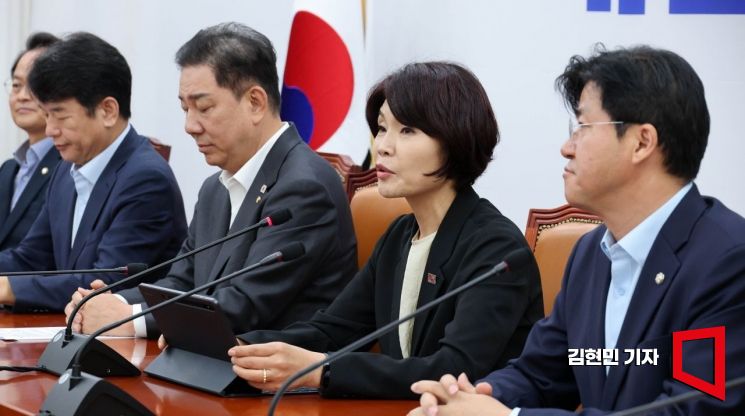 Hanjungae, the Policy Committee Chair of the Democratic Party of Korea, is speaking at the party floor strategy meeting held at the National Assembly on the 5th. 2025.8.5 Photo by Kim Hyunmin
Regarding concerns about the potential loss of management rights, she said, "The rights of minority shareholders have been strengthened. We will never side with minority shareholders who, with the backing of foreign capital, attempt a hostile takeover through M&A." She continued, "While we are strengthening the rights of minority shareholders, I want to encourage them to exercise their voting rights responsibly."
She also suggested actively utilizing employee stock ownership associations as a means of defending management rights. Chair Han mentioned, "For example, major shareholders can help employees secure a significant stake through the employee stock ownership association." She also raised the possibility of improving the application of breach of trust in relation to the business judgment rule. She said, "The scope of breach of trust is currently too broad in relation to several aspects of the business judgment rule, so I believe it needs to be clarified somewhat," and added, "We can discuss how to hold people accountable when, even after transparent corporate governance and decisions made through board discussions based on substantial business judgment, issues arise."
She reiterated that the business community does not need to be anxious about the Yellow Envelope Act. Citing the aftermath of amendments to the Industrial Safety and Health Act and other laws that had previously concerned the business sector, she explained, "The Yellow Envelope Act simply compiles existing precedents into guidelines to make them operational, so there is no need to be overly concerned."
Regarding concerns that negotiations between primary contractors and subcontractors could become endless, she said, "Since the implementation of the Multiple Unions Act, a procedure for unifying bargaining channels has been established," and explained, "Just as this method works for multiple unions, it can similarly be applied to negotiations between primary and subcontractors if both parties agree."
Regarding concerns about management conditions being included as subjects of industrial disputes, she said, "These concerns are somewhat exaggerated." She explained, "In the past, layoffs were considered management decisions and thus not subject to industrial action, but the Supreme Court has ruled that they can be the subject of industrial action, and this is what has been reflected."
© The Asia Business Daily(www.asiae.co.kr). All rights reserved.
![Clutching a Stolen Dior Bag, Saying "I Hate Being Poor but Real"... The Grotesque Con of a "Human Knockoff" [Slate]](https://cwcontent.asiae.co.kr/asiaresize/183/2026021902243444107_1771435474.jpg)















