Governance Forum Calls for Swift Reform Roadmap
Foreign Investors Cite Deep Distrust and Demand Tangible Change
LG Group Faces Criticism Over Dual Listings and Undervaluation
Proposal Raised for Samsung Electronics to Split Business Units
The Korea Corporate Governance Forum emphasized that breaking down the international community's "wall of suspicion" toward the Korean capital market will require significant joint efforts from both the public and private sectors, and urged the newly appointed leadership of the financial authorities to swiftly prepare governance reform measures.
Namwoo Lee, Chairman of the Korea Corporate Governance Forum, stated at a press briefing held on the 19th at Yeouido 2IFC, "Earlier this month, I met with over 50 Asia-based offices of sovereign wealth funds, hedge funds, and major Anglo-American funds in Hong Kong and Singapore to explain our government's efforts to advance the capital market, but the 'wall of distrust' was beyond imagination." He pointed out that, unlike Japan, which has worked for over a decade to advance its capital market, Korea has repeatedly disappointed foreign investors through actions such as reversing commercial law amendments and banning short selling, resulting in a buildup of distrust over the past 20 years.
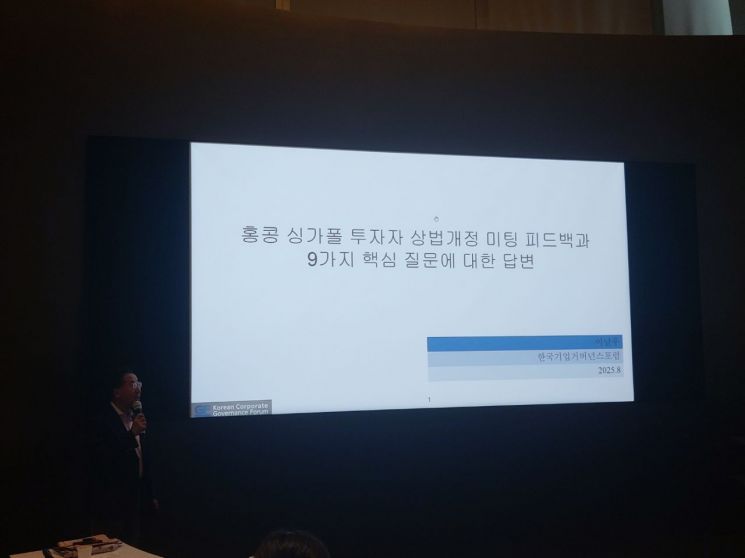 The scene of the Korea Corporate Governance Forum press briefing held on the 19th at Yeouido 2IFC. Photo by Jinyoung Kim
Chairman Lee said, "Although a lot of legislative materials are produced in the National Assembly, there are almost no English documents, so it is common for incorrect information to be conveyed to global investment banks that have almost no Korean experts." He stressed, "The Financial Services Commission and the Financial Supervisory Service, which now have appointed leaders, must move quickly to accurately inform the international financial community of the governance reform roadmap."
According to Chairman Lee, foreign institutional investors he met considered the "first commercial law amendment," which focuses on expanding directors' fiduciary duties, to be merely declarative legislation. They indicated that they would only increase investment in Korea if they could see concrete improvements in shareholder value. Lee stated, "The principle of mandatory treasury stock cancellation is directly linked to improving shareholder value and is the strongest among the supplementary commercial law amendments under discussion," and called on the government and the ruling party to actively pursue this measure.
Suggestions for improving governance at major domestic conglomerates also followed. Chairman Lee noted, "All foreign investors agreed with the claim that LG Group is the least interested in governance improvement among the four largest groups," citing as background the failed listing and renewed IPO attempt of LG Electronics' Indian subsidiary. Foreign investors especially called for solutions to the abnormal situation where the market capitalization of parent company LG Chem is only 20 trillion won, while its subsidiary LG Energy Solution has a market capitalization of 90 trillion won.
There was also an opinion that Samsung Electronics should consider a spin-off into three divisions-semiconductors, foundry (semiconductor contract manufacturing), and home appliances-and especially consider listing the foundry business overseas, such as on the US Nasdaq. The argument is that bundling business units of different natures under one entity undermines corporate value.
In the case of Hyundai Motor and Kia, Chairman Lee reported that while efforts to improve governance are evident in areas such as board composition, there was disappointment regarding the stock price of Hyundai Motor, the group's flagship. With a price-earnings ratio (PER) of 5 and a price-to-book ratio (PBR) of 0.5, Hyundai Motor's corporate value ranks at the bottom among major global automakers, leading to calls for improvements in its lax balance sheet.
© The Asia Business Daily(www.asiae.co.kr). All rights reserved.

















