Korean Air Teams Up, Sparking Rivalry Among Defense Firms
Success Could Neutralize North Korea's Web-Like Air Defense Network
LIG Nex1 is working in partnership with Korean Air to participate as the prime contractor in the research and development project for a Korean-style electronic warfare aircraft. An electronic warfare aircraft is a strategic weapon that neutralizes enemy anti-aircraft radars using electronic equipment and jamming devices. Developing such an aircraft would mean possessing technology currently held only by advanced countries. Its competitor, Hanwha Systems, is expected to partner with Korea Aerospace Industries (KAI), setting the stage for a rivalry among domestic defense companies.
The Defense Acquisition Program Administration has been conducting a bidding process since last month for a project that involves modifying a foreign-made medium-sized commercial aircraft to equip it with electronic warfare mission equipment. The government plans to invest 1.7775 trillion won in this initiative.
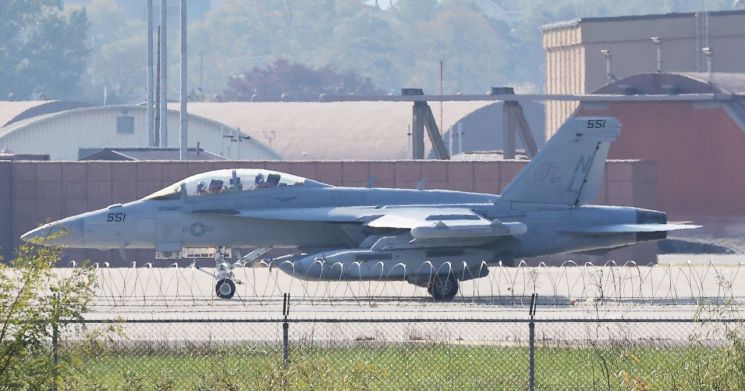
Fighter jets face threats from air defense networks when penetrating enemy territory. These networks track fighters with anti-aircraft radars, but electronic warfare aircraft can infiltrate enemy territory ahead of fighters to neutralize these radars. In 2013, during the third phase of the next-generation fighter (FX) program, the South Korean military considered Boeing's F-15 Silent Eagle. Boeing proposed supplying the U.S. Navy's EF-18 (Growler) electronic warfare aircraft. However, the program ultimately selected Lockheed Martin's F-35, and the introduction of electronic warfare aircraft was abandoned.
North Korea Densely Deploys Russian Surface-to-Air Missiles
The South Korean military is eager to acquire electronic warfare aircraft due to North Korea's "web-like air defense network." The U.S. Central Intelligence Agency (CIA) also assesses North Korea's air defense network density as among the highest in the world. North Korea is known to have established a four-layered air defense system around Pyongyang to counter the combined air power of South Korea and the United States. North Korea possesses SA-5 (Gammon, high-altitude) surface-to-air missiles with a maximum range of 260-300 km, SA-2 (Guideline, medium- and high-altitude) with a maximum range of 48 km, and SA-3 (Goa, low- and medium-altitude) with a range of 13-35 km. It is estimated that North Korea has about 40 SA-5s, 140 SA-3s, and 180 SA-2s.
In addition, North Korea also possesses portable surface-to-air missiles such as the SA-7 (maximum range 3.7 km) and SA-16 (4.5 km). North Korea imported these air defense weapons from Russia. These weapons gained fame by shooting down the U.S. high-altitude reconnaissance aircraft U-2, which scouted the Soviet mainland during the U.S.-Soviet Cold War.
Korean Air and KAI Both Modify Canadian Aircraft
For this electronic warfare aircraft project aimed at neutralizing North Korea's air defense network, Korean Air and KAI plan to modify business jets into electronic warfare aircraft. Both companies have selected Bombardier's latest model, the Global 6500 (G6500), manufactured by the Canadian aircraft maker. The U.S. Navy's escort jammer electronic warfare aircraft is based on the F-18 fighter, which has a limited flight range. In contrast, using a jet allows for a longer range, making it possible to develop a stand-off jammer type of electronic warfare aircraft.
The G6500 jet has a flight range of over 10,000 km and a maximum endurance of 11 hours. The United States is also replacing its next-generation electronic warfare aircraft with the G550 business jet. The weight of the electronic warfare equipment has been reduced from 8.1 tons to 3.6 tons, thereby increasing operational capability and endurance. Introducing the G6500 is also expected to make aircraft maintenance easier. The Air Force is currently pursuing a project to introduce airborne early warning and control aircraft, known as "command posts in the sky," and L3 Harris, which is participating in the project, has also proposed the G6500 as a candidate aircraft. Using the same model is advantageous for pilot training and parts procurement.
Electronic Warfare Aircraft Jamming Range Reaches 250 km
The military is reported to have set the required operational capability (ROC) for the electronic warfare aircraft's jamming range at 250 km. Deploying five to six electronic warfare aircraft in an attack formation would enable the rapid destruction of North Korea's four-layered air defense network around Pyongyang.
LIG Nex1 was responsible for the new Baekdu reconnaissance aircraft project. The company developed instrument information (FISINT) capabilities, which include communication intelligence (COMINT), electronic intelligence (ELINT), and a flame detection function that can determine whether a missile has actually been launched. LIG Nex1 has produced the ALQ-200, an electronic warfare system for aircraft, and has also supplied the integrated electronic warfare system for the KF-21 fighter jet. The company claims to possess electronic warfare aircraft technology ranked among the world's top five. The military plans to produce a total of four electronic warfare aircraft through this project and deliver them to the Air Force. Two will be built as Block-1 basic models, and the remaining two are expected to be developed later as Block-2 models with enhanced performance. "Block" refers to the sequence of performance upgrades.
LIG Nex1 stated, "Based on 47 years of accumulated electronic warfare technology, we will lead the research and development of the Korean-style electronic warfare aircraft."
© The Asia Business Daily(www.asiae.co.kr). All rights reserved.

















