Only Three Full Committee Meetings Held, No Subcommittee Sessions Yet
Wi Seongon: "Will Make It the Control Tower for Designing the Future"
Less than four months after its launch, both the chairperson and the ruling and opposition party secretaries of the National Assembly's Special Committee on the Climate Crisis have been replaced simultaneously. This was the result of their "promotion" to other key positions, such as the ruling party's Policy Committee Chair, the Chair of the National Assembly's Strategy and Finance Committee, and the secretary of the Special Committee on Budget and Accounts. As the threats posed by the climate crisis have become increasingly significant, calls have grown for the climate committee to take a more active role.
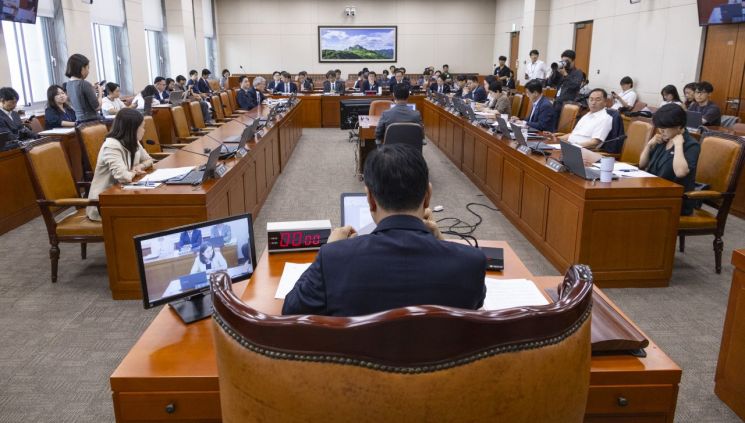
At the full committee meeting of the climate committee held at the National Assembly on the 18th, an unusual scene unfolded as both the chairperson and the secretaries from the ruling and opposition parties were replaced in succession. Han Jeoungae of the Democratic Party, who had served as the climate committee chair, became the party's Policy Committee Chair. Lee Soyoung, who had been the Democratic Party's climate committee secretary, was appointed as the secretary of the Special Committee on Budget and Accounts. Lim Ija, who had been the People Power Party's climate committee secretary, was appointed as the Chair of the Strategy and Finance Committee. The new appointments saw Wi Seongon assume the role of climate committee chair, with Park Jihye of the Democratic Party and Kim Sohee of the People Power Party becoming the ruling and opposition party secretaries, respectively.
This personnel reshuffle resulted from the National Assembly's customary avoidance of holding multiple key posts concurrently, as well as the associated workload. Former chair Han is now able to oversee the ruling party's policies, while former secretary Lee has taken on the crucial responsibility of negotiating next year's budget, not only within the party but also with the government and the opposition. Despite being a three-term senior lawmaker, Lim, who had previously served as secretary, was able to rise to the position of standing committee chair. The explanations from the lawmakers' offices regarding this reshuffle are largely similar. One official explained, "It is a heavy burden to hold two positions at once," adding, "We have decided to continue serving on the special committee."
The climate committee was a special committee that lawmakers from both parties had advocated for in a bipartisan manner even before the launch of the 22nd National Assembly. At a press conference on May 10 last year, lawmakers from both parties made the unusual move of holding a bipartisan press conference to call for the establishment of the climate committee as a standing committee. Ultimately, the climate committee was launched nearly ten months later, on March 13 of this year, as a special committee with the authority to propose legislation and offer opinions on the budget.
However, including yesterday's meeting, the climate committee has convened only three times so far. The first meeting on April 10 of this year, which lasted about an hour, was mainly for the committee's formation, meaning the committee has effectively operated only on April 14 and August 18. Furthermore, the climate committee was supposed to have two subcommittees: the Carbon Neutrality Framework Act Review Subcommittee and the Emissions Trading Act and Climate Budget Review Subcommittee. However, although these subcommittees were established, not a single meeting has been held.
This summer, as Korea experienced repeated extreme heatwaves and heavy rains, the importance of the climate committee has only increased. Lawmakers from both parties share this sense of urgency. Park Jihye, who became the ruling party secretary, expressed her regret, saying, "Even at the last climate committee meeting, I suggested that it would be good to proceed with the schedule regardless of political timetables."
Wi Seongon, the new chair of the climate committee, stated in his inaugural remarks, "To overcome the limitations of being a special rather than a standing committee, I will work to institutionalize regular meetings and promote a meaningful restructuring of the subcommittees." He added, "We will focus on the two pillars of greenhouse gas reduction and adaptation to the climate crisis, reviewing laws and budgets to find efficient ways to achieve tangible results." Wi further emphasized, "The climate crisis has now become not just a natural disaster issue, but a matter of national security involving food, energy, and the economy. I will make the climate committee the control tower for designing the nation's future."
© The Asia Business Daily(www.asiae.co.kr). All rights reserved.

















