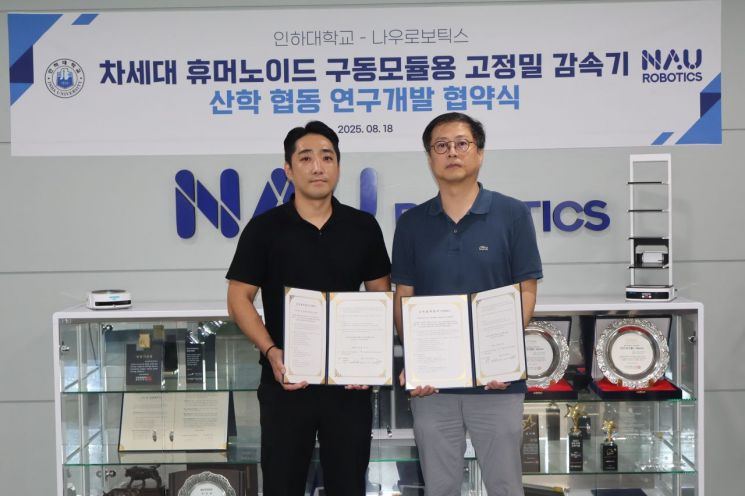
Now Robotics, a company specializing in intelligent robots, announced on August 19 that it has begun joint development of a next-generation precision reducer for high-precision drive modules for industrial humanoid robots, in collaboration with Professor Lee Chulhee of Inha University.
The core objective of this industry-academia partnership is to develop an innovative reducer that overcomes the technical limitations of existing precision reducer structures and delivers groundbreaking performance in terms of precision, durability, and weight reduction.
Furthermore, the plan is to expand the reducer into an integrated drive module that combines the drive motor and controller, ultimately creating a next-generation drive platform that can be immediately utilized not only in humanoid robots but also across various industrial sites.
Now Robotics will lead the design of the next-generation reducer, leveraging its proprietary innovative mechanism design to enable precise and stable control even in high-speed, high-torque environments. Inha University will provide theoretical support through structural analysis, precision engineering, and motion characteristic analysis, as well as prototype performance verification.
The reducer currently under development will: ▲ dramatically improve precision and torque stiffness compared to existing products; ▲ resolve vibration and micro-position fluctuation issues that occur in the low- to mid-speed range; and ▲ implement a structure that can be stably applied even in low-reduction-ratio environments. By overcoming the performance limitations of conventional reducers in all aspects, this technology is drawing attention as a potential replacement for traditional high-precision reducers.
A Now Robotics representative stated, "Existing precision reducers have shown clear limitations in terms of repeat durability and ultra-precise stop control. Through this joint development, we aim to realize a highly reliable, high-precision reducer that applies an entirely different structural principle from existing products, thereby elevating the core competitiveness of robot drive systems to a new level."
This reducer is designed not only as a component for humanoid robots, but also to replace existing global reducers in a wide range of industries requiring high-precision drives, including ▲ industrial robots ▲ collaborative robots ▲ electric vehicles (EVs) ▲ semiconductor/display equipment. Through this, Now Robotics aims to achieve technological independence and market substitution potential in the global precision drive system market.
Additionally, this drive module will be applied to the industrial humanoid robot commercialization platform that Now Robotics is co-developing with DGIST (Daegu Gyeongbuk Institute of Science and Technology) in the future.
The company plans to secure integrated drive module technology that combines the reducer, controller, and servomotor through this development, maximize the localization rate of the entire system, and further strengthen its global competitiveness.
Professor Lee Chulhee of Inha University stated, "We will organically combine the design, control, and analysis technologies possessed by both institutions to realize a design differentiated from existing reducers in terms of mechanical structure and motion characteristics. This collaboration is not just about developing a component; it is a challenge to redefine the structural standards for next-generation robot drive systems, and it will greatly enhance the potential for commercialization of high-performance core components that can be applied to actual manufacturing sites."
Meanwhile, Professor Lee Chulhee gained practical experience at Hyundai Motor Company, earned his Ph.D. in Mechanical Engineering from the University of Illinois at Urbana-Champaign (UIUC), and has been a professor in the Department of Mechanical Engineering at Inha University since 2007, successfully leading government and industry-academic projects that meet a wide range of industrial demands. In particular, leveraging his accumulated research capabilities and practical experience in mechanical design and virtual product development, he will directly conduct innovative reducer mechanism design and virtual performance verification in this joint development.
Through this joint development, Now Robotics aims to secure ▲ ultra-precision mechanism design technology ▲ lightweight, high-rigidity structural design ▲ high-efficiency/high-torque mechanisms ▲ AI-based integrated control module technology, and complete the development of core parts for next-generation industrial humanoid robots by 2026.
© The Asia Business Daily(www.asiae.co.kr). All rights reserved.
![Clutching a Stolen Dior Bag, Saying "I Hate Being Poor but Real"... The Grotesque Con of a "Human Knockoff" [Slate]](https://cwcontent.asiae.co.kr/asiaresize/183/2026021902243444107_1771435474.jpg)















