Minister of Health and Welfare Stresses Ample Investment and Compensation for Training Essential Healthcare Professionals
The government is officially moving forward with the introduction of a "regional doctor system" and the establishment of a "Public Medical School" to strengthen regional, essential, and public healthcare services, which were campaign pledges of President Lee Jaemyung.
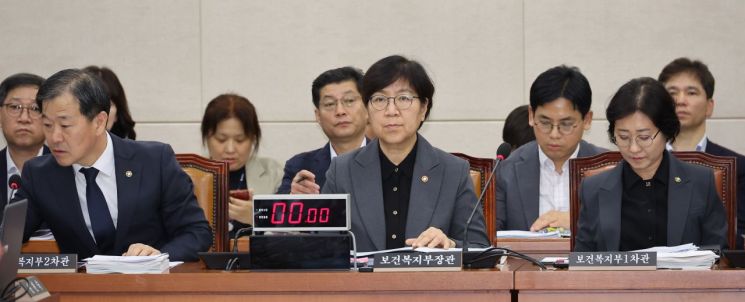 On the 18th, a full meeting of the Health and Welfare Committee was held at the National Assembly with Jeong Eunkyung, Minister of Health and Welfare, and others in attendance. Photo by Yonhap News
On the 18th, Minister of Health and Welfare Jeong Eunkyung reported on the main policy initiatives to the National Assembly's Health and Welfare Committee, stating, "We will spare no investment or compensation to foster regional, essential, and public healthcare professionals."
In a subsequent detailed briefing, Kim Hyejin, Director General for Planning and Coordination at the Ministry of Health and Welfare, explained, "We will introduce a regional doctor system and establish a Public Medical School to create a stable foundation for nurturing public healthcare personnel."
Accordingly, the Ministry of Health and Welfare is reportedly considering a plan to select and support a certain proportion of new medical students as regional doctors starting as early as the 2028 academic year, requiring them to serve in designated regions after graduation.
The ministry also plans to establish the Public Medical School as an affiliated educational institution of the National Medical Center. The aim is to set up medical schools in relatively underdeveloped provinces so that doctors trained there can ultimately provide critical care to local patients.
However, the medical community is opposed to these policies, which were key pledges of President Lee Jaemyung, and significant backlash is expected. The Korean Medical Association (KMA) argues that the regional doctor system infringes on the constitutional right to choose one's profession, and that the Public Medical School lacks effectiveness, as it would take at least 10 years before new doctors can be produced.
Meanwhile, Minister Jeong stated on the same day, "We will pursue patient-centered healthcare reform that resonates with both the public and the medical community to create a sustainable healthcare system," adding, "We will foster national university hospitals as regional hub hospitals." She also said, "We will gradually apply health insurance coverage to nursing care costs at long-term care hospitals to ease the financial burden on the public," and "We will also work to strengthen the basic livelihood security system and expand sickness benefits."
Regarding President Lee's review of improving the current "application-based welfare system," under which beneficiaries must apply to receive support, Minister Jeong explained, "We are examining ways to reduce welfare blind spots and enable automatic disbursement where possible," adding, "After reviewing the technical aspects, we will proceed with procedures such as amending relevant laws and gathering public opinion."
© The Asia Business Daily(www.asiae.co.kr). All rights reserved.

















