Second Supplementary Budget Set at 2.2133 Trillion KRW
7.9% Increase Compared to Previous Year
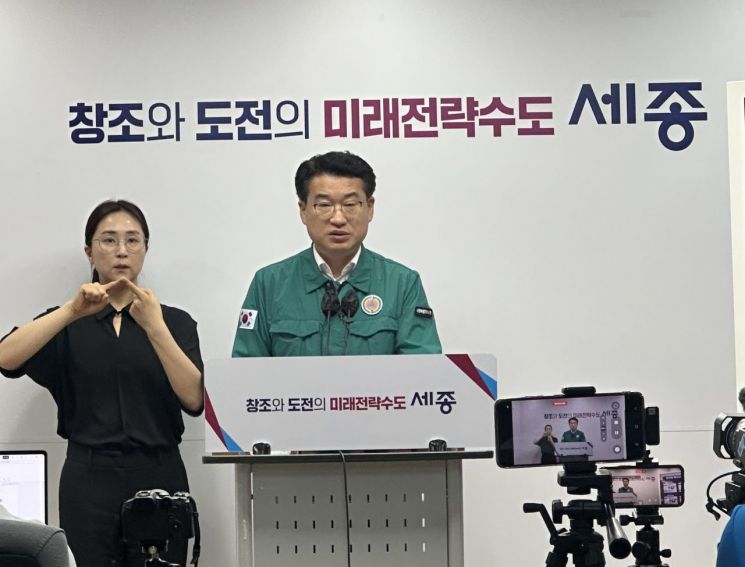 Lee Yongil, Director of Planning and Coordination Office of Sejong City, is explaining the supplementary budget proposal. Photo by Budget Officer
Sejong City has prepared its second supplementary budget proposal for 2025, totaling 105.7 billion KRW, and recently submitted it to the city council. Of this, the general account comprises 101.3 billion KRW, while the special account amounts to 4.4 billion KRW.
According to Sejong City on August 18, the supplementary budget proposal submitted to the council focuses on national government-subsidized projects, support for vulnerable groups, economic revitalization, and citizen safety, in line with the central government’s supplementary budget. If passed as proposed, the city’s total budget for this year will reach 2.2133 trillion KRW, including the previously established budget of 2.1076 trillion KRW. This represents a 7.9% (162.3 billion KRW) increase compared to last year’s final budget of 2.051 trillion KRW.
The main sources of revenue for the 105.7 billion KRW supplementary budget are 79.3 billion KRW in national government subsidies, 11.7 billion KRW in local taxes, 3.3 billion KRW in non-tax revenue, and 2.3 billion KRW in local allocation tax, among others.
On this day, Lee Yongil, Director of the Planning and Coordination Office, held a briefing and announced that the city would focus on restoring the local economy in line with the central government’s supplementary budget. To stimulate local consumption and support small businesses, the city allocated 72.6 billion KRW for livelihood recovery consumption coupons. This first round of consumption coupons consists of 65.3 billion KRW from national funds and 7.3 billion KRW from city funds. The second round of consumption coupons will also be reflected in the budget without delay.
The city expects that increased consumer spending will boost sales for local small businesses and revitalize the local commercial district. In addition, to promote a virtuous cycle of local consumption, the budget for cashback on the local currency (Yeominjeon) was increased by 3.1 billion KRW, from 6 billion KRW to 9.1 billion KRW.
Furthermore, 1.3 billion KRW was allocated for the establishment of the Chungcheong Region Information Security Cluster, aimed at fostering the information security industry and creating jobs. This project will be promoted over five years through cooperation among the four cities and provinces of the Chungcheong region, and is expected to serve as a foundation for Sejong City to become a key hub for the information security industry.
In particular, support for citizen welfare and overcoming low birth rates will be strengthened. In line with changes to government subsidies, the city allocated 7.2 billion KRW to support infant and toddler care fees, aiming to reduce the childcare burden on parents and create a stable childcare environment. In addition, the basic livelihood benefit for low-income households was increased by 2.1 billion KRW to ensure their minimum standard of living.
Following the central government’s supplementary budget, the special temporary support project for youth rent, designed to reduce housing costs for low-income young people, was increased from 800 million KRW to 1.5 billion KRW, thereby expanding support.
Moreover, to address the low birth rate, the city increased funding for infertility treatment support for couples by 300 million KRW, aiming to boost the birth rate. The city also increased the budget for pre-pregnancy health management support by 100 million KRW, and for dispatching professional personnel to families with newborns by 200 million KRW.
The city also reinforced budgets for disaster prevention, which may be required at any time. To urgently enhance citizen traffic safety, the city increased the budget for maintenance of aging roads and traffic signal facilities by 900 million KRW. Additionally, 360 million KRW was allocated for the installation of automatic barrier systems at the Horayeoul and Mir underpasses to prevent sudden flooding caused by heavy rainfall. This is seen as a supplementary policy following fatal accidents caused by torrential rains last month.
To ensure smooth operation of town and township offices, 200 million KRW was added to the public operating expenses budget. Essential expenses such as 300 million KRW for social service personnel salaries and 200 million KRW for civil servant honorary retirement allowances were also included in the supplementary budget proposal.
Lee Yongil, Director of the Planning and Coordination Office, stated, "The supplementary budget proposal will undergo preliminary review by each standing committee, review by the Special Committee on Budget and Accounts, and a final review before being confirmed at the plenary session on September 8." He added, "Although the city’s fiscal conditions are challenging, we have included projects that are essential for citizens." He continued, "We will continue to pay close attention to citizens’ livelihoods and safety, and strive to make Sejong City a happier place for all residents."
© The Asia Business Daily(www.asiae.co.kr). All rights reserved.

















