Safe Zones Under 860 Million Won,
Redevelopment and Transportation Boosts
PK Region Sees Recovery Amid
Regulatory Gaps and Tourism/Industry Boosts
"Positive Signal" vs. "Possibility of Optical Illusion"
Fifty-two days after the implementation of the June 27 loan regulations, an upward trend in housing prices has been detected, particularly on the outskirts of the Seoul metropolitan area and in the Busan and South Gyeongsang (PK) regions. Analysts say the so-called "balloon effect" is now in full swing, as housing prices are rising in metropolitan areas where the impact of the new 600 million won mortgage loan limit is minimal, as well as in certain non-metropolitan regions that remain unregulated.
According to an analysis by the Korea Real Estate Board on August 19 of this year's regional apartment price trends, 23 regions nationwide shifted from a cumulative decline over the 24 weeks prior to the regulation to an upward trend afterward. These include 10 areas in Gyeonggi Province, 3 in Busan, 4 in South Gyeongsang, and 1 each in Seoul, South Chungcheong, North Chungcheong, North Jeolla, North Gyeongsang, and Gangwon. The majority of these are in the metropolitan area (11 regions) and the PK region (7 regions). A reversal in sentiment has been observed in the metropolitan area, where apartments priced at or below 860 million won-thus largely unaffected by the 600 million won loan regulation based on a 70% loan-to-value (LTV) ratio-are concentrated, as well as in non-metropolitan areas exempt from the new rules.
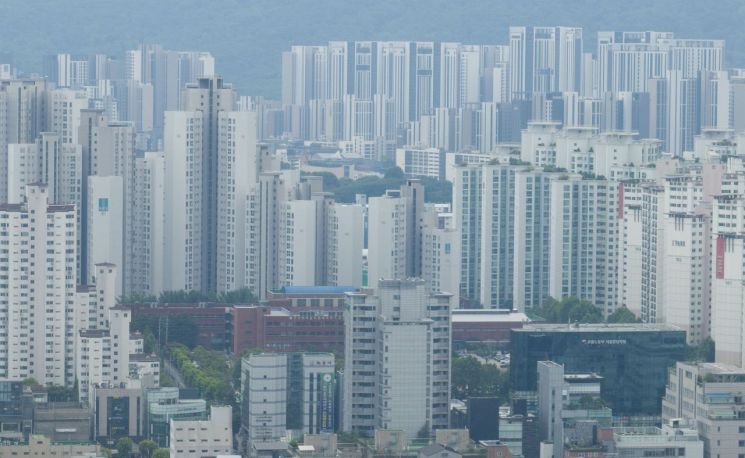
Regulation-Free Zones Under 860 Million Won, Boosted by Redevelopment and Transportation Projects
The most dramatic turnaround occurred in Gwangmyeong, Gyeonggi Province. The annual cumulative growth rate in Gwangmyeong rose from -2.17% before the regulation to 0.86% after. Gwangmyeong is a hub for major redevelopment, with 25,000 new town units and key metropolitan transportation lines such as KTX, the Wolpan Line, and the Shinansan Line.
Jungwon-gu in Seongnam also rebounded from -0.27% to 0.59%. The area benefits from redevelopment in Moran and Seongnam-dong, as well as strong demand from neighboring Pangyo and Bundang. Ojeong-gu in Bucheon shifted from -0.23% to 0.39%, driven largely by redevelopment in Wonjong and Ojeong and improved access to the Airport Railroad, which attracted buyers.
Other areas that saw a reversal from decline to growth include Deogyang-gu in Goyang (-1.00%→0.17%), Gunpo (-0.46%→0.25%), Namyangju (-0.31%→0.20%), and Gwangju (-0.26%→0.25%). These regions are benefiting from positive developments such as the Changneung New Town and the GTX-A line in Goyang, the first-generation pilot district in Gunpo, and expanded transportation infrastructure for the third-generation new towns in Namyangju.
In Seoul, Dobong-gu was the only district to make the list, reversing from -0.05% to 0.24%. Analysts attribute this to the influx of demand seeking to avoid regulations, as Dobong is an area with a high concentration of relatively affordable mid- to low-priced apartments.
PK Region: Tourism and Industrial Developments Combine Amid Regulatory Loopholes
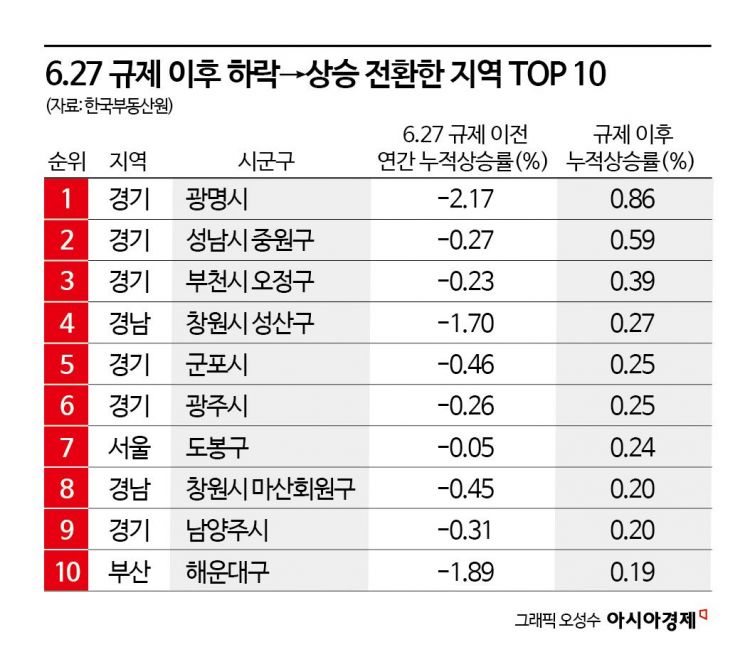
In non-metropolitan areas untouched by the new regulations, the recovery has been most pronounced in Busan and South Gyeongsang. Haeundae-gu, the real estate hub of Busan, rebounded from -1.89% to 0.19%. Gijang-gun (-1.19%→0.11%) and Nam-gu (-0.86%→0.09%), both alternative residential areas near Haeundae that have become attractive due to undervaluation, also saw a turnaround, supported by demand from the Munhyeon Financial District and the Kyungsung University-Daeyeon-dong commercial zone.
Changwon in South Gyeongsang Province also showed a clear shift before and after the regulation. Sungsan-gu (-1.70%→0.27%), Masanhwawon-gu (-0.45%→0.20%), and Uichang-gu (-0.69%→0.04%) all switched to an upward trend. Changwon is accelerating infrastructure development, including the construction of the Jinhae New Port and the creation of supporting industrial complexes. Gongju in South Chungcheong (-0.45%→0.03%) and Gimje in North Jeolla (-0.28%→0.04%) also managed to reverse their previous declines.
"Positive Signal" vs. "Possible Illusion"

In the seven weeks since the June 27 regulation, the increase in the 23 regions has ranged from 0.1% to 0.8%, which is not a significant scale yet. However, analysts note that the shift from declining to rising prices in these areas sends an important signal to the market. They suggest that a combination of perceived price bottoms and demand seeking to avoid regulations may be interpreted as a "signal of a trend reversal."
Yang Jiyeong, a senior specialist at Shinhan Premier Pathfinder, commented, "Since the June 27 regulation, the market has become less uniform, with differentiated trends emerging by region. The outcome now depends on whether regulations apply, price ranges, and location conditions." She added, "In metropolitan areas such as Gwangmyeong, Jungwon in Seongnam, and Gunpo, as well as in parts of Busan and Changwon, the buying sentiment that existed during price stagnation is now spreading in conjunction with the new regulations."
However, some experts urge caution. Park Wongap, chief real estate analyst at KB Kookmin Bank, said, "While it is true that some regions have shifted to an upward trend, the change in prices may be an illusion, given that transaction volumes have dropped significantly. Even within neighborhoods, the situation varies greatly, so it is too early to conclude that a full-fledged trend reversal is underway."
© The Asia Business Daily(www.asiae.co.kr). All rights reserved.



















