President Lee Reviews and Approves Key Cabinet Agenda
Mandatory CEO Recommendation Process for Public Broadcasters and News Channels under Broadcasting Act
Contingency Budget Approved for Ministry of Oceans and Fisheries Relocation to Busan
On August 18, President Lee Jaemyung approved the promulgation of amendments to the Broadcasting Act, the Grain Management Act, and the Act on Distribution and Price Stabilization of Agricultural and Fishery Products during a Cabinet meeting. These bills had previously been subject to a request for reconsideration (veto) by former President Yoon Sukyeol.
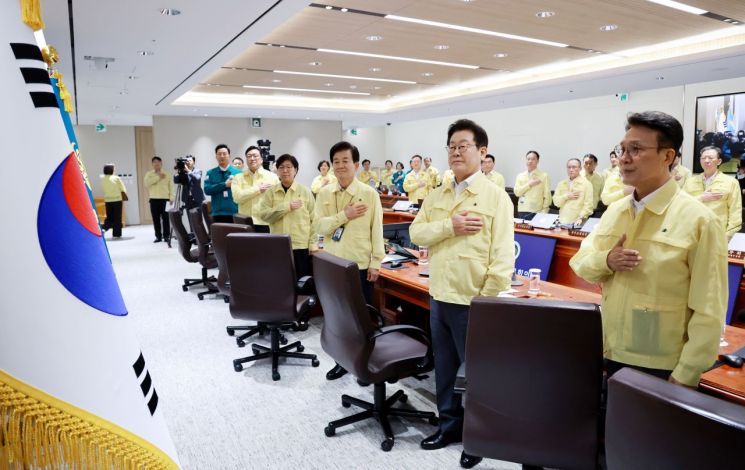
During the morning Cabinet meeting held at the presidential office in Yongsan, President Lee reviewed and approved a total of 15 legislative promulgation bills, including the aforementioned amendments. The amendment to the Broadcasting Act, a key component of the Democratic Party’s push for media reform, centers on restructuring the governance of public broadcasters. Under the amendment, a Presidential Candidate Recommendation Committee, composed of at least 100 citizens, must be formed to nominate candidates for the heads of public broadcasters. For news channels, a President Recommendation Committee must be established and operated through agreement with the representative labor union.
As a result, the KBS Board of Directors will be reorganized with 15 members recommended by parliamentary negotiation groups, the viewers’ committee, employees, academic societies, and lawyers. Additionally, terrestrial broadcasters, general programming channels, and news channels must establish programming committees composed of an equal number of representatives nominated by management and employees. Most provisions, except for certain rules related to the establishment and operation of viewers’ committees and license renewals, will take effect immediately upon promulgation. According to supplementary provisions, KBS, its board, and news channels must reorganize their personnel in line with the amendment’s intent within three months.
Furthermore, the amendments to the Grain Management Act and the Act on Distribution and Price Stabilization of Agricultural and Fishery Products (the Agricultural and Fishery Products Act) place the responsibility for stabilizing the supply and prices of key agricultural and fishery products, including rice, on the government. Under the Grain Management Act, a Grain Supply and Demand Management Committee, with at least five members from producers’ organizations, will review supply and demand measures. If rice production or price drops exceed set thresholds, the government is required to implement measures such as purchasing surplus production.
The Agricultural and Fishery Products Act mandates that the government establish and implement annual supply and demand plans for agricultural and fishery products, following review by a Supply and Demand Adjustment Committee. It also allows for compensation to producers’ organizations for losses incurred from contract transactions. If, despite the establishment and implementation of supply and demand plans and government purchases, the average annual price of agricultural and fishery products falls below the reference price, a price stabilization system will be introduced, under which the government pays all or part of the difference to producers. Previously, the Democratic Party had pushed for these amendments during the previous administration, but former President Yoon exercised his veto, resulting in their rejection.
Other bills passed at the Cabinet meeting included an amendment to the Local Gift Certificate Act, which mandates administrative and financial support from the central and local governments for the operation of local gift certificates, and a partial revision of the Presidential Decree on the Organization of the Ministry of the Interior and Safety and its affiliated agencies, which reduces staffing in preparation for the abolition of the Police Bureau. The Cabinet also reviewed and approved various project plans related to the promotion of the artificial intelligence (AI) industry, a priority for President Lee since the beginning of his term, as well as a contingency fund allocation plan in preparation for the Ministry of Oceans and Fisheries’ relocation to Busan.
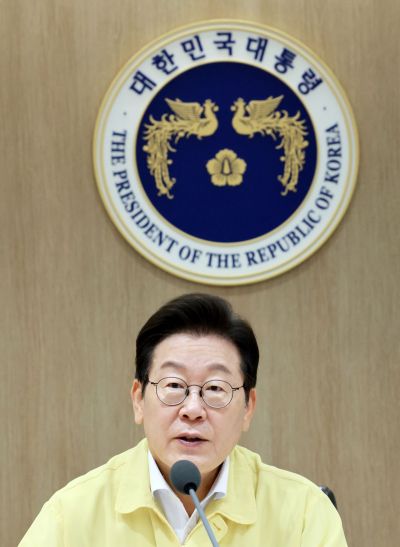
At the Cabinet meeting, a total of 27 agenda items were handled, including one legislative bill, nine presidential decrees, and 17 general agenda items. The partial amendment to the Disaster and Safety Industry Promotion Act added false or exaggerated labeling and advertising as grounds for revoking the designation of disaster safety new technologies and products, aiming to promote sound development of the disaster safety industry.
A presidential decree to abolish the Police Bureau under the Ministry of the Interior and Safety was also submitted. The Police Bureau, established under the Yoon Sukyeol administration, will be dissolved after about three years, with the aim of ensuring the independence and political neutrality of the police. The Police Bureau was composed of 13 members: one Senior Superintendent General, one Senior Superintendent, one Senior Superintendent or Grade 4 official, four Superintendents, one Inspector, four Inspectors, and one Grade 3, Grade 4, or Senior Superintendent. In addition, in response to President Lee’s directive to drastically reduce industrial accident fatalities, a presidential decree was discussed to increase the workforce dedicated to industrial safety supervision by 300 people (135 at Grade 6, 135 at Grade 7, and 30 at Grade 8).
General agenda items included the allocation of general contingency funds for the Ministry of Oceans and Fisheries’ relocation to Busan and the review and approval of a plan to establish a demonstration valley for the “Artificial Intelligence (AI) Transformation (AX)” project. The core of the plan is to exempt the project from a preliminary feasibility study to ensure timely implementation and finalize the project plan. Additional AI-related agenda items included securing integrated data specialized for physical AI to develop foundational technology for Large Action Models (LAM), promoting global demonstration projects, establishing an “AX R&D Hub” in Suseong Alpha City, Daegu, and rapidly advancing AX innovation technology development in regional specialized industries such as bio and robotics.
© The Asia Business Daily(www.asiae.co.kr). All rights reserved.


















