Announcement of Joint Statement Demands on the 18th
"Request for at Least a One-Year Implementation Delay"
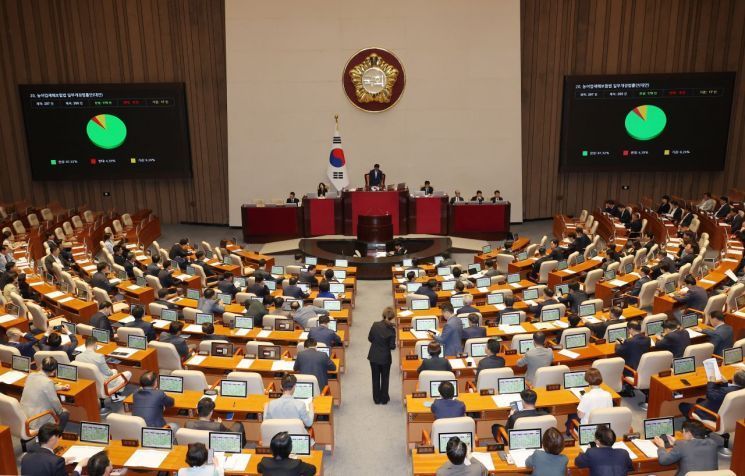
The business community has officially requested that the implementation of the "Amendment to Articles 2 and 3 of the Trade Union and Labor Relations Adjustment Act" (commonly known as the Yellow Envelope Act) be postponed for at least one year, even if it passes the National Assembly. Business leaders have expressed strong opposition to provisions that would expand corporate responsibility to subcontracted workers or include 'managerial decisions' as legitimate grounds for strikes. However, they indicated a willingness to accept, in principle, certain aspects of the legislation that would reduce liability for damages resulting from illegal strikes, in line with the legislative intent.
On August 18, six major economic organizations-including the Korea Employers Federation, Korea Chamber of Commerce and Industry, Federation of Korean Industries, Korea International Trade Association, Korea Federation of SMEs, and Korea Federation of Middle Market Enterprises-issued a joint statement at the National Assembly's press center alongside Kim Hyungdong, a lawmaker from the People Power Party. The statement, titled "Joint Statement by Six Economic Organizations Urging Amendments to the Trade Union Act," was intended to request that the minimum demands of the business community be accommodated.

The business community stated, "If the law is amended, its implementation should be postponed for at least one year," adding, "At the very least, a one-year period is needed to fully gather the opinions of labor and management and devise measures to minimize confusion in the industrial field."
They also asserted that Article 2, Paragraph 2 of the amendment-which would expand corporate responsibility to subcontracted workers-is a red line that cannot be crossed. This provision broadens the definition of 'employer' from 'the party to the labor contract' to those with 'substantial and specific control.' Business leaders argue that this standard is ambiguous and could turn primary contractors into potential offenders. The economic organizations stated, "The current definition of 'employer' should be maintained," and warned, "If labor unions from dozens or even hundreds of subcontractors demand negotiations, the primary contractor will not be able to respond to each case, plunging the industrial sector into extreme chaos."
Regarding Article 2, Paragraph 5 of the amendment, they insisted, "Even if the scope of labor disputes is expanded, 'managerial decisions' must be excluded from the scope of labor disputes," explaining, "If managerial decisions affecting working conditions are included, not only industrial restructuring but also overseas investments could become the subject of industrial action, making it difficult for Korean companies to conduct business normally in the face of fierce global competition." Under current law, only strikes over working conditions such as wages, working hours, welfare, and dismissals are legal, whereas the amendment would allow strikes in response to business decisions as well.
The business community has shown a forward-looking stance on Article 3 of the amendment, which stipulates that the proportion of damages claimed from each worker participating in a strike should be limited, thereby reducing individual liability. Since the Yellow Envelope Act emerged in response to excessive claims for damages during the 2009 SsangYong Motor mass layoff strike, business leaders say they respect the legislative intent. In the joint statement, the economic organizations emphasized, "In keeping with the intent of the Yellow Envelope Act to alleviate the burden of damages from illegal strikes on workers, we have proactively proposed to the National Assembly that the maximum amount of damages be set by presidential decree, and that wages should not be subject to seizure."
They added, "The Yellow Envelope Act represents a significant change that could bring enormous disruption to labor-management relations," and urged, "Even at this stage, we strongly request that the National Assembly seriously consider and adopt the business community's alternatives, so that workers' rights are protected while Korean companies can maintain their competitiveness."
The business community's decision to take a more flexible stance on certain provisions was largely influenced by the need to compromise with reality. With the ruling party having announced its intention to push the bill through on August 21, business leaders recognized that outright opposition would yield no results. This means that they are willing to identify and concede on points that are negotiable, rather than holding out for provisions that are entirely unacceptable.
The Korea Employers Federation and other economic groups have launched a "final all-out effort" to block the Yellow Envelope Act by August 21. As even the presidential decree could become unfavorable, they are also considering filing a constitutional appeal as a last resort. Lee Donggeun, Executive Vice Chairman of the Korea Employers Federation, stated, "We do not know what decision the Constitutional Court will make, but a constitutional appeal is the business community's final option," adding, "If the presidential decree does not reflect the business community's position, we will proceed with a constitutional appeal."
Previously, the Korea Employers Federation delivered a letter from Chairman Sohn Kyungshik outlining business leaders' concerns about the Yellow Envelope Act to all 298 members of the National Assembly. In the letter, Sohn warned, "Given that Korea's domestic industries, such as automobiles, shipbuilding, and construction, are structured around multi-layered collaboration by sector, if the bill passes, industrial action against primary contractors will become routine, leading to the collapse of the industrial ecosystem between primary and subcontractors." He added, "With employers having virtually no right to defend against strikes (such as allowing replacement workers or prohibiting workplace occupation), if even restructuring or overseas facility investment becomes subject to industrial action, it will be difficult for Korean companies to conduct business normally amid fierce global competition."
© The Asia Business Daily(www.asiae.co.kr). All rights reserved.
![Clutching a Stolen Dior Bag, Saying "I Hate Being Poor but Real"... The Grotesque Con of a "Human Knockoff" [Slate]](https://cwcontent.asiae.co.kr/asiaresize/183/2026021902243444107_1771435474.jpg)
















