Restoration Budget of 2.7235 Trillion Won
Allocated for Facility Restoration, Disaster Prevention Enhancement, and Relief Funds
The damage from the heavy rains that occurred between July 16 and 20 has been finalized at 1.0848 trillion won. This is the largest amount of damage caused by a natural disaster in the past ten years. A total of 2.7235 trillion won will be allocated for restoration.
According to the Ministry of the Interior and Safety on August 17, the Central Disaster and Safety Countermeasures Headquarters (CDSCH) determined the amount of damage and restoration costs from last month's heavy rains through a review process. The heavy rains last month resulted in 24 people dead or missing and 33 injured, totaling 57 casualties.
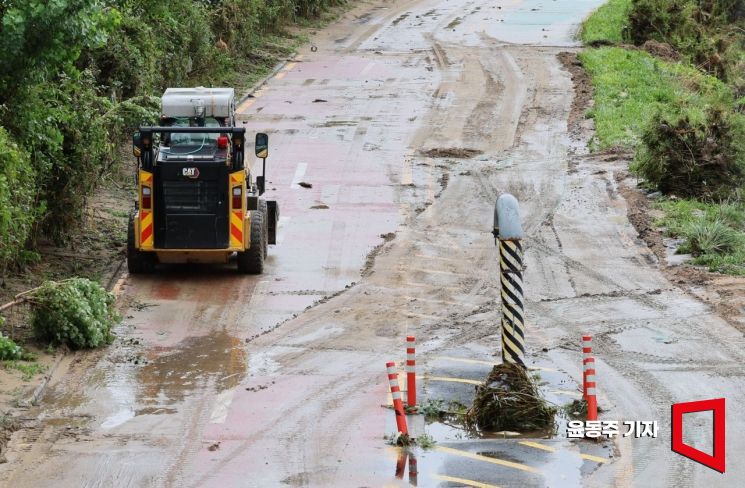 On August 14, when heavy rain poured over the northeastern and northwestern areas of Seoul, the Jungnang Stream flowing through Wolgye-dong, Nowon-gu, Seoul, overflowed, and restoration work on the walking trail is underway. 2025.08.14 Photo by Dongju Yoon
Privately owned facilities affected include 4,927 homes (227 completely destroyed, 220 partially destroyed, and 4,480 flooded), 3,055 hectares of agricultural and forest crops, 1,447 hectares of farmland, approximately 1.86 million livestock, and 5,480 small business establishments.
Public facilities affected include 1,017 rivers, 1,609 small streams, 654 landslide sites, 806 roads, 2,095 small-scale facilities, and 820 water management facilities.
The damage from last month's heavy rains ranks first among natural disaster damages over the past ten years. The second largest was the heavy rain from July 28 to August 11, 2020 (1.0371 trillion won in damage, 3.4277 trillion won in restoration costs), and the third was the heavy rain from June 27 to July 27, 2023 (751.3 billion won in damage, 1.713 trillion won in restoration costs).
Of the 2.7235 trillion won allocated for restoration from this heavy rain, 2.4538 trillion won will be used for public facility restoration. Of this, 1.352 trillion won will be spent on simple functional restoration of facilities with minor damage, and 1.1018 trillion won will be used to improve disaster prevention performance at facilities with a high risk of recurring damage. The remaining 269.7 billion won will be used as disaster relief funds for affected residents.
Tax reductions and other benefits will be provided to those affected. In general disaster areas, 24 types of benefits will be offered, including: ▲deferment of national tax payments ▲extension of local tax deadlines ▲exemption from national pension contributions ▲disaster recovery loans ▲emergency business stabilization loans ▲reduction of water and sewage fees. In special disaster areas, 13 additional benefits will be provided, such as ▲reduction of electricity and telecommunications fees ▲reduction of city gas fees.
Yoon Ho-joong, head of the CDSCH and Minister of the Interior and Safety, stated, "This restoration plan was established to fundamentally prevent disasters and to help affected residents quickly return to their daily lives, reflecting as much government support as possible," adding, "We will do our utmost to help the affected regions be reborn as safer and stronger communities."
© The Asia Business Daily(www.asiae.co.kr). All rights reserved.

















