ISO Certification for Compliance Management System
Continuous Advancement of Cleantech Strategies for Climate Response
19% Reduction in Greenhouse Gas Emissions Compared to 2018
LG disclosed its achievements in governance enhancement and sustainable strategy through its ESG (Environmental, Social, and Governance) report released last year.
This report comprehensively details the efforts of LG’s major affiliates to strengthen compliance management in the area of governance. The companies covered by the report include LG and its subsidiaries LG CNS and D&O, as well as key affiliates such as LG Electronics, LG Chem, and LG Uplus, totaling six companies.
Last year, the holding company LG reviewed compliance with its compliance control standards and assessed the effectiveness of its systems through its board of directors, further advancing company-wide compliance risk management and oversight. All LG employees completed separate compliance training sessions focused on key compliance risks, such as the use of undisclosed material information. Participation in the “Autonomous Compliance Check Program,” which reviews legal risks and management status by department, also reached 100%.
These efforts culminated this year in LG obtaining the ISO 37301 certification for compliance management systems from the International Organization for Standardization (ISO). ISO 37301 is an international standard that evaluates compliance management policies and risk management frameworks. Together with LG Electronics, LG Chem, and LG Uplus, which had already received certification, LG was recognized for its global-level compliance risk management capabilities.
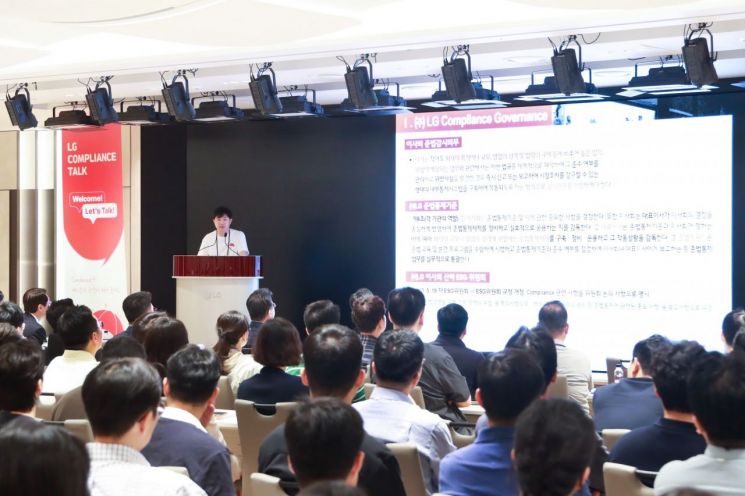
LG’s major affiliates operate a compliance governance system centered on their boards of directors and ESG committees. They are also strengthening implementation through internal compliance councils composed of relevant departments that manage key risks and compliance officers.
In the environmental sector, LG achieved meaningful results in cleantech, one of the pillars of its “ABC (AI, Bio, Cleantech)” strategy for future growth. LG’s major affiliates responded to physical climate risks such as heatwaves and floods, as well as transitional risks like rising energy costs, by developing diverse businesses that meet the government-designated “K-Taxonomy” criteria for green economic activities. Last year, excluding LG Energy Solution’s battery business, LG’s major affiliates achieved KRW 8.4541 trillion in revenue from battery materials such as cathodes, electric vehicle components, HVAC, heat pumps, smart factories, data center (IDC) construction and operation, PCR (post-consumer recycled) plastic products, and blue hydrogen production.
LG plans to continue analyzing the impact of climate-related risks on its business and to advance its cleantech strategy for climate change response. This includes transitioning to low-carbon fuels and raw materials, improving process efficiency, utilizing renewable energy, and implementing disaster response measures.
LG is also achieving long-term results in greenhouse gas reduction. With a goal of achieving carbon neutrality by 2050, LG has established and is implementing a carbon neutrality roadmap for seven affiliates-LG Electronics, LG Display, LG Innotek, LG Chem, LG Energy Solution, LG Household & Health Care, and LG Uplus-which together account for 99% of LG’s greenhouse gas emissions. Last year, these seven companies emitted a total of 17.03 million tons (CO₂eq) of greenhouse gases, a 19% reduction from the baseline year 2018, when emissions were 21.12 million tons.
LG plans to gradually reduce its greenhouse gas emissions by 34% compared to 2018 levels by 2030, and by 52% by 2040. The company has also set targets to increase its renewable energy usage ratio to 76% by 2030, 89% by 2040, and 100% by 2050.
In the social sector, specifically in safety and health, LG is continuously improving the overall safety level at its workplaces through the elimination of facility and equipment risk factors, advancement of management systems, strengthening of safety and health capabilities among partner companies, and operation of dedicated safety and health organizations and training programs.
This year, LG’s ESG report reflected, for the second consecutive year, both the Global Reporting Initiative (GRI) standards for sustainable management and the draft sustainability disclosure standards of the Korea Sustainability Standards Board (KSSB).
LG has also expanded its disclosure scope by applying KSSB standards not only to climate change but also to all areas of safety and health and compliance management. LG explained that this is an exceptional level even among major domestic conglomerates and is considered a proactive example of setting standards ahead of the mandatory ESG disclosure requirements.
Going forward, LG plans to continue publishing ESG reports in accordance with global disclosure standards and to further enhance transparency in ESG information disclosure by communicating with customers, shareholders, employees, and other internal and external stakeholders through disclosures on the group’s website and other channels.
© The Asia Business Daily(www.asiae.co.kr). All rights reserved.
![Clutching a Stolen Dior Bag, Saying "I Hate Being Poor but Real"... The Grotesque Con of a "Human Knockoff" [Slate]](https://cwcontent.asiae.co.kr/asiaresize/183/2026021902243444107_1771435474.jpg)















