OpenAI Responds to Demands to Restore Previous Version
Users Petition for Return of GPT-4o, Citing Disappointment with GPT-5
The latest model of ChatGPT, 'GPT-5,' ambitiously launched by OpenAI, has received evaluations that it does not meet users' expectations.
 The latest model of ChatGPT, 'GPT-5,' is receiving evaluations that it does not meet users' expectations. Reuters Yonhap News
On August 14 (local time), CNN in the United States reported that the latest version of ChatGPT has become the subject of ridicule. Sam Altman, CEO of OpenAI, had previously described GPT-5 as "at the level of a PhD expert," calling it "a major leap forward and a significant step toward Artificial General Intelligence (AGI)." He claimed that, compared to previous models-GPT-3 and GPT-4, which were at the level of a high school student and a college student, respectively-GPT-5 represented a significant advancement, bringing AI closer to having intelligence equal to or greater than that of humans. For this reason, when GPT-5 was first unveiled on August 7, both the AI industry and users were filled with high expectations.
However, users who actually tried GPT-5 could not hide their disappointment as it made mistakes even with basic names of people and places. For example, when asked to create a table with photos and names of the first 12 U.S. presidents, it wrote "Gearge Washingion" instead of George Washington, and "Thomason Jefferson" instead of Thomas Jefferson.
Furthermore, when instructed to draw a map of the United States and label the states, it wrote "CALFORHIA" instead of California and "1OAHO" instead of Idaho. Users actively shared and mocked these errors made by GPT-5.
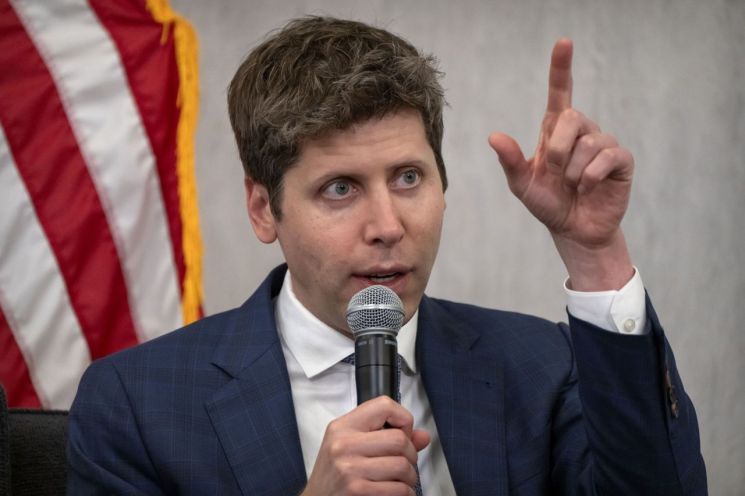
Some users responded by saying, "GPT-5 is worse than the previous model, GPT-4o," and "GPT-4o felt like a friend, but GPT-5 feels like a robot," launching an online petition to bring back the previous version. OpenAI responded by granting paid users access to GPT-4o. On August 9, CEO Altman explained on X (formerly Twitter), "The 'auto-switch' mechanism (of the model) was broken, making GPT-5 appear dumber than it actually is," and added, "Starting today, it should appear smarter."
However, CNN criticized that even after Altman's explanation, when they instructed the model to draw a map of the United States, the results were still poor. Gary Marcus, a professor emeritus at New York University known as an 'AI critic,' remarked, "I never thought OpenAI would put its brand name on such a mediocre model," and pointed out, "In a rational world, their corporate value would have taken a hit."
Immediately after the release of GPT-5, Elon Musk, CEO of Tesla, boasted that 'Grok,' the model developed by his company xAI, performed better. However, Professor Marcus retorted, "Grok isn't much better either."
© The Asia Business Daily(www.asiae.co.kr). All rights reserved.
![Clutching a Stolen Dior Bag, Saying "I Hate Being Poor but Real"... The Grotesque Con of a "Human Knockoff" [Slate]](https://cwcontent.asiae.co.kr/asiaresize/183/2026021902243444107_1771435474.jpg)

















