Preference for Experienced Hires Becomes More Pronounced
Job Postings Concentrated from February to April, Applications from April to May
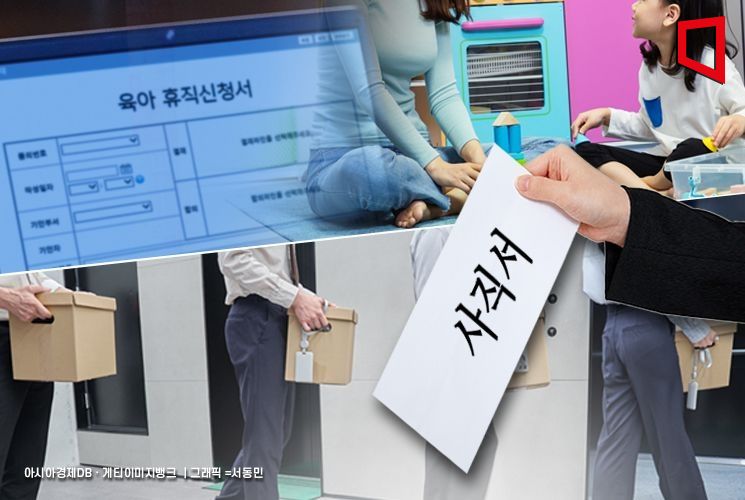
Due to the economic downturn, companies have become more conservative in their hiring practices, resulting in a significant decrease in employee resignations during the first half of this year.
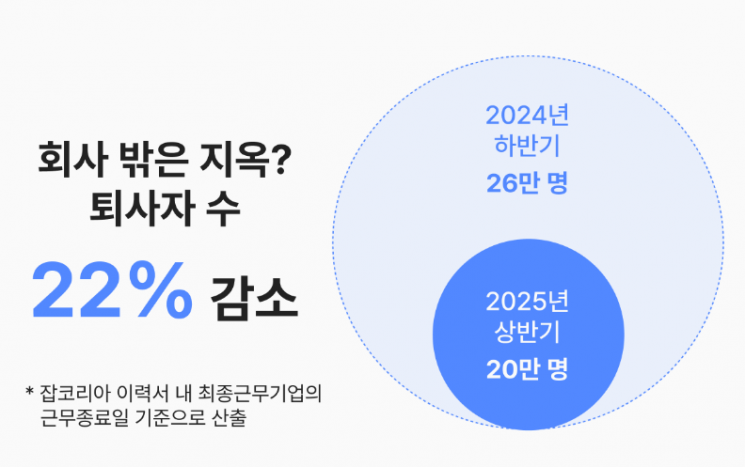
According to the "2025 First Half Employment Trend Report" recently published by JobKorea, the number of resignations in the first half of this year was 200,000, which is a 22% decrease compared to the second half of last year (260,000). JobKorea analyzed that this structural change occurred because, as uncertainty increased amid the economic recession, employees chose to remain at their current jobs rather than seek new positions, prioritizing stability.
However, the number of job postings containing the keyword "artificial intelligence (AI)" increased by 8% during the same period, indicating that demand for AI talent continues to rise. The report explained that possessing AI-related skills can help job seekers remain competitive even during a hiring downturn.
Preference for Experienced Hires Becomes More Pronounced
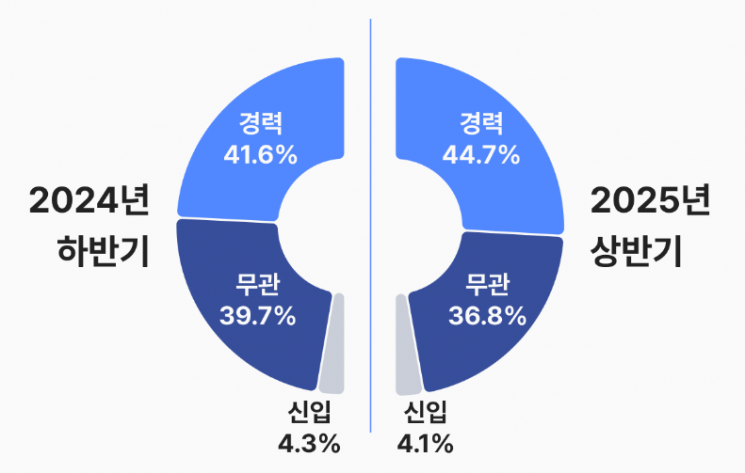
The trend of preferring experienced hires has also become more noticeable. While the number of postings open to entry-level applicants decreased compared to the second half of last year, the proportion of postings for experienced positions increased by 3.1%. This demonstrates a deepening preference for hiring candidates who can be immediately deployed to the job.
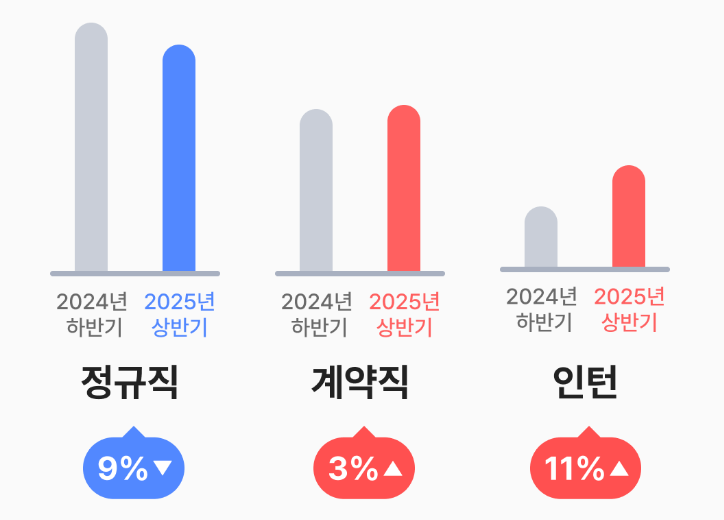
A polarization in hiring between large corporations and small businesses was also observed. Large corporations maintained relatively stable hiring, with a fluctuation rate of less than 1% despite economic changes, whereas hiring at small businesses decreased by 8%. Additionally, regular full-time hiring in the first half of this year decreased by 9% compared to the second half of last year, while hiring for contract and internship positions increased by 3% and 11%, respectively. As the proportion of non-regular positions rises in overall hiring, employment instability is also intensifying.
Job Postings Concentrated from February to April, Applications from April to May
Another notable characteristic is the clear distinction between peak and off-peak seasons in the job market. Although on-demand hiring has increased compared to open recruitment, job postings are still heavily concentrated from February to April, and applications are mainly submitted from April to May.
The number of positions offering remote work is steadily declining. While remote work surged during the COVID-19 pandemic, it has gradually decreased, with only 2% of job postings in the first half of this year allowing for remote work. This represents a 0.3% decrease compared to the second half of last year.
JobKorea suggested three job search strategies ahead of the public recruitment season in the second half of the year: targeting periods with relatively lower competition, highlighting AI-related skills to increase acceptance rates, and leveraging experience at small businesses to transition to mid-sized or large companies.
© The Asia Business Daily(www.asiae.co.kr). All rights reserved.



















