Captured on Bulgapsan Mountain in Yeonggwang in 1908 and Sold to a Japanese Buyer
Donated as Taxidermy to Yudal Elementary School, Displayed for Over a Century
A Symbol of Colonial Exploitation with High Historical and Educational Value
Recent Calls for the Tiger's Return from Yeonggwang County
Strong Opposition from Yudal Alumni and Other Hurdles Remain
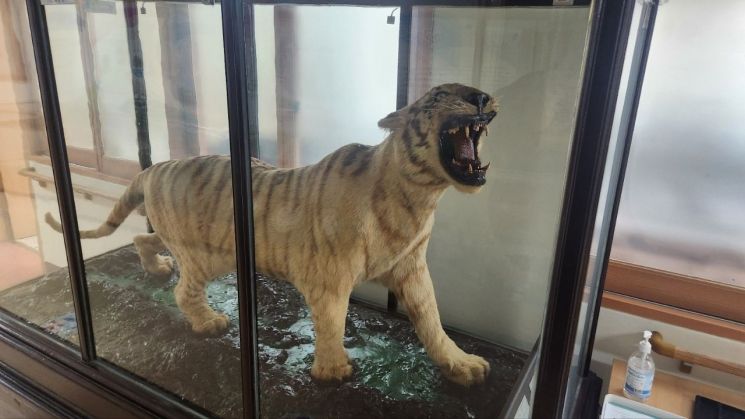
The last tiger unofficially captured in the Honam region just before the National Humiliation of 1910 is currently exhibited in taxidermy form at Yudal Elementary School in Mokpo, Jeonnam, drawing significant attention. As Korea marks the 80th anniversary of Liberation this year, the meaning of this tiger is being felt even more deeply.
According to Mokpo Office of Education, Mokpo City, and Yeonggwang County on August 15, the prevailing view is that the "Yudal Elementary School Tiger" was captured in 1908 on Bulgapsan Mountain in Yeonggwang County. This is also why some in Yeonggwang and nearby areas refer to the Yudal Elementary School Tiger as the "Bulgapsan Tiger."
Records show that the tiger, an adult female estimated to be about 10 years old, was caught in a trap set by an anonymous farmer at the time. The tiger measured 160 cm in body length and weighed as much as 180 kg.
The unnamed farmer sold the captured tiger to a wealthy Japanese man, Harakuji Shoji, for 350 won-a huge sum considering that the average monthly wage for a college graduate worker at the time was only 40 to 50 won.
After purchasing the tiger, Harakuji Shoji temporarily took it to Japan, had it preserved through taxidermy, and then donated it to Yudal Elementary School in 1909. It is believed that the donation was made because Yudal Elementary School was an elementary school for Japanese students living in Joseon at that time.
This tiger, as the last one captured in the Honam region, has been with the students of Yudal Elementary School for over a century, carrying great symbolic meaning.
In fact, during the Japanese colonial era, Japanese interest in the "Joseon Tiger" was immense. Large felines native to the Korean Peninsula, including tigers and leopards, inspired both awe and fear among the Japanese. Because these animals were also linked to the Korean national identity, there was an even stronger desire to eradicate them.
While the official justification was the "harmful animal eradication" project, the large-scale overhunting of tigers and leopards was driven by these motives. According to records from the Governor-General of Korea, 97 tigers and 624 leopards were captured between 1910 and 1945, but many believe the actual number was at least two to three times higher.
This is cited as a decisive cause that accelerated the extinction of tigers in South Korea.
The Yudal Elementary School Tiger has come to represent both fond memories and painful history for the school's alumni and the people of Jeonnam.
Perhaps due to this significance, the Yudal Elementary School Tiger is often at the center of ownership disputes.
Recently, a petition movement for the return of the tiger has been initiated by Yeonggwang County and some local residents, who argue that since the tiger was captured in Yeonggwang, it should not remain in Mokpo.
However, in reality, the return of the Yudal Elementary School Tiger seems unlikely.
There is strong opposition among Yudal Elementary School alumni, and since the tiger holds considerable value as a tourist attraction and educational resource, the relevant authorities-including Mokpo City and the Mokpo Office of Education-are also reluctant. In fact, a formal request for donation from Yeonggwang County to Yudal Elementary School in 2015 was rejected for the same reasons.
An official from the Mokpo Office of Education stated, "The Yudal Elementary School Tiger is a painful yet invaluable educational resource, symbolizing the exploitation of the Japanese colonial era. Especially for the alumni of Yudal Elementary School, it is a cherished part of their childhood memories. Although Yeonggwang County is requesting its return, this is an issue that requires social consensus, so it is difficult to provide a clear answer at this time."
© The Asia Business Daily(www.asiae.co.kr). All rights reserved.
![Clutching a Stolen Dior Bag, Saying "I Hate Being Poor but Real"... The Grotesque Con of a "Human Knockoff" [Slate]](https://cwcontent.asiae.co.kr/asiaresize/183/2026021902243444107_1771435474.jpg)















