City to Raise Base, Distance, and Time Taxi Fares in September
Taxi Companies: "Individual Taxi Shift System Must Return"
Drivers: "No Wage Increase, Only Longer Working Hours"
Civic Groups: "Lack of Consensus, Unilateral Fare Hike"
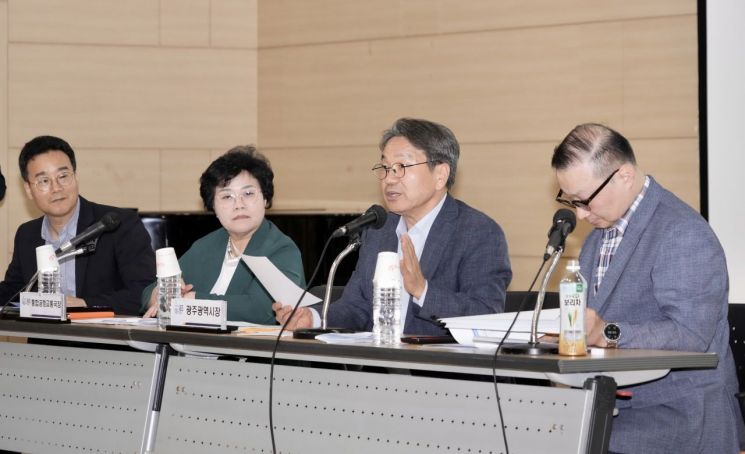 Kang Gijeong, mayor of Gwangju, attended the "Gwangju Citizens' Public Hearing for Taxi Fare Realization" held at the Gwangju Transportation Culture Training Center on the afternoon of the 22nd of last month. He shared the results of the appropriate taxi fare calculation service with the attendees and exchanged opinions. Provided by Gwangju City
With base, distance, and time fares for taxis in Gwangju all expected to increase as early as September, both the taxi industry and civic groups are calling for supplementary measures to accompany the fare hike.
They argue that raising taxi fares solely based on inflation rates could have negative consequences, such as a decrease in the number of passengers, a decline in service quality, and reduced revenue for taxi companies. Additionally, since a taxi fare increase could have a significant impact on citizens' lives, there are calls for a process of social consensus.
According to Gwangju City and the taxi industry on August 14, the city held a "Public Hearing for Taxi Fare Realization" on July 22, where it reached a tentative agreement with the taxi industry on plans to raise taxi fares.
At the time, the city presented the results of a study on appropriate taxi fare calculation, which found that taxi fares in Gwangju are lower than the national average, and that fare adjustments are inevitable when considering the financial situation of the taxi industry.
Looking at the base taxi fares across the country: Seoul 4,800 won (1.6 km), Incheon 4,800 won (1.6 km), Busan 4,800 won (2 km), Daegu 4,500 won (1.7 km), Daejeon 4,300 won (1.8 km), while Gwangju's base fare is 4,300 won (2 km), which is lower than other regions. The average fare for a 5 km trip, reflecting distance and time, is 8,100 won in Seoul and Incheon, but only about 7,200 won in Gwangju. The current transportation cost per kilometer is 1,633.2 won, a 13.3% increase from 1,440.9 won in 2023.
On this day, both individual and corporate taxi operators expressed the opinion that taxi fares should be increased by about 13.35%. The agreed-upon basic plan includes: ▲ Base fare of 4,800 won (1.7 km) ▲ Distance fare every 132 meters ▲ Time fare every 32 seconds.
However, controversy continues between the taxi industry, drivers, and civic groups regarding the fare increase.
◆ Corporate taxis: "Even with a fare increase, we will still operate at a loss... the shift system must be reinstated"
First, within the taxi industry, there are calls for the reinstatement of the mandatory rest shift system for individual taxis (hereafter referred to as the "shift system"). The shift system is a policy requiring taxi drivers to take regular breaks to prevent overwork and allow for vehicle maintenance. In Gwangju, individual taxis operated on a three-shift system (one rest day every three days), while corporate taxis operated on a six-shift system (one rest day every six days).
However, during the COVID-19 pandemic, many corporate taxi drivers left for other high-demand sectors such as parcel delivery, and individual taxi drivers avoided late-night shifts, leading to a so-called "taxi crisis." In response, the government lifted the shift system nationwide in 2022.
After the shift system was lifted, corporate taxis effectively continued the six-shift system due to wage issues, but individual taxis were allowed to operate without restriction. As a result, the late-night taxi shortage persists, while there is an oversupply during peak hours such as weekends and daytime.
Actual corporate taxi operation figures show a steady decline: ▲ About 18.7 million trips in 2020 ▲ About 16.8 million in 2021 ▲ About 16 million in 2022 ▲ About 14.9 million in 2023 ▲ About 14.8 million in 2024. Notably, in 2023, the year after the fare increase and the lifting of the shift system, the number of trips dropped by about 1 million compared to the previous year. In contrast, individual taxis made about 24.5 million trips last year, nearly 10 million more than corporate taxis.
Kwon Donggyu, head of the Gwangju Taxi Transportation Association, stated, "After the shift system was lifted, individual taxis saw their revenue increase by 40-50% along with the fare hike, but corporate taxis saw only a slight increase." He argued, "For a fare increase that takes inflation into account to be properly implemented, the shift system must first be reinstated."
◆ Drivers: "No real wage increase, only longer working hours"
Drivers argue that even if taxi fares are increased, their daily dues will also rise, so their actual wages will not change. In fact, a temporary decrease in passengers could force drivers to work longer hours just to meet their daily dues. Currently, the monthly dues for the 75 corporate taxi companies in Gwangju are 5.76 million won, while drivers' monthly salaries are reported to be between 2.1 and 2.2 million won.
There are also calls for improvements in the transportation system to enhance service quality. In fact, complaints about taxi service inconveniences have consistently exceeded 1,000 cases per year: 1,290 in 2021, 1,376 in 2022, 1,103 in 2023, and 1,000 in 2024.
Moon Honggeun, head of the Gwangju branch of the National Taxi Union, explained, "A fare increase does not automatically lead to higher income. Under the current fare system, considering inflation and operating profits, there is no solution that labor and management can reach on their own," adding, "Gwangju City must consider support measures for taxi workers along with the fare increase."
He continued, "If the fare increase leads to fewer passengers, taxi drivers will naturally have to work longer hours. Starting next month, pick-up and drop-off will also be prohibited in front of Gwangju Songjeong Station. To provide high-quality service to citizens in line with the fare increase, the entire transportation system needs to be overhauled."
◆ Civic groups: "A social consensus with citizens is necessary"
There has also been criticism that the process of gathering citizens' opinions on the fare hike was insufficient. At the public hearing held last month, only the views of the taxi industry were presented, while the potentially negative perspectives of civic groups were not heard.
Ki Usik, secretary general of the Gwangju Civic Group Council, pointed out, "Since Gwangju taxis receive subsidies through modernization projects and other means, public funds are involved, so a certain level of social consensus is needed on fare increases, just like with city buses and subways." He added, "It is contradictory to accept subsidies and other benefits while disregarding the impact of fare increases on citizens' lives."
He continued, "The decision-making process for this fare increase was mostly composed of stakeholders. Although the study found that Gwangju's taxi fares are relatively low compared to other regions, considering the use of public funds, a consensus process with local citizens should have taken place, reflecting the characteristics of the region."
Meanwhile, Gwangju City plans to raise taxi fares as early as the end of next month, following reviews by the Taxi Policy Committee, the Gwangju City Council's standing committee, and the Price Countermeasures Committee.
© The Asia Business Daily(www.asiae.co.kr). All rights reserved.

















