Lower Tax Burden for Additional Home Purchases in Depopulation Areas

The number of regions where individuals who already own a home can receive tax benefits when purchasing an additional property outside the Seoul metropolitan area will increase. The price threshold for eligible homes will also be raised to 900 million won. For local social overhead capital (SOC) projects, the threshold for preliminary feasibility studies will be raised, and construction cost burdens for local builders are expected to be eased.
On August 14, the government held an Economic Ministers’ Meeting and announced the “Measures to Strengthen Construction Investment Centered on Local Areas.” This initiative was introduced in response to the prolonged slump in regional construction markets, which has impacted small business owners and vulnerable groups, and has also become a burden on the national economy by affecting GDP and potential growth rates. Deputy Prime Minister and Minister of Economy and Finance Koo Yooncheol stated in his opening remarks, “All resources and infrastructure are concentrated in the Seoul metropolitan area and are not circulating to local regions, which are the ‘roots of the economy,’ resulting in a decline in our economic growth capacity. We will revive local economies and ensure the lifeblood flows again.”
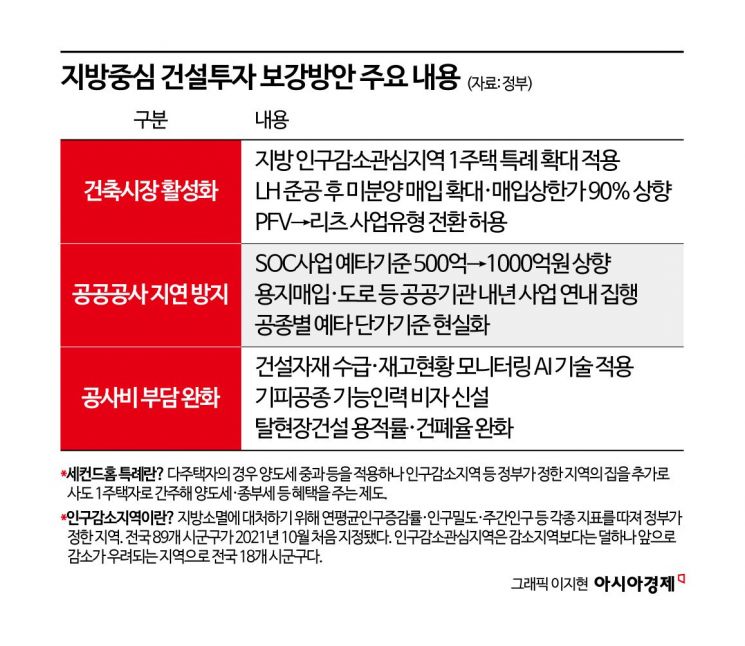
Lower Tax Burden Even When Buying an Additional Home in Population-Declining Regions
The government has decided to expand the regions eligible for “second home” tax benefits. The second home system grants a special “one household, one home” tax status to existing homeowners who purchase an additional property. Previously, only population-declining regions were eligible, but now the scope will be expanded to include non-metropolitan areas designated as “population decline concern” regions. Newly included areas are Gangneung, Donghae, Sokcho, and Inje in Gangwon Province; Iksan in North Jeolla Province; Gyeongju and Gimcheon in North Gyeongsang Province; and Sacheon and Tongyeong in South Gyeongsang Province. These “concern” regions are relatively better off than population-declining regions but are at risk of future population decline.
In non-metropolitan population-declining regions, the price threshold for homes eligible for capital gains and property tax benefits will be raised from 400 million won to 900 million won based on the officially assessed value. The acquisition tax exemption threshold will also be raised from 300 million won to 1.2 billion won. In “population decline concern” regions, the existing threshold of 400 million won will continue to apply. A government official explained, “An assessed value of 900 million won is equivalent to a market price of about 1.2 billion won. By raising this threshold, there is likely to be increased demand for building high-end villas and similar properties in local areas, which will stimulate local construction. Since the introduction of this policy last year, the amount of acquisition tax reductions has reached several tens of billions of won, indicating its effectiveness.”

In population-declining regions, the “10-Year Private Rental Apartment Purchase Program” will be temporarily reinstated for one year. The government is also considering excluding these rental properties from heavy capital gains taxation. This program had previously been abolished due to concerns about market instability, but it will be restored for one year to evaluate its effectiveness. In local areas, various tax benefits for unsold homes after completion will be extended for another year until next year. A new measure will also exclude additional capital gains taxation when purchasing unsold apartments through Corporate Restructuring Real Estate Investment Trusts (CR-REITs).
Additionally, the government plans to establish a system within this year to utilize national funds when converting privately owned residential or commercial buildings in local areas into integrated government offices or official residences. Korea Land and Housing Corporation (LH) will increase its target for purchasing unsold homes after completion to 5,000 units next year, up from this year’s target of 3,000 units. The purchase price cap will also be raised from 83% to 90% of the appraised value. This measure addresses concerns that the previous cap was too low, reducing the effectiveness of the program.
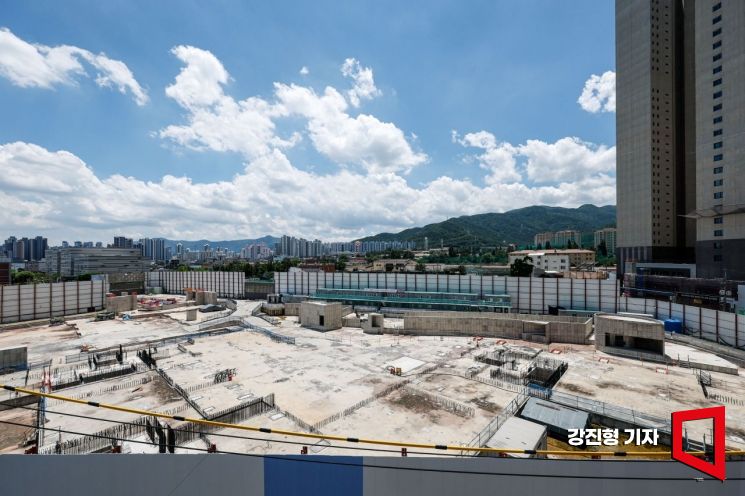 Construction has been halted at an apartment construction site in Daemyeong-dong, Nam-gu, Daegu. Photo by Kang Jin-hyung
Preliminary Feasibility Study Threshold Raised to 100 Billion Won... Faster SOC Projects
To accelerate regional SOC projects, the threshold for preliminary feasibility studies will be raised from 50 billion won to 100 billion won. This standard has been in place for 26 years since the system was introduced in 1999. The evaluation criteria for these studies will also be revised to better promote regional growth. However, as this requires legal amendments, the details and implementation timeline will be discussed further with the National Assembly and other stakeholders. A government official commented, “While there are concerns that projects with low economic feasibility could still proceed, it is necessary to review the system in a way that incorporates the value of regional growth.”
To better reflect actual construction costs at each stage, the government will revise short-term standards for each construction type and update the criteria for reflecting price changes from the project planning stage to the start of investigations. Currently, the “construction investment GDP deflator” is used, but if the difference between this figure and the construction cost index exceeds 4%, the average of the two will be applied. The government will also expand the range of major managed construction types for which market prices are surveyed annually, so that price increases can be reflected more quickly at the ordering and bidding stages.
Some public institutions will bring forward next year’s planned SOC projects to this year, focusing on projects that can be implemented immediately, such as land acquisition and road improvement works. This is expected to allow up to an additional 400 billion won in spending. Of the 15 advanced national industrial complexes currently underway, administrative procedures will be streamlined so that preliminary feasibility studies for four can be completed within this year. The period for corporate tax reductions for companies relocating their headquarters or factories from the metropolitan area to regional areas will be extended from 8 to 15 years, and the sunset date for these benefits will be pushed back to 2028.
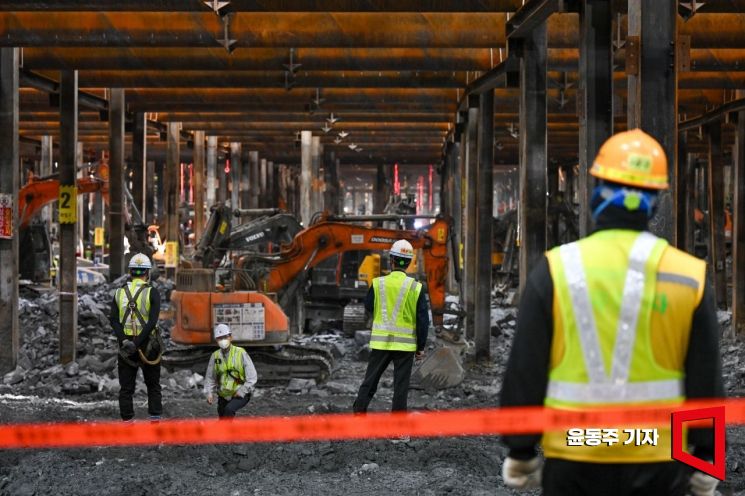 Seoul Gangnam-gu Yeongdong-daero Underground Space Complex Development Construction Site. 2025.04.23 Photo by Dongju Yoon
To ease construction cost burdens for the industry, the new measures include establishing a monitoring system using artificial intelligence (AI) technology. Currently, materials such as ready-mixed concrete and rebar are monitored manually, but the government expects that real-time tracking of regional conditions and inventory status will improve supply and demand conditions. In addition, the government will work to simplify the permit process for extracting marine aggregates and forest soil and rocks, introduce new visas for skilled workers, and revitalize the skilled worker grading system to encourage young people to enter the field. When using off-site construction (OSC) methods, regulations on floor area ratio, building coverage, and height restrictions will be relaxed.
The government will also revise its financial support methods to ensure that local governments have the capacity to carry out regional development projects. Deputy Prime Minister Koo stated, “Starting next year, the size of the Regional Balanced Development Special Account’s block grants to local governments will be increased from 3.8 trillion won to over 10 trillion won. This will promote region-specific investments by allowing local governments to autonomously choose the scale and scope of their projects and investments.”
As these measures cover a wide range of areas, the industry has welcomed them. However, there are calls for additional measures, such as easing regulations on owners of multiple homes, to address the polarization of the housing market. Han Seunggu, Chairman of the Korea Construction Association, said, “As many of the tax and regulatory reforms we have long requested to stimulate investment have been broadly accepted, this will mark a turning point. Along with economic recovery, we will make special efforts to ensure safety management and prevent accidents on construction sites.”
© The Asia Business Daily(www.asiae.co.kr). All rights reserved.



















