Hyundai Engineering & Construction announced on August 14 that it has signed a technology development agreement with the Korea Institute of Energy Technology Evaluation and Planning for the sequential transfer and expansion of floating facilities and basic design technologies for the operation of decentralized carbon capture and storage (CCS) sites in Southeast Asia.
CCS technology involves collecting emitted carbon dioxide and injecting it deep underground for storage. The main focus of this project is to secure the concept and basic design technology for a floating carbon dioxide injection system that will enable depleted oil and gas fields in Southeast Asian offshore regions to be used as carbon dioxide storage sites. The research project is valued at 5.8 billion KRW. Hyundai Engineering & Construction will lead the research as the principal institution, collaborating over the next 42 months with eight organizations, including Korea National Oil Corporation, American Bureau of Shipping, Seoul National University, and Pertamina University of Indonesia.
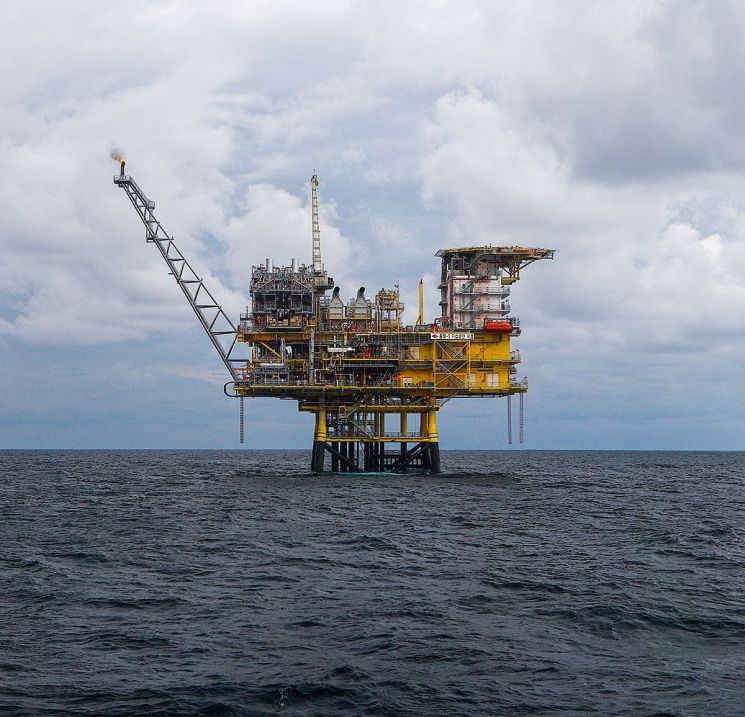 Donghae Gas Field. Hyundai Engineering & Construction has taken charge of the demonstration project to convert it into the largest carbon dioxide storage site in Korea. Provided by Korea National Oil Corporation and Hyundai Engineering & Construction.
Until now, offshore carbon dioxide storage has relied on fixed structures and pipelines installed under the sea. However, the company explained that in Southeast Asia, where storage sites are scattered across various locations, floating facilities are more efficient. In addition to ship-based floating structures, Hyundai Engineering & Construction has developed a floating concrete-based carbon dioxide injection system that can remain afloat on the sea. The company plans to commercialize this as a business model after obtaining basic design approval. It expects that infrastructure construction costs can be reduced by up to 25% compared to conventional fixed methods.
The company also announced plans to refine this research and expand its applications to hydrogen and ammonia businesses. A Hyundai Engineering & Construction representative stated, "By completing this project, we aim to utilize it in cross-border CCS projects that transport and store domestic carbon dioxide overseas, thereby contributing to the acquisition of carbon credits and establishing a foothold for entering the global carbon reduction market."
© The Asia Business Daily(www.asiae.co.kr). All rights reserved.
![Clutching a Stolen Dior Bag, Saying "I Hate Being Poor but Real"... The Grotesque Con of a "Human Knockoff" [Slate]](https://cwcontent.asiae.co.kr/asiaresize/183/2026021902243444107_1771435474.jpg)















