"Laying the Groundwork for a Second Meeting"
Hints at Halting Talks if Putin Remains Uncooperative
On August 13 (local time), U.S. President Donald Trump warned that there would be "very serious consequences" if Russian President Vladimir Putin does not agree to a ceasefire agreement at the upcoming U.S.-Russia summit scheduled for August 15. He also announced his intention to immediately hold a subsequent trilateral summit with Ukrainian President Volodymyr Zelensky following the U.S.-Russia talks. As concerns have been raised that President Putin, who has so far been passive in ceasefire negotiations, could once again deliver an unexpected blow, the U.S. is ramping up pressure on Russia for a ceasefire ahead of the summit.
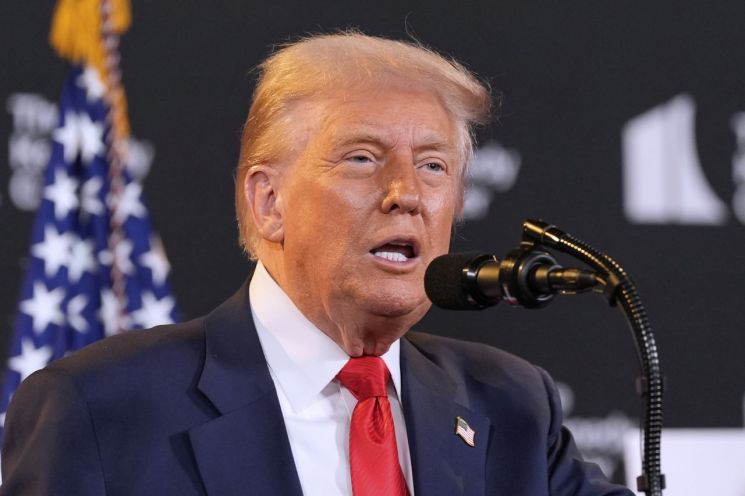
Speaking to reporters at the Kennedy Center in Washington, D.C. on the same day, President Trump said, "I hope to have a prompt second summit with President Zelensky in attendance," adding, "There is a very high possibility that the second summit will be more productive than the first. We are currently laying the groundwork for the second summit."
Since taking office, he has pushed for an end to the war in Ukraine, but negotiations have stalled as President Putin has shown little willingness to engage. In response, Trump recently warned of a second round of tariffs on countries and companies purchasing Russian oil, and following this pressure, the U.S.-Russia summit scheduled for August 15 was arranged.
President Trump also indicated that he is willing to suspend talks if President Putin does not participate in the negotiations in good faith. He emphasized, "There may not be a second summit," and added, "If I determine that the talks are not appropriate or if I do not receive the necessary answers, I will not hold it."
When asked whether he could persuade President Putin to halt attacks on Ukrainian civilians, Trump replied, "No," explaining that even in past conversations with Putin, attacks on civilians continued.
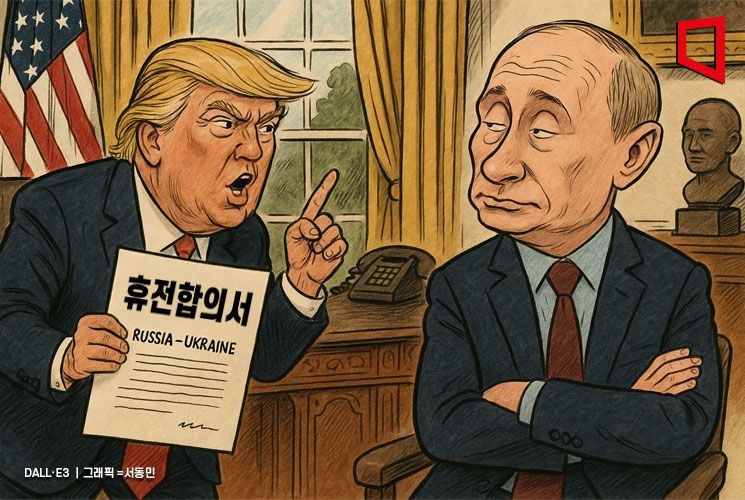
President Trump’s warning to Russia and mention of a U.S.-Russia-Ukraine trilateral summit came immediately after a virtual meeting with Ukrainian and European leaders earlier that day. As the U.S.-Russia summit in Anchorage, Alaska, approached in two days, concerns grew that Ukraine might be sidelined. In particular, as scenarios involving ceding part of Ukrainian territory to Russia were discussed, President Zelensky and European leaders demanded that there be no changes to borders by force and called for firm security guarantees.
According to German Chancellor Friedrich Merz, who chaired the meeting, President Trump stated that he would not negotiate territorial issues with Russia and that the parties directly involved must discuss these matters themselves. He also conveyed that while the North Atlantic Treaty Organization (NATO) would not participate in security guarantees for Ukraine, the United States and Europe would jointly work to provide future security assurances. It was also reported that President Trump and European leaders discussed possible venues for the trilateral summit, including locations in Europe and the Middle East. French President Emmanuel Macron told reporters after the meeting, "President Trump made clear the United States’ commitment to achieving a ceasefire at the upcoming Alaska summit."
Meanwhile, U.S. Treasury Secretary Scott Besant also warned Russia that sanctions could be eased or tightened depending on the outcome of the U.S.-Russia summit, and called on Europe to join in the sanctions.
In an interview with Bloomberg TV that day, he said, "Europe must join our sanctions," adding, "We have imposed a second round of tariffs on India for purchasing Russian oil, and if the situation does not improve, we can further strengthen sanctions or secondary tariffs."
Previously, on August 6, President Trump signed an executive order imposing a 25% tariff on India for importing Russian oil.
© The Asia Business Daily(www.asiae.co.kr). All rights reserved.
![Clutching a Stolen Dior Bag, Saying "I Hate Being Poor but Real"... The Grotesque Con of a "Human Knockoff" [Slate]](https://cwcontent.asiae.co.kr/asiaresize/183/2026021902243444107_1771435474.jpg)
















