Remarks at Symposium Hosted by Seoul National University Institute of Financial Economics
"Virtually No Demand for Won-Based Coins... Korea Needs a Different Approach from the US"
"Stablecoins Are a Winner-Takes-All Market... Lower Entry Barriers Could Lead to Cutthroat Competition"
As discussions on the legalization of Korean won stablecoins are expected to gain momentum, there have been calls for issuers to be subject to strict capital ratio regulations equivalent to those imposed on banks. Some experts argue that the regulatory threshold, which is currently being debated mainly in terms of capital size, should be raised even higher than it is now.
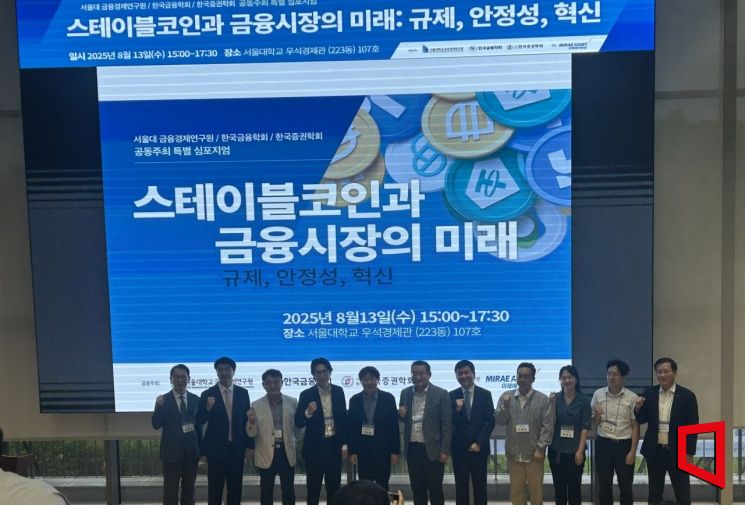 Participants of the symposium "Stablecoins and the Future of Financial Markets: Regulation, Stability, Innovation," co-hosted by the Seoul National University Institute of Financial Economics, the Korean Finance Association, and the Korean Securities Association, are taking a commemorative photo. Photo by Yuri Kim
Choi Jaewon, a professor at the Department of Economics at Seoul National University, emphasized this point during his presentation at the symposium "Stablecoins and the Future of Financial Markets: Regulation, Stability, Innovation," held at the Wooseok Economics Hall at Seoul National University on August 13. The symposium was co-hosted by the Seoul National University Institute of Financial Economics, the Korean Finance Association, and the Korean Securities Association.
Professor Choi stressed that the situations surrounding the United States and dollar stablecoins, and Korea and won stablecoins, are different. He said, "In the United States, there is already a $220 billion (KRW 300 trillion) dollar stablecoin market. This is due to excess demand for the dollar. The Genius Act, which seeks to legalize this, is essentially like bringing a wild animal playing outside into the house." He continued, "As for won stablecoins, it is fair to say that there is virtually no demand. While there are won-based coins on platforms like Binance, they are hardly ever used in practice. Frankly, the justification and practical benefits for institutionalization are much weaker in Korea compared to the United States."
Professor Choi pointed out, "There is no real demand for won stablecoins, but all the suppliers are preparing for them. Stablecoins are a winner-takes-all market, dominated by early market capture and network effects. If entry barriers are lowered, this could lead to excessive cutthroat competition and a heightened risk of coin runs, making consumer protection even more difficult." He explained that if competition intensifies, there will be greater incentives to shift reserve asset management toward high-risk bonds that offer higher yields, and that "window dressing" could occur, where assets are temporarily switched to safer ones just before month-end audits.
Professor Choi stated, "Currently, most discussions on regulation focus on capital requirements, but in addition to minimum capital requirements, minimum capital ratio regulations are also necessary. Stablecoins should either be issued by banks or be required to meet the same prudential standards as banks."
He also raised concerns about stablecoin reserve assets, saying, "If reserves are mainly in government bonds, government debt will increase while private lending may decrease, resulting in a crowding-out effect. As an alternative, using bank deposits simply shifts run risk to the banks, and since these are institutional deposits, they are not protected by deposit insurance, making this approach inappropriate."
Professor Choi emphasized the need for serious consideration regarding the privatization of seigniorage. He said, "Tether’s business structure is much simpler than a bank’s, with only about 30 employees. Its main revenue source is seigniorage, essentially making money with little effort. If a won stablecoin is issued, seigniorage will be split among the stablecoin issuers instead of the Bank of Korea and commercial banks. We need to discuss whether it is appropriate for private companies to share this power, which derives from the right of issuance, and whether the issuers should be required to fulfill a public function, similar to the public responsibilities of banks."
© The Asia Business Daily(www.asiae.co.kr). All rights reserved.

















