Second Quarter Earnings Call
Sharp Increase in Indemnity Insurance Loss Ratio
Difficulties in Raising Base Auto Premiums
'Super-Gap' Profit Management Becomes a Complex Equation
On August 13, Samsung Fire & Marine Insurance announced during its second-quarter earnings conference call that it would maintain its capital adequacy ratio (K-ICS) at a minimum of 220%. As of the end of June, the ratio stood at 274.5%, a 10 percentage point increase year-on-year. However, the company indicated it would pay close attention to managing this figure, given potential downward factors such as shareholder dividends and overseas investment expenses.
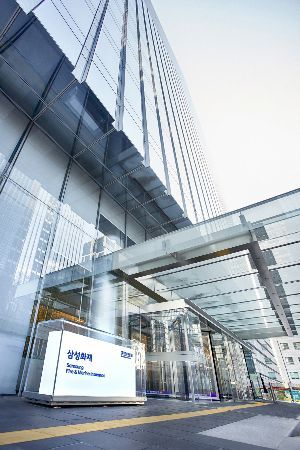 Seoul Seocho-gu Samsung Fire & Marine Insurance Headquarters exterior. Samsung Fire & Marine Insurance
Lee Yongbok, Executive Director and Head of Risk Management at Samsung Fire & Marine Insurance, was asked about the company's target K-ICS ratio in light of the financial authorities lowering the recommended ratio for insurers from 150% to 130%. He responded, "Due to year-end shareholder dividends and overseas investments such as Canopius, the ratio could fall by about 15 to 16 percentage points compared to the first half. Considering ongoing discussions such as the recent Financial Supervisory Service's 'Insurance Industry Soundness Task Force' and the potential adjustment of discount rates, our current operational target is 220%."
Samsung Fire & Marine Insurance acknowledged that there has indeed been a surge in indemnity insurance payouts. The company's long-term insurance loss ratio for the first half of the year (the ratio of insurance payouts to premiums collected) was 94.5%, up 7.6 percentage points from the same period last year.
Cho Eunyoung, Executive Director and Head of Long-term Insurance Strategy at Samsung Fire & Marine Insurance, was asked why the double-digit (over 10%) annual increase in insurance payouts has persisted for several years. She explained, "The long-term insurance loss ratio in the first half rose by 7.6 percentage points year-on-year, with indemnity insurance accounting for more than half of the increase. The rise in indemnity insurance loss ratio has been steeper than expected due to the rapid growth in insurance payouts."
Samsung Fire & Marine Insurance is focusing its efforts on reducing the gap between expected and actual insurance payouts (the 'expected-actual difference'). Executive Director Cho stated, "We are continuously strengthening investigations into false or exaggerated indemnity insurance claims in order to reduce the expected-actual difference."
The company's automobile insurance profit for the first half was KRW 30.7 billion, a sharp 79.5% decline from KRW 149.3 billion in the previous year. Samsung Fire & Marine Insurance explained that while raising the base premium would be the most certain way to improve profitability, it is not currently considering such a move.
Lee Kyuhyun, Head of Automobile Insurance Profit at Samsung Fire & Marine Insurance, was asked about the outlook for a turnaround point in the automobile insurance sector, given the ongoing unfavorable market conditions. He responded, "Raising the base premium is the most straightforward way to reverse profitability, but considering external factors, we believe it is difficult to do so at this time. As alternatives, we are expanding the sale of coverage riders and, starting from the second quarter, restructuring discount-type riders to bring excessive discount rates in line with reality."
The company refrained from commenting on the Financial Supervisory Service's adjustments to assumptions regarding insurers' loss and expense ratios.
Song Hayoung, Executive Director and Head of Financial Planning at Samsung Fire & Marine Insurance, said, "The Financial Supervisory Service typically issues guidelines when specific issues arise regarding loss or expense ratios. However, recently, the review of assumption management levels is not due to any particular issue, but rather as part of efforts to enhance policy consistency and identify areas for improvement. Since no concrete details have been released, it is difficult to predict whether there will be any impact on the company's finances."
Samsung Fire & Marine Insurance stated that it will continue to pursue its 'super-gap' strategy, aiming to achieve both enhanced profitability and strengthened financial soundness.
Gu Youngmin, Executive Vice President and CFO of Samsung Fire & Marine Insurance, emphasized, "The business environment for the second half of the year is more uncertain than ever. We will do our utmost to secure profit sources, enhance loss ratio management, and discover new growth models to establish a sustainable and profitable business model."
He added, "In the second half, we will strengthen our profit base by focusing on insurance products with high contractual service margins (CSM) and solidify our market position. We will also carry out structural improvements to enhance both profitability and soundness, building a 'super-gap' business structure."
© The Asia Business Daily(www.asiae.co.kr). All rights reserved.

















