Household Loans Reach 1,164.2 Trillion Won, Up 2.8 Trillion Won
Strong Growth in Mortgage Loans for Home Purchases
Sharp Drop in Living Expense Mortgages and Unsecured Loans With Short Regulatory Lag
Seoul Housing Price Growth Remains High,
Last month, the increase in household loans from banks slowed significantly, with the total increase amounting to only 2.8 trillion won. The overall increase in household loans across the entire financial sector also remained in the 2 trillion won range. This contraction in growth defied previous expectations that household loan growth-centered on mortgage loans-would expand through July and August, following the surge in housing transactions in May and June. Analysts attribute this slowdown to strengthened household loan management measures implemented by financial institutions after the June 27 measures were announced, which led to a sharp decrease in mortgage loans for living expenses and unsecured loans, both of which have short regulatory time lags.
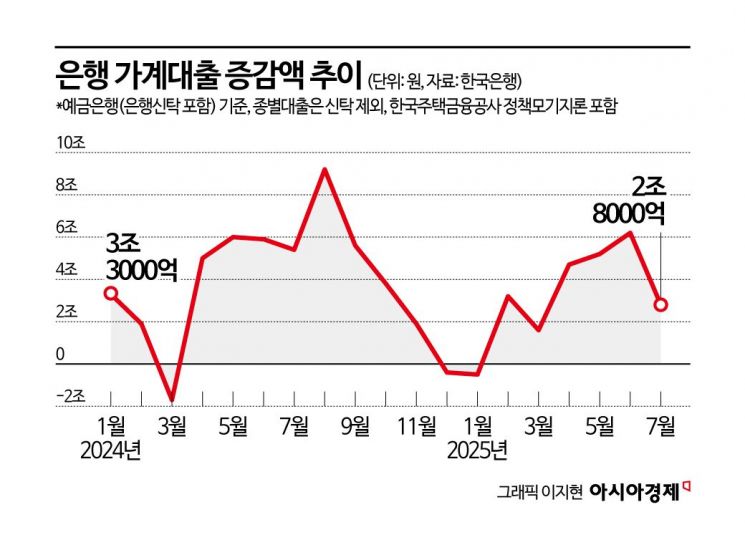
According to the "Financial Market Trends in July 2025" report released by the Bank of Korea on August 13, the outstanding balance of household loans from banks at the end of last month stood at 1,164.2 trillion won, an increase of 2.8 trillion won compared to the end of the previous month. This represents a significant decrease from the previous month’s increase of 6.2 trillion won.
Last month, mortgage loans increased by 3.4 trillion won, reaching 926.4 trillion won. This was a slight decrease in the pace of growth compared to June’s increase of 5.1 trillion won. The continued impact of increased housing transactions from April to June kept mortgage loans for home purchases on a strong upward trend. According to the Ministry of Land, Infrastructure and Transport, the number of apartment sales transactions in Seoul rose from 5,000 in April to 7,400 in May and 10,900 in June. However, following the announcement of the June 27 measures, factors such as the reduction in the limit for mortgage loans for living expenses-which have a short regulatory time lag-and decreased demand for interim payments related to housing pre-sales contributed to the slowdown in growth.
Park Mincheol, Head of the Market Operations Team at the Bank of Korea’s Financial Markets Department, explained, "After the announcement of the June 27 measures, strengthened household loan management by financial institutions led to a significant reduction in mortgage loans for living expenses and unsecured loans, which was the main driver behind the slowdown in household loan growth in July." He added, "Since the measures were announced, the rate of increase in apartment prices in Seoul has slowed, and transaction volumes have also decreased significantly, indicating that the overheated housing market in the Seoul metropolitan area is generally calming down. As household loan management has been strengthened, the policy effects are appearing quickly, especially in loan categories with short regulatory time lags."
However, there are observations that it remains to be seen whether household loans will stabilize in a sustained trend going forward. Park noted, "The rate of increase in housing prices in key areas of Seoul remains very high, and various risk factors for household loan instability persist, such as expectations of easing financial conditions and balloon effects between regions. Therefore, it will be necessary to monitor the market further to determine whether a stable trend will be established in the future."
Jeonse deposit loans, which are included in mortgage loans, increased by 300 billion won compared to the end of the previous month. Other loans-which include general unsecured loans, credit line loans (overdraft accounts), commercial real estate secured loans, deposit and savings secured loans, and stock secured loans-decreased by 600 billion won. This shift to a decrease was driven by factors such as reduced credit loan limits and stricter lending attitudes by banks.
Corporate loans turned to an increase due to seasonal factors. At the end of last month, the outstanding balance of corporate loans from banks stood at 1,346.4 trillion won, up 3.4 trillion won from the previous month. Loans to large corporations increased by 500 billion won, as some loans that had been repaid at the end of the previous quarter for financial ratio management were reissued, resulting in a slight increase. Loans to small and medium-sized enterprises (SMEs) rose by 2.9 trillion won, with the increase driven by demand for value-added tax payments in July and expanded sales activities at some banks. Park explained, "For SMEs, loan demand typically increases in July due to value-added tax payments and the tendency to invest in facilities during the summer vacation season. However, compared to previous Julys, last month’s increase was not particularly large."
In June, bank deposits turned to a decrease, falling by 11.4 trillion won compared to the end of the previous month, mainly due to a decline in demand deposits. Demand deposits dropped sharply by 24.2 trillion won, as funds deposited for quarter-end financial ratio management were withdrawn and due to value-added tax payment demand. Time deposits increased by 9.6 trillion won, driven by efforts by some banks to attract deposits for regulatory ratio management and the temporary deposit of fiscal funds by local governments.
Assets under management at asset management companies surged by 46.6 trillion won. Money market funds (MMFs) switched to an increase, rising by 23.3 trillion won, as corporate funds that had flowed out at the end of the previous month for financial ratio management returned. Bond funds and equity funds also saw increases of 8.9 trillion won and 9.3 trillion won, respectively, expanding the scale of inflows. Other funds continued their upward trend, increasing by 4.6 trillion won.
© The Asia Business Daily(www.asiae.co.kr). All rights reserved.
![Clutching a Stolen Dior Bag, Saying "I Hate Being Poor but Real"... The Grotesque Con of a "Human Knockoff" [Slate]](https://cwcontent.asiae.co.kr/asiaresize/183/2026021902243444107_1771435474.jpg)
















