The Korea Research Institute of Bioscience and Biotechnology announced on August 13 that the research team led by Dr. Juyeon Park at the Bio-Nano Research Center has developed a 'Nanobody' technology capable of precisely identifying and attacking only lung cancer cells.
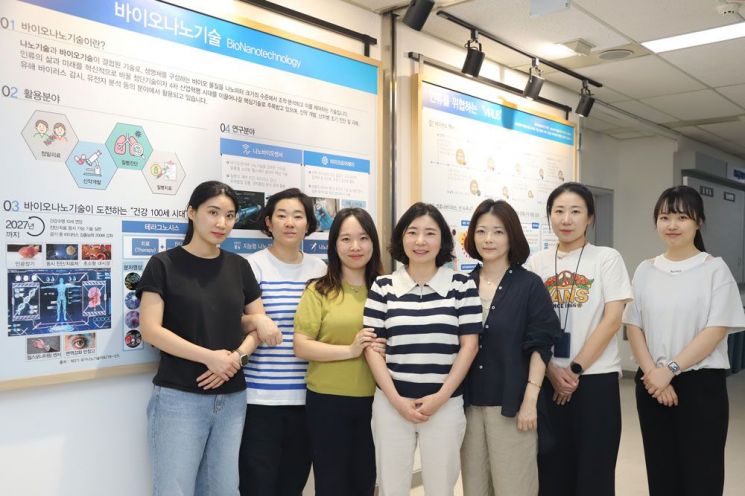 Members of Dr. Juyeon Park's research team are posing for a commemorative photo. Provided by Korea Research Institute of Bioscience and Biotechnology
Conventional anticancer drugs often attack even healthy cells, leading to side effects such as hair loss, nausea, and weakened immunity. Additionally, these drugs sometimes fail to reach cancer cells accurately, resulting in less-than-expected therapeutic outcomes.
In contrast, the nanobody technology developed by the research team offers the advantage of minimizing the side effects of conventional anticancer drugs while maximizing the effectiveness of cancer cell destruction.
This technology is particularly recognized for its effectiveness in treating lung adenocarcinoma, a type of non-small cell lung cancer. Lung cancer is a deadly disease that claims millions of lives each year, and lung adenocarcinoma accounts for over 50% of all lung cancer cases. However, early diagnosis is difficult and recurrence rates are high, making treatment challenging.
To address these issues, the research team developed an ultra-small antibody called 'A5 Nanobody' that specifically binds to the protein 'CD155' found in lung adenocarcinoma cells.
This nanobody is about one-tenth the size of a typical antibody, allowing it to penetrate deep into the body. It also demonstrates high precision by attaching only to the surface of cancer cells, leaving healthy cells largely unaffected. In practice, the A5 Nanobody selectively binds to lung adenocarcinoma cells with high levels of CD155 and has been shown to inhibit the migration and invasion of cancer cells by more than 50%.
The research team also developed 'A5-LNP-DOX' by combining the A5 Nanobody with a liposomal drug capsule containing the anticancer agent doxorubicin (DOX). This functions much like a drone, delivering the anticancer drug precisely to the CD155 target on the surface of cancer cells.
Based on this, animal experiments and patient-derived organoid model tests showed that tumor size was reduced by 70 to 90%, and cell death markers increased significantly. The research team also emphasized that there was minimal damage to major organs such as the liver, heart, and kidneys, indicating only minor side effects.
Dr. Juyeon Park stated, "This study is significant in that it presents a new therapeutic strategy capable of precisely targeting cancer cells and effectively delivering drugs. We hope that the nanotechnology developed by our team will contribute to the realization of precision medicine in future cancer treatments."
© The Asia Business Daily(www.asiae.co.kr). All rights reserved.
![Clutching a Stolen Dior Bag, Saying "I Hate Being Poor but Real"... The Grotesque Con of a "Human Knockoff" [Slate]](https://cwcontent.asiae.co.kr/asiaresize/183/2026021902243444107_1771435474.jpg)















