Criticism Mounts Over Japanese Festival Held on Liberation Day
Debate Over Japanese Cultural Events and National Sentiment Continues
As the 80th anniversary of Liberation Day approaches, debates over the consumption of Japanese culture have resurfaced. Every year during the March 1st Movement and Liberation Day, controversies arise as emotions calling for anti-Japanese and overcoming Japan sentiments, which recall the Japanese colonial era, coexist with feelings of familiarity toward Japan as a neighboring country closer than North Korea. On August 13, Yonhap News introduced several cases highlighting the ongoing controversies surrounding the enjoyment of Japanese culture ahead of Liberation Day.
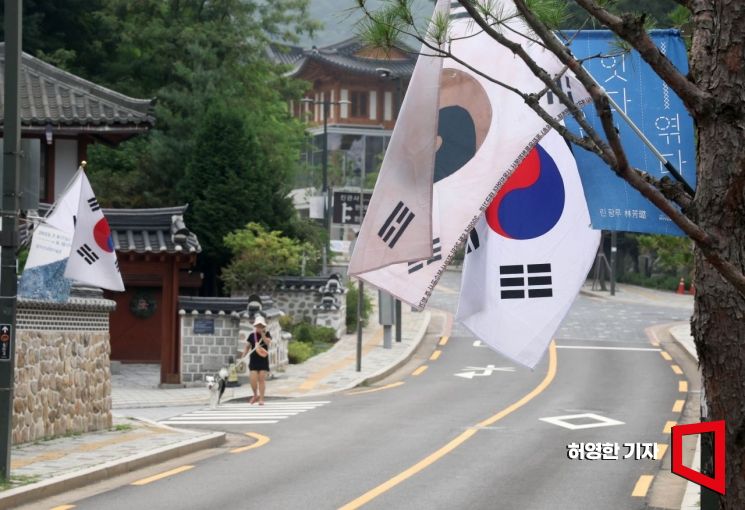 On August 15, 2023, in celebration of Liberation Day, Eunpyeong District in Seoul displayed the "Jingwansa Taegukgi," a Taegukgi flag discovered during the restoration of Jingwansa Temple in 2009 that was used in the independence movement, alongside regular Taegukgi flags on major roads in the district. Photo by Hyuh Younghan
First, on August 7, the professional baseball team LG Twins announced that they would invite Tanjiro and Nezuko, the main characters from the popular Japanese animation "Demon Slayer," to throw the ceremonial first pitch at their game against the Hanwha Eagles on August 9. This announcement drew heavy criticism. "Demon Slayer" is set during the Japanese imperial era, and there have been ongoing concerns that the design of the protagonist's earrings resembles the Rising Sun Flag, a symbol associated with Japanese imperialism.
News that these characters would throw the ceremonial first pitch sparked a wave of criticism on social media. One user commented, "I don't understand why the team would take such a risk for a 'Demon Slayer' anime that isn't even popular enough to significantly boost marketing." As criticism continued to mount, LG Twins ultimately canceled the event. However, some people expressed confusion over the controversy.
Many argued that canceling such an event, especially when it does not even fall on Liberation Day itself, is out of step with the times. This issue sparked divided opinions among online communities. One user said, "It's contradictory to ban these things only on the March 1st Movement and Liberation Day," while another countered, "If we don't acknowledge history even on those days, then when will we? A nation that forgets its history has no future."
Criticism Continues Over Holding Japanese Traditional Festival on Liberation Day
Additionally, Nijimori Studio, a Japanese-themed village in Dongducheon, Gyeonggi Province, became embroiled in controversy for hosting the Japanese traditional summer festival "Natsumatsuri" during the period including Liberation Day (July 26 to August 17). Professor Seo Kyung-duk of Sungshin Women's University criticized the event on his social media on July 31, stating, "Holding such an event on Liberation Day, which commemorates Korea's liberation from Japanese colonial rule and the restoration of sovereignty, goes against the national sentiment."
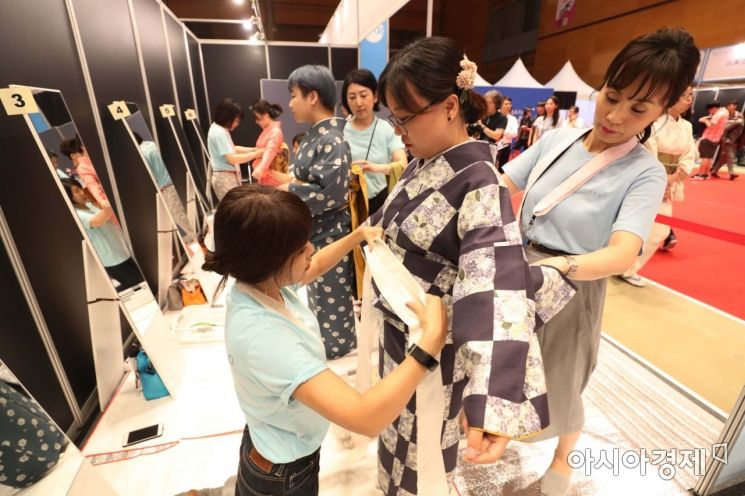 Citizens experiencing kimono at the Korea-Japan Festival held at COEX in Gangnam, Seoul. Photo by Asia Economy.
As the controversy grew, the organizers explained via their official social media, "As a cultural space that respects General Thomas An Jung-geun's 'Theory of Peace in East Asia,' we aim to create a platform for mutual understanding and cooperation," adding, "We will continue to promote messages of peace through cultural exchange." They also announced that on Liberation Day itself, they would hold events such as the "Declaration of Peace for Liberation Day," a fireworks display, and the launching of lanterns for peace.
Regarding these controversies, Na Haengju, a professor of Japanese Studies at Korea National Open University, said, "We must distinguish between historical criticism and cultural consumption," and pointed out, "The attitude of 'We were once colonized, so we should not consume Japanese culture' can be somewhat dangerous." However, he also noted, "While there is no need to automatically cancel Japanese-related events during the Liberation Day season, it is important to make decisions appropriate to the situation, as such events may provoke negative reactions among older generations who share historical experiences."
Yoon Injin, a professor of sociology at Korea University, stated, "Evaluations of Japanese cultural events coinciding with Liberation Day may vary depending on the nature and organizers of the event," adding, "If there is potential for misunderstanding, it is advisable to adjust the timing or location." However, he also emphasized, "It is not desirable to restrict all non-political fields such as culture and the arts in connection with Liberation Day," and added, "In the long run, it will be positive for the younger generation to broaden mutual understanding through cultural exchanges that are separated from politics."
© The Asia Business Daily(www.asiae.co.kr). All rights reserved.
![Clutching a Stolen Dior Bag, Saying "I Hate Being Poor but Real"... The Grotesque Con of a "Human Knockoff" [Slate]](https://cwcontent.asiae.co.kr/asiaresize/183/2026021902243444107_1771435474.jpg)
















