Operating Profit Turns Positive at 21.6 Billion Won
Sales Rise Across Discount Stores, Specialty Stores, and Traders
Price Competitiveness and Store Renewals Attract More Customers
Subsidiaries: Property and Food Units Boost Profitability
SSG.com, Gmarket Underperform... "Plans to Strengthen Competitiveness"
Emart has successfully returned to operating profit in the second quarter. This turnaround is attributed to cost reductions achieved through integrated purchasing and the resulting price competitiveness, which significantly boosted customer traffic.
According to the Financial Supervisory Service's electronic disclosure system on August 12, Emart's standalone total sales (transaction volume) for the second quarter of this year reached 4.2906 trillion won, with operating profit at 15.6 billion won. Compared to the same period last year, sales increased by 12%, and operating profit turned positive. The standalone basis reflects only the core businesses: Emart discount stores, Traders, Everyday, and specialty stores. Sales increased across all segments-Traders, discount stores, and specialty stores (such as No Brand and Electronic Market)-which drove the overall performance.
Warehouse Club Traders Sees Explosive Growth Amid High Inflation
Among these, the warehouse-style discount store Traders recorded an 8.1% year-on-year increase in total sales, marking a significant growth in revenue. Operating profit reached 30.9 billion won, up 8.6 billion won from 22.3 billion won in the same period last year. The surge in customer demand for warehouse discount stores is attributed to the increased burden of grocery shopping caused by high inflation. The number of customers grew by 3% in the first quarter and accelerated to 4% in the second quarter.
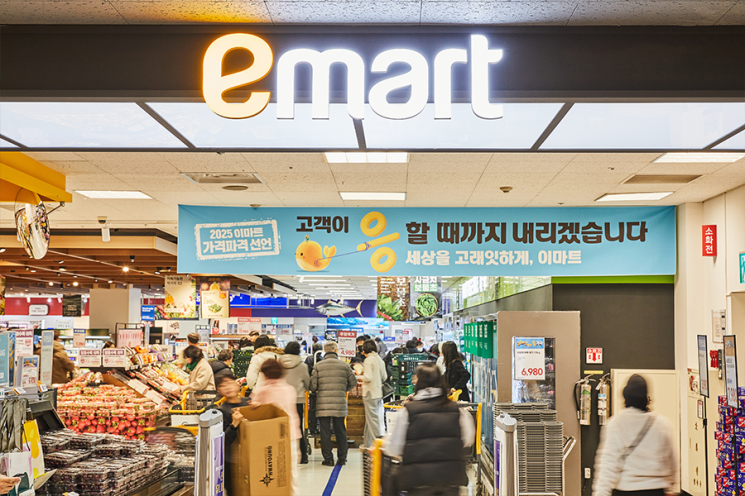
Emart's enhanced price competitiveness through integrated purchasing also contributed to its improved performance. The sales growth rate for discount stores was 0.5%, and the operating loss narrowed to 34 billion won, reducing the deficit by about 20 billion won compared to the second quarter of last year. This year, Emart has been running the large-scale discount event "Goraeit Festa," which has received strong customer response. The event offers popular items such as Korean beef, watermelon, and pork belly, as well as processed foods and daily necessities, at up to half price, attracting customers to stores. During the Goraeit Festa held in June as part of the first half's customer appreciation event, both sales and customer numbers increased by 33% and 18%, respectively, compared to the same period last year.
The effects of store renewals have also been reflected. By introducing relaxation spaces like Book Ground and Kids Ground, and combining these with popular tenant stores, the Starfield Market has established itself as a regional landmark that reflects customers' evolving lifestyles. The Starfield Market Jukjeon, the first location, saw its second-quarter sales and customer numbers jump by 104% and 82%, respectively, compared to the same period last year. The Starfield Market Kintex, which reopened as the second location on June 26, recorded a 29% increase in sales and a 67% increase in visitors in the month following its reopening, compared to the same period last year.
An Emart representative stated, "In the second half of the year, we plan to further strengthen our market dominance by expanding differentiated products through overwhelming price leadership and enhancing the renewal of new-format stores." The representative added, "In September, we will open a new Traders store and accelerate the discovery of ultra-low-priced products through strategic price investments."
Starfield Operating Profit Soars, but E-Commerce Slump Continues
Among Emart's subsidiaries, Shinsegae Property, Shinsegae Food, and Chosun Hotel & Resort posted strong results, while SSG.com and Gmarket continued to struggle. Shinsegae Property achieved 83.3 billion won in sales and 5.2 billion won in operating profit, driven by strong performance at key locations such as Starfield Goyang and Starfield COEX. Sales increased by 11% year-on-year, and operating profit surged by 642%.
During the same period, Shinsegae Food posted sales of 371.5 billion won and operating profit of 13.5 billion won. While sales declined by about 6%, operating profit rose by 40% year-on-year, thanks to improved cost ratios and reductions in selling and administrative expenses such as advertising costs.
However, e-commerce subsidiaries Gmarket (open market) and SSG.com recorded poor results. SSG.com's net sales fell by 11% year-on-year to 350.3 billion won. Operating profit was negative 31 billion won, with losses increasing by 14 billion won compared to the same period last year. Total transaction volume reached 1.5 trillion won, up 4% year-on-year, supported by expanded delivery coverage. Gmarket posted second-quarter sales of 181.2 billion won, a 28% year-on-year decline. Operating profit was negative 29.8 billion won, with losses widening from negative 7.6 billion won in the same period last year.
Emart plans to systematically pursue strategies to restore competitiveness in its online business in the second half of the year. An Emart representative stated, "SSG.com will strengthen grocery price competitiveness based on integrated purchasing and focus on developing unique, irreplaceable products." The representative continued, "Gmarket will enhance customer programs by expanding membership-exclusive events and strengthening partnerships, and will work to restore overall platform competitiveness by improving seller capabilities and search convenience."

© The Asia Business Daily(www.asiae.co.kr). All rights reserved.


















