Mandatory Renewable Energy Facilities for Large Buildings
Private Sector Now Required to Meet Energy Performance Standards Equivalent to ZEB Grade 5
Starting in December this year, when constructing large buildings with a total floor area of 1,000 square meters or more, it will become mandatory to install facilities that supply a portion of the building’s energy from renewable sources. Certain items that offer high energy-saving effects relative to their cost, such as windows and lighting, will also be required.
The Ministry of Land, Infrastructure and Transport announced that it will issue an administrative notice from August 13 to September 1 for the revised energy-saving design standards for buildings. These standards are mandatory requirements for permits and approvals, aiming to create a comfortable indoor environment and build low-energy buildings by applying high-efficiency equipment from the design stage. Multi-family housing complexes with 30 or more units, detached houses, and botanical or zoological gardens are excluded from these requirements.
According to the revision, the current specification-based scoring system (65 points for the private sector) will be maintained, but eight specific items will become mandatory for buildings with a total floor area of 1,000 square meters or more. These include solar heat gain through windows, living room lighting density, and high-efficiency heating and cooling systems. Facilities for producing renewable energy, such as solar power and geothermal systems, must also be installed, enabling buildings to generate some of their own energy. Most of the energy consumed in buildings is used for purposes such as heating, cooling, hot water, and lighting.
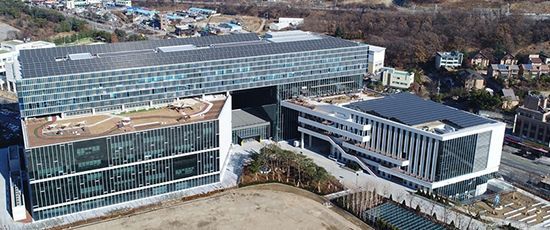 Pangyo 2nd Technovalley Corporate Support Hub. It received Zero Energy Building certification by applying high-insulation and high-air-tightness triple glazing, high-insulation exterior walls, high-efficiency PV and BIPV, and geothermal heat pumps. Korea Energy Agency Zero Energy Building website
The performance standard will be set at 150 kWh per square meter per year (annual primary energy consumption per unit area), which is less stringent than the level required for Grade 5 Zero Energy Building (ZEB) certification, which applies a threshold of less than 130 kWh per square meter per year. To encourage creative design in the private sector, buildings can receive permits and approvals as long as they meet the performance standard, even if they do not follow the specific itemized requirements.
Until now, the government has promoted carbon neutrality in the building sector mainly by making ZEB certification mandatory for public buildings. This revision is intended to ensure that private buildings also achieve energy performance equivalent to ZEB Grade 5. The new standards will take effect in December this year. For multi-family housing complexes with 30 or more units, strengthened design standards equivalent to ZEB Grade 5 have already been applied since the end of June.
Hong Sungjun, Director of the Green Architecture Division at the Ministry of Land, Infrastructure and Transport, stated, "Until now, the public sector has led the way in zero-energy buildings, but to achieve greenhouse gas reduction targets, it is essential to improve the energy performance of private buildings, which make up the majority of the building stock. We expect that active participation from the private sector will help reduce energy costs for the public and accelerate the transition to a carbon-neutral society."
© The Asia Business Daily(www.asiae.co.kr). All rights reserved.
![Clutching a Stolen Dior Bag, Saying "I Hate Being Poor but Real"... The Grotesque Con of a "Human Knockoff" [Slate]](https://cwcontent.asiae.co.kr/asiaresize/183/2026021902243444107_1771435474.jpg)















