Cube Satellite to Be Launched with Korea's First Crewed Spacecraft Next Year
K-RadCube to Join Artemis II Mission for Space Radiation Measurement
International Collaboration Expands Korea's Role in Space Exploration
The Space Aviation Agency announced on August 12 that the development of the K-RadCube Cube Satellite, which will be loaded onto Artemis II, has been completed and that it will be transported to the Kennedy Space Center of the National Aeronautics and Space Administration (NASA) in the United States.
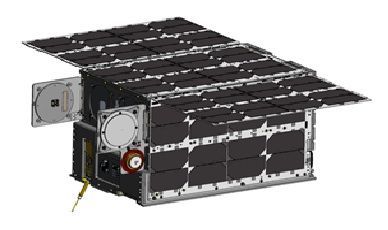
The Cube Satellite will be transported by air to the Kennedy Space Center, where it is scheduled to be installed on the Orion Stage Adapter (OSA) of the Space Launch System (SLS).
Artemis II is a mission in which four crew members will board the Orion spacecraft, orbit the Moon, and return to Earth. The Cube Satellite will be the first satellite from Korea to be launched together with a crewed spacecraft.
The Cube Satellite will operate in a highly elliptical Earth orbit, measuring space radiation in the Van Allen radiation belts. It is expected to collect basic data that will enable the analysis of the effects of radiation on astronauts.
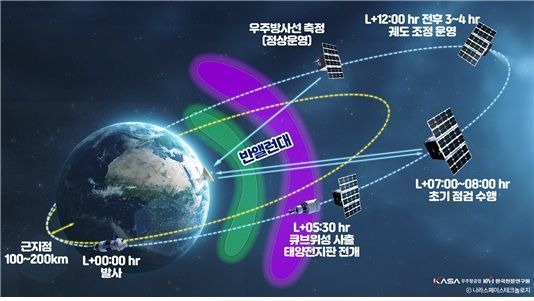
The Korea Astronomy and Space Science Institute oversaw the development of the Cube Satellite and developed its radiation measurement payload. Naraspace Technology was responsible for the satellite system, while KT SAT is in charge of ground station operations. In addition, semiconductor devices developed by Samsung Electronics and SK hynix will be loaded onto the satellite to verify the radiation resistance characteristics of semiconductor devices in the space environment.
Artemis II is scheduled to launch in April next year, and the observation data from the Cube Satellite will be made available to both domestic and international researchers.
Kang Kyungin, Director of the Space Science Exploration Division at the Space Aviation Agency, stated, "Through our ability to manufacture Cube Satellites that meet the payload requirements of Artemis II, a crewed space exploration mission, we have taken a step toward enhancing our international competitiveness," adding, "We will continue to expand Korea's opportunities to participate in space exploration through international cooperation with organizations such as NASA."
© The Asia Business Daily(www.asiae.co.kr). All rights reserved.


















