Gwangmyeong City in Gyeonggi Province has launched comprehensive policy support measures to revitalize local commercial districts and restore the livelihood economy.
On August 12, Gwangmyeong City held a policy briefing in the city hall’s main conference room and announced its “Livelihood Economy and Local Commercial District Revitalization Plan,” which centers on expanding livelihood stabilization subsidies and strengthening support projects for local commercial district growth.
Hong Myunghee, Director of the Economic and Cultural Bureau of Gwangmyeong City, stated, “We are expanding support to help small business owners, who are economically vulnerable, overcome difficulties amid the economic downturn and political instability, and to help them make a new leap forward.” He added, “We will do our utmost to ensure that small business owners can operate stably and that commercial districts can become vibrant and sustainable, making Gwangmyeong a city where people want to stay and the local economy thrives.”
Livelihood Stabilization Subsidies and Consumption Coupons... Major Catalysts for Local Economic Recovery
In January this year, Gwangmyeong City made a bold decision to revive the struggling livelihood economy. Regardless of age or income, every citizen received 100,000 won in “Gwangmyeong Sarang Local Currency.” Among the 31 cities and counties in Gyeonggi Province, only Gwangmyeong and Paju independently implemented such large-scale livelihood stabilization subsidies at the beginning of the year.
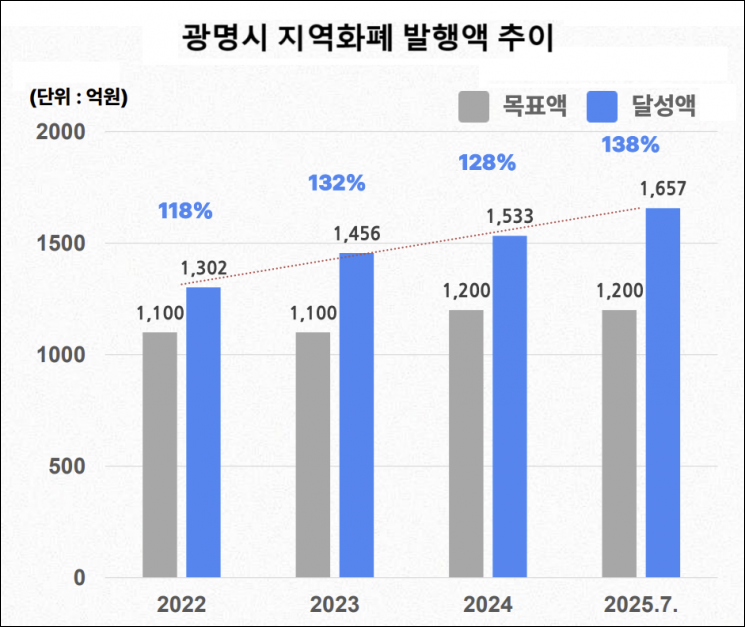
93.4% of the city’s total population applied for the livelihood stabilization subsidy, and 98.9% of the distributed funds were spent, providing much-needed relief to small business owners suffering from declining sales.
The city also responded quickly to the central government’s decision to distribute consumption coupons for livelihood recovery to all citizens. Based on its experience with the livelihood stabilization subsidy, the city formed a dedicated policy task force and operated a dedicated call center, establishing a rapid distribution system.
Thanks to this proactive approach, Gwangmyeong achieved a 96.4% distribution rate for the livelihood recovery consumption coupons (as of 6 p.m. on August 10), the highest among all cities and counties in the province.
The city’s own analysis attributes this high distribution rate to the experience gained from providing the livelihood stabilization subsidy earlier in the year. As citizens became accustomed to using local currency, confusion related to the distribution of the livelihood recovery consumption coupons was minimized. In fact, 53% of the distributed consumption coupons in Gwangmyeong were issued as local currency.
Gwangmyeong City also offers relatively high incentives to promote the use of local currency. Since 2020, the city has maintained a 10% discount rate on recharge incentives year-round. As a result, as of July, the number of local currency users in Gwangmyeong reached 273,515, accounting for 94.6% of the city’s total population of 289,030.
The city plans to further accelerate its local currency activation policy. To this end, it intends to increase this year’s issuance target from 120 billion won set at the beginning of the year to 500 billion won, more than quadrupling the original goal. In addition, since last month, the incentive purchase limit has been raised from 300,000 won to 700,000 won, and the city is considering further increases in October.
Reviving the Economic Lifelines... Expanding Comprehensive Support in Systems, Finance, and Institutions
The city is also expanding a variety of policy supports to help local commercial districts recover.
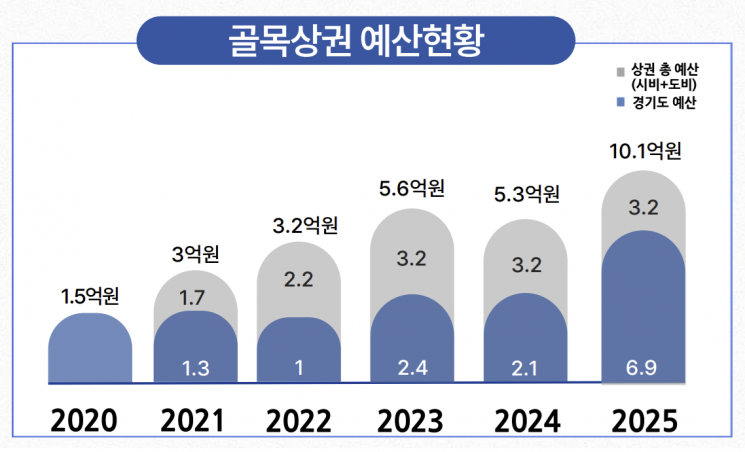
In 2019, the city established an institutional foundation to protect and foster local commercial districts by enacting the “Ordinance on Supporting Small Business Owners.” The following year, Gwangmyeong became the first local government in the province to establish the “Gwangmyeong Self-Employed Support Center,” creating a systematic support structure for small business owners. The center actively supports the formation of alleyway merchant associations, and currently 20 such associations are active.
Since 2021, the city has independently promoted a community support project for alleyway commercial districts. To support this, the related budget, which was only 150 million won in 2020, has been increased to 1.01 billion won this year.
The city is also increasing various forms of support to help small business owners improve management efficiency. For example, it partially subsidizes self-payment for the “Smart Store Technology Distribution Project,” which supports the installation of kiosks and serving robots to enhance digital competitiveness. The city also continues to provide “Special Guarantee for Small Business Owners” to those lacking collateral, as well as subsidies for loan interest differentials.
Starting next year, the city plans to launch and operate the “Gwangmyeong Win-Win Platform,” an integrated online platform for small business owners. This platform will provide comprehensive support-including customized online marketing, content production, and distribution channel connections-enabling small business owners to remain competitive in the evolving digital and distribution environment.
The city will select 73 businesses and provide each with content production support worth 2.5 million won, as well as offer tailored online promotional marketing strategy training by sector.
Recently, following its selection for the “Commercial District-Friendly City Development Project” organized by the Gyeonggi-do Market Commercial District Promotion Agency, the city is further strengthening its small business support infrastructure. It will establish and operate on-site, one-stop support centers, and run a “Master Craftsman University” to foster professional talent. The city also plans to conduct advanced commercial district policy training to enhance the management capabilities of small business owners.
Infrastructure to revitalize commercial districts will also be expanded. The city will install flexible parking lots tailored to each commercial district, create a “Retro Street” to add unique character, hold local signature festivals suited to commercial district specialization, and operate win-win flea markets and harmony events where citizens and small business owners participate together.
© The Asia Business Daily(www.asiae.co.kr). All rights reserved.


















