Service sector has youngest average CEO age at 54.8
Women CEOs remain at 12 for three consecutive years, just over 2% of total

Amid an economic downturn and rapidly changing market conditions, domestic companies appear to be strengthening internal promotions to ensure organizational stability, while also driving generational change.
On August 12, Leaders Index, a corporate analysis research institute, analyzed the CEOs of 369 companies that submitted business reports out of the top 500 companies by sales that filed business reports. The average age of these companies' CEOs showed a downward trend, falling from 61.1 years in 2023, to 60.3 years in 2024, and to 59.8 years this year. The youngest average CEO age was found in the service sector at 54.8 years, while public enterprises had the highest average at 65.4 years. Companies where the average age dropped significantly over the past two years include Hansol Paper, GS Retail, and Meritz Fire & Marine Insurance.
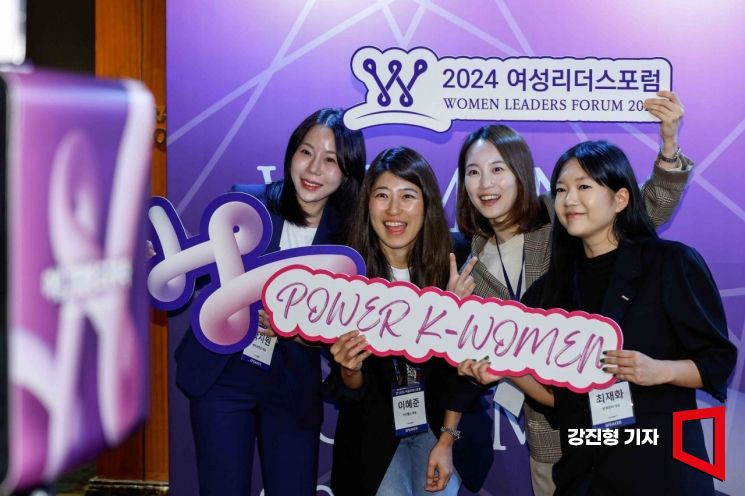 On October 30 last year, session discussants who attended the '2024 Women Leaders Forum' hosted by Asia Economy at Lotte Hotel in Jung-gu, Seoul, are taking photos after finishing their discussion. From the left, Jiwon Park, CEO of Save&Co; Hyejun Lee, CEO of KaiHealth; Hyemin Lee, CEO of Finda; Jaehwa Choi, CEO of Bungaejangter.
Hansol Paper saw a leadership transition from former CEO Han Cheolgyu (63) to Han Kyungrok (46). GS Retail, after three years under former CEOs Heo Yeonsu and Kim Hosung (average age 64.7), and then Heo Yeonsu (65.0), appointed Heo Seohong (48) as CEO this year, resulting in a lower average CEO age. At Meritz Fire & Marine Insurance, following former CEO Kim Yongbeom (62), Kim Junghyun (48), who is in his 40s, has led the company since 2024.
The youngest professional CEO is Lee Jaesang (43) of HYBE. Among owner-operators including founders, only two are in their 30s: Koo Woongmo (36), CEO of LT, and Kwon Hyukmin (39), CEO of Deutsche Motors. Park Juhwan (42), CEO of TKG Taekwang, and Kim Sula (42), CEO of Kurly, are in their early 40s. The oldest professional CEO is Lee Sugwang (81), Chairman of DB Group. Other CEOs in their 70s include Lee Jaekyu (79), Vice Chairman of Taeyoung Construction; Hong Saseung (77), Chairman of Ssangyong C&E; Kwon Ohgap (74), Chairman of HD Hyundai; Park Udong (74), Vice Chairman of Poongsan; Kim Wongap (73), Vice Chairman of Hyundai Corporation; and Park Junyoung (73), Vice Chairman of SGC Energy. Among owner-operators, Sohn Kyungshik, Chairman of CJ, and Kang Byungjung, Chairman of Nexen, are the oldest at 86. Lee Myungkeun (81), Chairman of Sungwoo Hitech, and Kim Dongnyeong (80), Chairman of Hansae Yes24 Holdings, are also in their 80s.
This year, 81.8% of CEOs were promoted internally... Only 2% are women
This year, 423 CEOs (81.8%) were promoted from within their own companies, the highest proportion in the past three years. In 2023, the figure was 80.0% (436 out of 545), and last year it was 80.3% (429 out of 534). By industry, all bank (13) and trading company (8) CEOs were internally promoted. This was followed by consumer goods at 99.5% (21 out of 22), holding companies at 88.6% (78 out of 88), and insurance at 88.0% (22 out of 25).
 Among domestic CEOs, the number of women remained at 12 for three consecutive years, accounting for just over 2% of the total. There were no new female appointments in 2025. Asia Economy
In particular, banks stood out for appointing CEOs with financial expertise, a characteristic of the sector. Newly appointed this year were Jeong Jinwan, CEO of Woori Bank; Lee Hosung, CEO of Hana Bank; Lee Hwanju, CEO of KB Kookmin Bank; and Lee Gwanghee, CEO of Standard Chartered Bank Korea. In the insurance sector, the proportion of internally promoted CEOs increased the most compared to two years ago, rising from 66.7% (20 out of 30) in 2023 to 88.0% (22 out of 25) this year. Newly appointed insurance CEOs this year include Song Chunsu of NH Nonghyup Property & Casualty Insurance, Jeong Mooncheol of KB Life Insurance, and Lee Seokhyun of Hyundai Marine & Fire Insurance.
In contrast, only 22.2% (2 out of 9) of public enterprise CEOs were promoted internally. In the service sector, the figure was just 56.5% (13 out of 23), with the remainder being outside professional managers. However, among CEOs, the number of women remained at 12 for three consecutive years, accounting for just over 2% of the total. There were no new female appointments in 2025.
© The Asia Business Daily(www.asiae.co.kr). All rights reserved.



















