Public-Private Task Force Launched to Prevent the Outflow of Science and Technology Talent
Former Samsung Executive Leads National Effort to Retain and Attract STEM Professionals
In the era of artificial intelligence (AI), the public and private sectors have joined forces to find ways to prevent the outflow of science and engineering talent to Silicon Valley in the United States, where starting salaries can reach $400,000. Kyung Kyehyun, former head of semiconductors at Samsung Electronics and now an advisor, is taking a leading role in this effort. The talent policy initiative led by Advisor Kyung is scheduled to be announced in September.
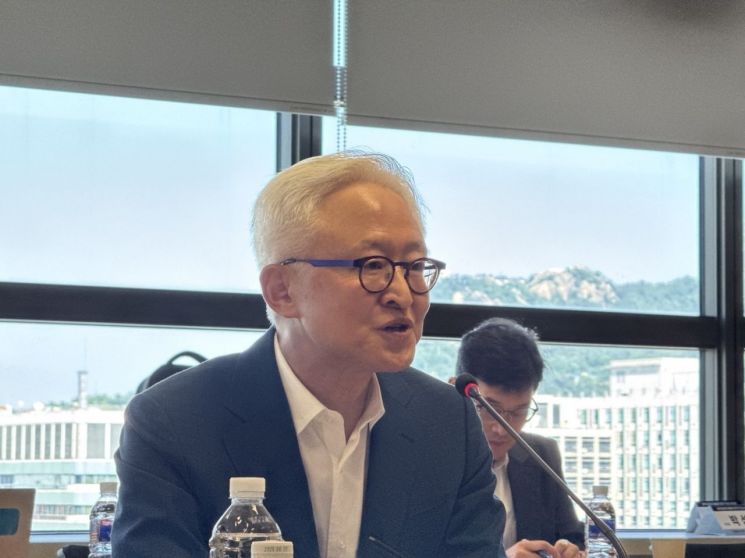 Samsung Electronics Advisor Kyung Kyehyun is giving opening remarks at the meeting held on the 12th. Photo by Baek Jongmin Tech Specialist
On the 12th, the Ministry of Science and ICT held the first meeting of a public-private joint task force (TF) at the Gwanghwamun Science and Technology Advisory Committee, aiming to develop measures to prevent the outflow of science and technology talent and attract top talent. The TF is co-chaired by Koo Hyukchae, First Vice Minister of Science and ICT, and Advisor Kyung. It is reported that Advisor Kyung readily accepted the ministry's request to serve as co-chair.
This TF is a cross-ministerial public-private partnership established to help young science and technology talent build careers in Korea amid intensifying global competition for talent, and to attract outstanding overseas talent needed for national strategies.
In his opening remarks, Chair Kyung cited projections that Korea’s potential growth rate could fall to 0% by 2040. He emphasized that, among the key drivers of economic growth?labor, capital, and productivity?both labor and capital investment are slowing, making innovation-driven productivity improvement the only viable solution. He stressed that “people are ultimately at the heart of innovation,” highlighting the seriousness of the outflow of young science and technology talent.
He pointed out that young people in Korea tend to flock to certain professions, such as medicine, or that science and technology talent nurtured in Korea often leave for overseas and do not return. He attributed this to the perception that “Korea is not attractive for scientists and engineers.” While doctors are guaranteed legal status, social respect, and stable income, scientists and engineers lack these advantages in Korea. In contrast, overseas environments offer appealing factors such as freedom, diversity, and ease of job mobility. Chair Kyung stated, “While companies can develop various approaches, ultimately, the government and private sector must work together to create actionable strategies.”
Koo, the government co-chair, also noted, “Even at this very moment, there are talented individuals considering offers from overseas universities, companies, and research institutes,” adding, “Today’s meeting must mark the starting point that gives both domestic and international science and engineering talent confidence that there is a future in Korea.” He continued, “All ministries must unite as one team and mobilize every available resource,” and pledged, “The Ministry of Science and ICT will work closely with private sector members to develop highly effective measures.”
The TF includes director-level officials from nine ministries?Ministry of Science and ICT, Ministry of Economy and Finance, Ministry of Education, Ministry of Justice, Ministry of National Defense, Ministry of Trade, Industry and Energy, Ministry of Health and Welfare, Ministry of SMEs and Startups, and the Korean Intellectual Property Office?as well as 23 experts from organizations such as the Science and Technology Advisory Council, the Special Committee on Future Talent, and the Korea Research Institute of Chemical Technology.
The Ministry of Science and ICT plans to use the TF to develop concrete action plans by September and implement them as the new administration's “No. 1 Talent Policy.”
© The Asia Business Daily(www.asiae.co.kr). All rights reserved.

















