Contaminants Removed with Blasting and Laser Cleaning
Gyeongbokgung Faced Graffiti Ordeal Just Over Two Years Ago
National Heritage Administration Chief: "We Will Never Tolerate Acts of Vandalism"
Gyeongbokgung Palace, once again marred by graffiti, was restored to its original state in just nine hours.
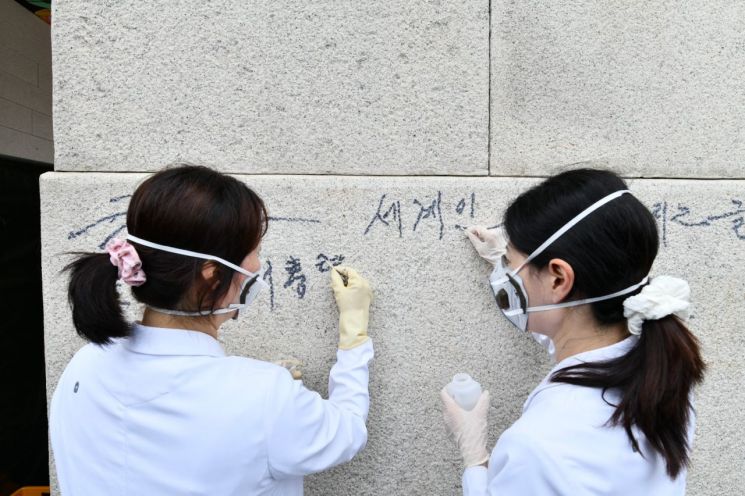 Conservation specialists removing graffiti from the stone wall of Gwanghwamun at Gyeongbokgung Palace
Photo by National Heritage Administration
The National Heritage Administration announced that as of 5:00 p.m. on August 11, the removal of graffiti from the stone wall of Gwanghwamun Gate at Gyeongbokgung Palace had been completed. Jeong Soyoung, head of the Artifact Science Division, explained, "We removed contaminants using blasting and laser cleaning, and corrected the color with acrylic paint." Blasting is a technique that sprays fine particles with compressed air to remove only the contaminants, while laser cleaning is a method that removes pigments, similar to erasing moles from the skin.
According to the National Heritage Administration, a man identified as Kim (age 79) was caught around 8:10 a.m. that day while writing graffiti on the stone wall of Gwanghwamun. He was discovered by an employee of the Gyeongbokgung Palace Management Office of the Royal Palaces and Tombs Center, who was patrolling the area, and was handed over to the police. The police arrested Kim at the scene and are currently investigating the case.
Kim used a black marker to write between the left and center Hongyemun arches at Gwanghwamun, specifically on the Musaseok?a neatly stacked rectangular stone next to the Hongyeseok. He began by writing "A message to the people and the world," and was in the process of writing "President Trump" underneath when he was caught by a staff member of the Gyeongbokgung Palace Management Office. The graffiti covered an area approximately 1.7 meters wide and 0.3 meters high.
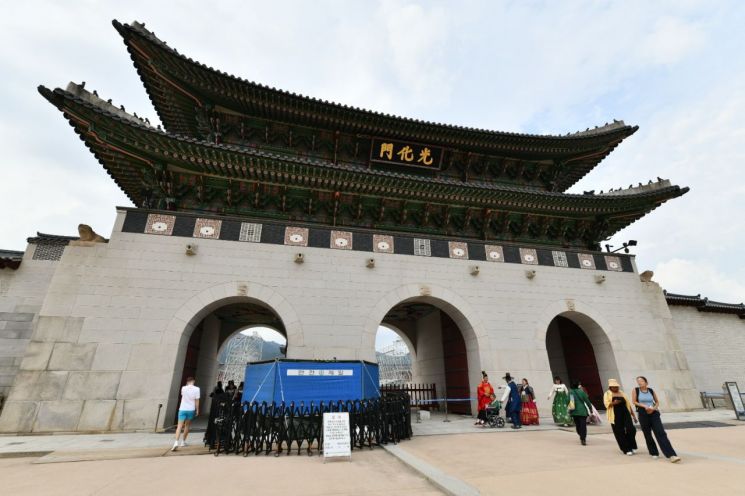 Graffiti site on the stone wall of Gwanghwamun at Gyeongbokgung Palace with installed partitions
 [Photo by National Heritage Administration]
The National Heritage Administration immediately installed partitions and mobilized conservation specialists from the Artifact Science Division of the National Palace Museum to remove the graffiti. Because chemicals alone could not erase it, they also brought in a laser device, which incurs a significant daily rental cost. Jeong Soyoung noted, "Thanks to our painful experience in the past, we were able to quickly decide on the removal method and shorten the work time."
Gyeongbokgung Palace faced a similar ordeal with graffiti just over two years ago. At the end of 2023, a teenager, after hearing that "300,000 won would be paid for graffiti," spray-painted graffiti on Yeongchumun Gate at Gyeongbokgung and on a side gate near the National Palace Museum. The National Heritage Administration spent about 131 million won to erase these traces.
The man in his 30s who instigated the minor to commit the graffiti was sentenced to a heavy prison term, while the teenage perpetrator also received a prison sentence of two years (maximum) and one year and six months (minimum). Not long after the incident, a man in his 20s who committed a copycat crime was given a suspended prison sentence.
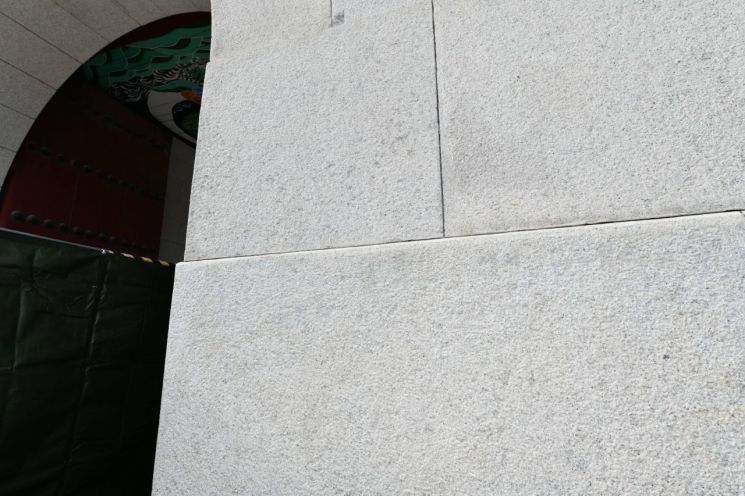 Stone wall of Gwanghwamun at Gyeongbokgung Palace after graffiti removal work completed
[Photo by National Heritage Administration]
Although the graffiti has been removed, the management of national heritage sites is now under a red alert. After the previous graffiti incident at Gyeongbokgung, nighttime patrols were increased and more closed-circuit (CC)TV cameras were installed to monitor the outer walls, but these measures failed to prevent another act of vandalism.
The National Heritage Administration has stated that it will respond strictly. Huh Min, head of the National Heritage Administration, said, "Our staff are constantly checking and monitoring to prevent a recurrence of graffiti," and emphasized, "We will never tolerate any acts that damage our cultural heritage."
According to the current "Act on the Preservation and Utilization of Cultural Heritage," anyone who writes graffiti on cultural heritage sites can be ordered to restore the site to its original condition, and may also be charged for the cost of restoration.
© The Asia Business Daily(www.asiae.co.kr). All rights reserved.



















