"Breaking Preconceptions About Korean Dubbing,
Hoping for Global Opportunities for K-Content"
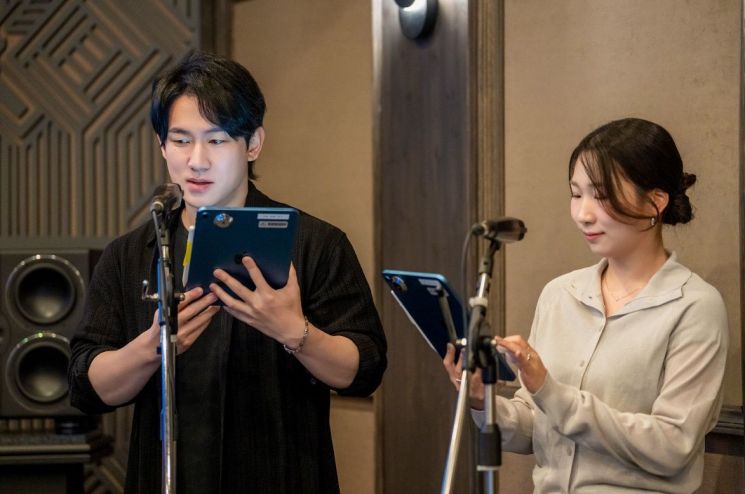
"The Korean-dubbed version of 'K-Pop Demon Hunters' carries a special significance, as it allows viewers to see characters speaking Korean within a story set in Korea."
At the "Netflix Foreign Content Korean Dubbing Story" press conference hosted by Netflix on August 11, voice actor Nari Shin, who participated in the Korean dubbing of "K-Pop Demon Hunters," shared her thoughts: "Even viewers who usually prefer the original language might be interested in the Korean-dubbed version of this work, and that gave me a sense of duty while working on it."
Shin, who voiced the main character LUMI, said, "Since the title is about K-pop and the story is set in Korea, I thought it would feel more natural for the characters to speak Korean," adding, "I tried to infuse the unique nuances and flavor of the Korean language into my performance."
According to Netflix, as the popularity of "K-Pop Demon Hunters" continues, the number of users watching the series through the Korean-dubbed version is steadily increasing. In the past, Korean dubbing was mainly preferred by children or older viewers, but as seen in the case of "K-Pop Demon Hunters," the audience that enjoys dubbed content is becoming much more diverse. While preserving the original meaning, the dubbing team has also used richer Korean expressions, expanding the demand for Korean-dubbed content. This is also why the directors, producers, and voice actors involved in the Korean dubbing are considered the hidden contributors to the show's success.
A Netflix representative emphasized, "Netflix's subtitles and dubbing teams support more than 30 languages," and added, "Dubbing is not simply a translation task; it is a crucial global operation that has a significant impact on the entire content industry." Depending on the title, Netflix supports dubbing in an average of 10 languages and also provides audio descriptions for Korean original content. Considering that, on average, 50 to 60 production staff are involved per language in the dubbing industry, dubbing for 10 languages is a project that requires a large workforce.
"Breaking Stereotypes About Korean Dubbing and Creating Global Opportunities"
Seungwoo Min, who voiced the character Jinwoo from Saja Boys, said, "When a work like 'K-Pop Demon Hunters' naturally incorporates Korean culture and elements throughout, as a voice actor, I try to express those details with greater delicacy," and added, "As a fan of K-pop myself, I put even more affection into my performance for this project." He emphasized the appeal of Korean dubbing, saying, "The very fact that we can enjoy our beautiful language in Korean is itself a charm."
He continued, "I tried to ensure that my voice acting was not exaggerated or distracting, and I think this project was an opportunity to show such efforts through K-content," adding, "I tried to serve it up deliciously, and I think we ended up with a perfect Korean full-course meal." Min also said, "I usually enjoy short-form content, and since 'K-Pop Demon Hunters' became so popular, the Korean-dubbed version with my voice has often become a meme," and added, "I believe we've come this far thanks to K-culture. I hope we can set many precedents in the future, diversify viewers' choices, and see more cases of people listening to Korean content globally."
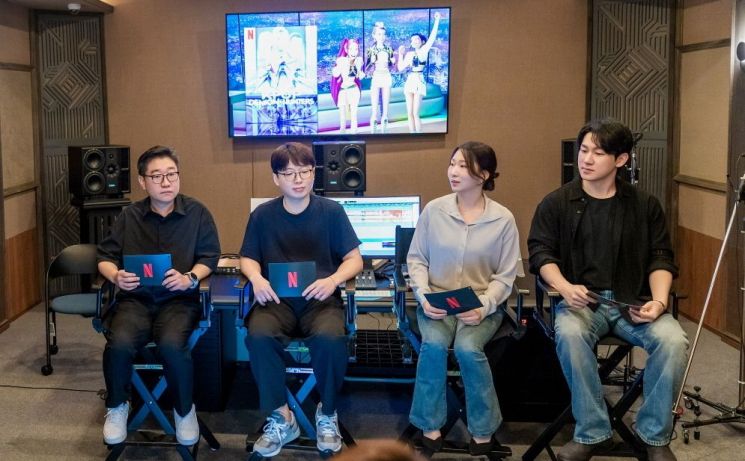 From the left in the photo: Minsu Kim, Director of Pixel Logic Korea; Hyungseok Kim, PD of Pixel Logic Korea; Nari Shin, voice actor; Seungwoo Min, voice actor.
However, in "K-Pop Demon Hunters," the Korean songs were not dubbed. There were internal discussions about whether to dub the Korean songs, but since the original artists are Korean and the songs themselves are in the K-pop genre, it was decided to use the original tracks as they are. Minsu Kim, Director of Pixel Logic Korea, explained, "All the speakers are Korean and it's K-pop, so it would be strange to re-sing K-pop songs in Korean, which is why we used the original audio."
Hyungseok Kim, PD of Pixel Logic Korea, said, "While many people love Korean dubbing, it's a pity that the overall volume is still small," and added, "Some viewers who dislike dubbing have closed minds and prejudices, so they don't even try dubbed content, but since you can experience greater enjoyment and elements that fit Korean sensibilities, I hope people will listen with an open mind and without prejudice."
Regarding concerns about the voice acting profession in the age of artificial intelligence (AI), Min said, "At first, I was scared by the development of AI and worried that everyone who works with their voice would lose their jobs, but when the camera was invented, painters didn't starve to death (laughs)," and added, "Just as photography and painting have developed together and influenced each other positively, although there will be growing pains during this transition, I believe our (voice acting) industry will find a way forward."
© The Asia Business Daily(www.asiae.co.kr). All rights reserved.


















